

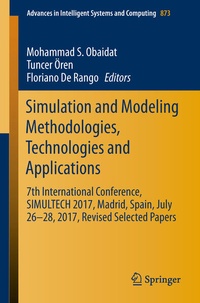
Simulation and Modeling Methodologies, Technologies and Applications
7th International Conference, SIMULTECH 2017 Madrid, Spain, July 26-28, 2017 Revised Selected Papers
1st Edition
Published on 20. November 2018
XIV, 368 pages
978-3-030-01470-4 (ISBN)
Description

This book highlights a set of selected, revised and extended papers from the 7th International Conference on Simulation and Modeling Methodologies, Technologies and Applications (SIMULTECH 2017), held in Madrid, Spain, on July 26 to 28, 2017. The conference brought together researchers, engineers and practitioners whose work involves methodologies in and applications of modeling and simulation. The papers showcased here represent the very best papers from the Conference, and report on a broad range of new and innovative solutions.
More details
Series
Language
English
Place of publication
Cham
Switzerland
Publishing group
Springer International Publishing
Target group
Professional and scholarly
Product notice
Reflowable
Illustrations
XIV, 368 p. 202 illus.
File size
56,72 MB
ISBN-13
978-3-030-01470-4 (9783030014704)
DOI
10.1007/978-3-030-01470-4
Schweitzer Classification
Other editions
Additional editions
Mohammad S. Obaidat | Tuncer Ören | Floriano De Rango
Simulation and Modeling Methodologies, Technologies and Applications
7th International Conference, SIMULTECH 2017 Madrid, Spain, July 26-28, 2017 Revised Selected Papers
Book
11/2018
Springer
€160.49
Shipment within 7-9 days
Persons
Content
- Intro
- Preface
- Organization
- Conference Chair
- Program Chairs
- Program Committee
- Invited Speakers
- Contents
- Simulation Tools and Platforms
- Simulation of Surface Plasmon Waves Based on Kretschmann Configuration Using the Finite Element Method
- Abstract
- 1 Introduction
- 2 Theory and Principles
- 2.1 Surface Plasmon Resonance (SPR) Phenomenon
- 3 The Simulated Experiments
- 4 Simulation Results
- 5 Conclusion
- References
- An Object Oriented Approach Towards Simulating Physical Systems with Fluids and Rigid Bodies Based o ...
- Abstract
- 1 Introduction
- 2 Particle Based Fluid Simulations and Rigid Body Physics
- 3 The Physolator Simulation Framework
- 4 Particle Modelling
- 5 Physical Systems with Fluids and Rigid Bodies
- 6 Using the FRB Library to Implement Physical Systems
- 7 Conclusion and Future Work
- References
- Distributed Co-simulation of Embedded Control Software Using INTO-CPS
- 1 Introduction
- 2 Exhaust Gas Water Handling System
- 3 WHS Simulation
- 3.1 The MAN Software Application Framework
- 3.2 The WHS Model
- 3.3 Simulation and Verification Process
- 3.4 Simulation Evaluation
- 4 Targeting Co-simulation
- 4.1 Functional Mock-up Interface
- 4.2 The INTO-CPS Tool Chain
- 5 WHS Co-simulation
- 5.1 Distributed COE Extension
- 5.2 Co-simulation Setup
- 5.3 Co-simulation Evaluation
- 6 Concluding Remarks
- References
- Model Oriented System Design Applied to Commercial Aircraft Secondary Flight Control Systems
- Abstract
- 1 Introduction
- 2 High Lift Systems
- 3 The Aircraft Design Process and System Engineering Approach
- 4 High Lift Functional Architecture
- 5 Mathematical Model
- 5.1 Model Architecture
- 5.2 High Lift Transmission
- 5.3 Power Drive Unit
- 5.4 Secondary Flight System Controller
- 5.5 Model Parameters
- 5.6 Model Verification
- 6 Results
- 6.1 Time Histories
- 6.2 Sensitivity Study
- 6.3 Performance Envelope
- 7 Conclusions
- References
- Simulation, Modeling and Technologies for Drones Coordination Techniques in Precision Agriculture
- 1 Drones Overview
- 2 Precision Agriculture
- 2.1 Video Analysis Systems for Supporting Precision Farming Activities
- 2.2 Use of UAV in Precision Agriculture
- 3 Coordination Techniques Based on Routing
- 3.1 Routing Protocols
- 3.2 Routing Type
- 3.3 Problem Statement for UAVs Coordination
- 3.4 Drones
- 4 UAVs Simulator to Coordinate Drones in Precision Agriculture
- 4.1 UAVS Simulator
- 4.2 Simulator Indicators in the GUI
- 4.3 Simulator Front-End
- 4.4 Proposed Recruitment Protocols
- 4.5 Performance Evaluation Through Simulator
- 5 Conclusions
- References
- Particle Based Blood Pressure Simulation in the Aorta with the Model Generated from CT Images
- 1 Introduction
- 2 Simulation Model
- 3 Simulation Method
- 4 Heart Pulsation
- 5 Simulation Results
- 6 Conclusions
- References
- Formal Methods
- Stochastic Simulation of Meteorological Non-Gaussian Joint Time-Series
- 1 Introduction
- 2 Real Data Analysis
- 3 Model Description
- 4 Extended Model
- 5 Numerical Experiments
- 6 Conclusions
- References
- Approaches to Fault Detection for Heating Systems Using CP Tensor Decompositions
- 1 Introduction
- 2 Preliminaries on Tensors
- 3 Signal-Based Fault Detection for Heating Systems
- 3.1 Fault Detection Based on Factor Matrices
- 3.2 Application Examples
- 4 Model-Based Fault Detection for Heating Systems
- 4.1 System Definition
- 4.2 Identify Parameter Tensor Slices
- 4.3 Construct Full Parameter Tensor
- 4.4 Fault Detection with Parity Equations
- 4.5 Application to Heating System Fault Detection
- 5 Conclusions
- References
- Describing Resource Allocation to Dynamically Formed Groups with Grammars
- 1 Introduction
- 2 Background
- 3 Resource Allocation and Dynamic Group Formation
- 3.1 Resource Supply
- 3.2 Candidate Group Formation
- 3.3 Final Group Formation
- 3.4 Resource Distribution
- 4 Definitions and Preliminaries
- 5 Modelling Resource Allocation to Dynamically Formed Groups
- 5.1 Modelling Resource Supply
- 5.2 Modelling Candidate Group Formation
- 5.3 Modelling Final Group Formation
- 5.4 Modelling Resource Distribution
- 6 Modelling Resource Allocation with only rPcg
- 7 Conclusions and Future Work
- References
- Parallel Simulation of Virtual Testbed Applications
- 1 Introduction
- 2 Related Work
- 2.1 Multi-threading in Modern 3D Simulators
- 3 Active Real-Time Simulation Database
- 3.1 Meta Information
- 3.2 Instances and Properties
- 3.3 Active Database
- 4 Scheduling
- 4.1 Task Scheduler and Event Queue
- 4.2 Time Controller
- 5 Modular Parallel Simulation of Virtual Testbeds
- 5.1 Simulation Thread
- 5.2 Simulation Architecture
- 5.3 Simulation Database Copies
- 5.4 Configuration of Simulation Threads
- 6 Synchronization
- 6.1 Synchronization Architecture
- 6.2 Synchronization Algorithm
- 7 Results/Validation
- 8 Conclusion/Future Work
- References
- Complete Lyapunov Functions: Computation and Applications
- 1 Introduction
- 2 Preliminaries
- 2.1 Complete Lyapunov Functions
- 2.2 Mesh-Free Collocation
- 3 Algorithm
- 4 Examples
- 4.1 Two Circular Periodic Orbits
- 4.2 Van-der-Pol Oscillator System
- 4.3 Homoclinic Orbit
- 4.4 Application to Biology
- 5 Conclusions and Outlook
- References
- Path Bundling in Modular Bipartite Networks
- 1 Introduction
- 1.1 Related Works
- 1.2 Contributions
- 2 Computing Modular Path Bundles
- 2.1 Basic Idea
- 2.2 Bundle Representation
- 2.3 Optimization Problem
- 3 Computational Experiments
- 3.1 Experimental Settings
- 3.2 Results and Discussion
- 4 Conclusion
- References
- Complex Systems Modeling and Simulation
- Using Gazebo to Generate Use Case Based Stimuli for SystemC
- 1 Introduction
- 2 Related Work
- 3 Design and Implementation
- 4 Evaluation
- 5 Future Work
- 6 Conclusions
- References
- Modeling Performance and Energy Efficiency of Virtualized Flexible Networks
- Abstract
- 1 Introduction
- 2 Energy-Efficiency Modelling and Control Aspects
- 3 Managing the QoS-Energy Trade-off in Virtualised Networks
- 4 The Experience of Two H2020 European Projects
- 4.1 INPUT - In-Network Programmability for Next-Generation Personal Cloud Service Support
- 4.2 MATILDA - A Holistic, Innovative Framework for Design, Development and Orchestration of 5G-Ready Applications and Network Services Over Sliced Programmable Infrastructure
- 5 Conclusions
- References
- Fast Algorithms for Computing Continuous Piecewise Affine Lyapunov Functions
- 1 Introduction
- 1.1 Notation
- 2 The Simplicial Complex TstdN,K
- 2.1 Added Functionality in [basicstyle=]| T_std_NK|
- 3 The Simplicial Complex TF
- 3.1 Implementation of [basicstyle=]| class FT|
- 3.2 Fast Search for SF Such that xSF
- 4 Computing Values of V() for VTF Directly
- 5 Summary
- References
- A Resource Flow Based Multistage Dynamic Scheduling Method for the State-Dependent Work
- Abstract
- 1 Introduction
- 2 Related Work
- 3 A Multistage Model for the State-Dependent Work
- 4 Resource Flow Based Dynamic Scheduling
- 4.1 Resource Flow Based Order Selection Method
- 4.2 Man-Hour Allocation Method
- 5 Multistage Model of Project Cost Estimation Process
- 6 Numerical Examples in Project Cost Estimation Process
- 6.1 Design of Simulation Experiments
- 6.2 Results of Simulation Experiments
- 7 Conclusion
- Acknowledgements
- References
- Application Domains
- Simulation Based Behavior for a Welfare Robot
- 1 Introduction
- 2 Related Work
- 3 Experimental Setup and Methodology
- 3.1 Tracking and Visual Servoing
- 3.2 Action Parametrization
- 3.3 Action Simulation
- 3.4 Action Learning
- 4 Results
- 4.1 Optimal Action for Pick-Up
- 4.2 Pick-Up Action Verification on the Real System
- 4.3 Optimal Action for Peg-in-Hole
- 4.4 PiH Action Verification on the Real System
- 5 Conclusions
- References
- Applying Deep Learning for Surrogate Construction of Simulation Systems
- 1 Introduction
- 2 Material and Method
- 3 Results
- 4 Conclusion and Discussion
- References
- A General Method to Compare Different Co-simulation Interfaces: Demonstration on a Case Study
- 1 Introduction
- 1.1 Motivation and Background
- 1.2 Tools and Interfaces
- 2 Method
- 2.1 Comparison with a Reference Simulation
- 2.2 Case Study
- 3 Model
- 3.1 Heat Storage Modelled in Trnsys
- 3.2 Heat Sink Modelled in Simulink
- 3.3 Co-simulation
- 4 Settings
- 4.1 Type155
- 4.2 BCVTB and FMI
- 5 Results
- 5.1 System Behaviour
- 5.2 Monolithic Simulation
- 5.3 Strong Coupling
- 5.4 Loose Coupling: Sequential
- 5.5 Loose Coupling: Parallel
- 6 General Method for Accuracy Estimation
- 7 Discussion
- 8 Conclusions
- References
- Author Index
