

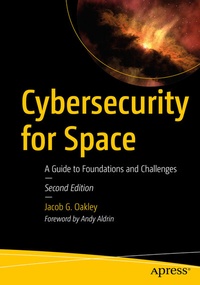
Cybersecurity for Space
Description

Space is one of the fastest growing military, government and industry sectors. Because everything in today's world exists within or connected to cyberspace, there is a dire need to ensure cybersecurity is addressed in the burgeoning field of space operations.
This revised and expanded edition will prime the reader with the knowledge needed to understand the unique challenges to space operations which affect the implementation of cybersecurity. Further, the reader will have foundational knowledge on what impacts cyber threats can have on space systems and how cybersecurity must rise to meet them.
The author, who spent years in the United States Marine Corps, originally involved in satellite communications is now a seasoned cyber security practitioner who has provided cyber security vision and strategy to a large portfolio of systems and programs, many focused specifically in space. A published academic and experienced professional, he brings a practical, real-world and tempered approach to securing the final frontier.
What You Will Learn
- Basic concepts of how different space vehicles operate in general.
- How such systems and their components integrate into cyberspace.
- A clear picture of the potential damage available via cyber-attacks to such systems.
- Basic efforts to mitigate such cyber threats will be presented through the various portions of space operations.
- Foundational issues at the intersection of the space and cyber domains
Who This Book Is For
This book is written for anyone curious about warfare in the era of cyber everything, those involved in cyber operations and cyber warfare, as well as security practitioners and policy or decision makers who are on the sending or receiving end of such activity.
More details
Other editions
Additional editions
Previous edition
Person
Jacob Oakley, PhD, DSc is a cybersecurity professional and author with 17 years of experience. A foremost expert on offensive cybersecurity, cyber warfare, and space system cybersecurity, he has advised Department of Defense (DoD) and Fortune 500 executives on strategic mitigation of risks and threats to globally distributed, multi-domain network architectures. He is an adjunct professor at Embry-Riddle Aeronautical University and is the Space Segment Vice Chair for the IEEE Space System Cybersecurity Standards Working Group. His other books, Professional Red Teaming, Waging Cyber War, Theoretical Cybersecurity, and The Business of Hacking are also published by Springer and Apress.
Content
Chapter 1: Space Systems.- Chapter 2: Space Challenges.- Chapter 3: Low Earth Orbit.- Chapter 4: Other Space Vehicles.- Chapter 5: Targeting.- Chapter 6: Pre-Operational Vectors.- Chapter 7: Operational Vectors.- Chapter 8: Exploiting Spacecraft.- Chapter 9: Exploiting Payloads.- Chapter 10: Compromise Microanalysis.- Chapter 11: Compromise Macroanalysis.
