

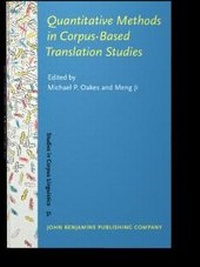
Quantitative Methods in Corpus-Based Translation Studies
A practical guide to descriptive translation research
1st Edition
Published on 20. March 2012
X, 361 pages
978-90-272-7478-6 (ISBN)
Description

This is a comprehensive guidebook to the quantitative methods needed for Corpus-Based Translation Studies (CBTS). It provides a systematic description of the various statistical tests used in Corpus Linguistics which can be used in translation research. In Part 1, Theoretical Explorations, the interplay between quantitative and qualitative methodologies is explored. Part 2, Essential Corpus Studies, describes how to undertake quantitative studies, with a suitable level of technical and relevant case studies. Part 3, Quantitative Explorations of Literary Translations, looks at translations of classic works by Cao Xueqin, James Joyce and other authors. Finally, Part 4 on Translation Lexis uses a variety of techniques new to translation studies, including multivariate analysis and game theory. This book is aimed at students and researchers of corpus linguistics, translation studies and quantitative linguistics. It will significantly advance current translation studies in terms of methodological innovation and will fill in an important gap in the development of quantitative methods for interdisciplinary translation studies.
More details
Other editions
Additional editions
Michael P. Oakes | Meng Ji
Quantitative Methods in Corpus-Based Translation Studies
A practical guide to descriptive translation research
Book
03/2012
John Benjamins Publishing Co
€104.94
Shipment within 10-15 days
Michael P. Oakes | Meng Ji
Quantitative Methods in Corpus-Based Translation Studies
A practical guide to descriptive translation research
Book
03/2012
John Benjamins Publishing Co
€38.16
Shipment within 10-15 days
Persons
Content
- Quantitative Methods in Corpus-Based Translation Studies
- Editorial page
- Title page
- LCC data
- Table of contents
- Preface
- List of contributors
- Explicit and tacit
- 1. Translation as reconceptualization
- 2. Data and methodology
- 3. Text profiles - language profiles
- 4. Keyness
- 5. Lexical Profiles
- 5.1 Lexical-semantic relations
- 5.2 A quantitative constructional profile of Polish and English emotion verbs
- 5.3 Collocations
- 6. Emotion scenarios in contrast
- 6.1 Metaphor
- 6.2 Frequencies
- FIGHT scenario
- FRIGHT
- FLIGHT
- 7. A translational dilemma, conceptual clusters, blending and equivalence
- 8. Conclusions: A system of communicative/translational tertia comparationis
- References
- Regression analysis in translation studies
- 1. Introduction
- 1.1 Types of regressions and variables
- 1.2 The example data
- 1.3 The software
- 2. Methods 1: binary logistic regression
- 2.1 From cross-tabulation to binary logistic regression
- 2.2 Binary logistic regression with one binary predictor
- 2.3 Binary logistic regression with an interval-/ratio-scaled predictor
- 2.4 Logistic regression with more than one predictor
- 3. Methods 2: linear regression
- 4. Concluding remarks
- References
- Hypothesis testing in corpus-based literary translation studies
- 1. Introduction
- 2. Measuring relationships in translations
- 3. Construction of quantitative relationship in two modern Chinese translations of Don Quijote
- 3.1 Construction of source text and target text relationship
- 3.2 Construction of the relationship between translated language and target language
- 4. Conclusion
- References
- Compiling a Norwegian-Spanish parallel corpus
- 1. Introduction
- 2. Corpora in translation studies
- 3. Compiling the NSPC
- 3.1 Criteria and procedure for text selection
- 3.2 Text selection procedure
- 3.3 Metadata and classification of the texts
- 3.3.1 Genre
- 3.3.2 The author's gender and the translator's gender
- 3.3.3 The translator's mother tongue
- 3.3.4 The Norwegian written standards Bokmål and Nynorsk
- 3.4 From texts to corpus
- 3.4.1 Pre-processing the texts
- 3.4.2 Alignment
- 3.4.3 Coding of the texts after alignment
- 3 Corpus interface and query syntax
- 3.5 Comparability with the P-ACTRES corpus
- 4. Preliminary findings in the NSPC
- 4.1 Word count and sentence length comparisons
- 4.2 Structural differenced between source text and target text
- 4.3 Omissions and explicitations in the NSPC
- 5. Ongoing and planned research based on the NSPC
- 6. Future expansion and conclusion
- Acknowledgements
- References
- Describing a translational corpus
- 1. Introduction
- 2. How normally distributed is a linguistic feature in a translational corpus?
- 2.1 Measures of central tendency
- 2.2 Measures of dispersion or variability
- 2.3 The shape of the normal distribution
- 2.4 Testing for a normal distribution
- 2.5 Confidence limits
- 2.6 Bar Charts
- 3. Determining the sample size: how big must the corpus be?
- 4. Aboutness
- 4.1 Raw frequency
- 4.2 The Chi-Squared Test
- 4.3 TF.IDF
- 5. Vocabulary richness
- 5.1 Heaps' Law
- 6. Collocations
- 6.1 Mutual Information
- 6.2 Z-score
- 6.4 Collocations of more than two words
- 6.5 Use of additional linguistic information
- 6.6 Mean and standard deviation of inter-word distances
- 6.7 Market basket analysis
- 7. Similarity between a translated text and the original
- 8. Conclusion
- References
- Clustering a translational corpus
- 1. Introduction
- 2. Problem statement
- 3. Data representation
- 3.1 Document representations
- 3.1.1 Bag-of-words
- 3.1.2 n-Grams
- 3.1.3 Multiple-word representation
- 3.2 Dimension reduction
- 3.2.1 Linguistic approaches
- 3.2.2 Statistical approaches
- 4. Measuring similarity
- 5. Clustering techniques
- 5.1 Hard and soft clustering
- 5.2 Hierarchical clustering
- 5.2.1 Agglomerative and divisive clustering.
- 5.2.2 Single-linkage, complete-linkage and average-linkage
- 5.2.3 Determine cluster number: Cutting the dendrogram
- 5.3 Partitioning (non-hierarchical) clustering
- 5.3.1 k-means
- 5.3.2 Expectation-Maximisation algorithm
- 6. Applying clustering techniques to translational documents
- 6.1 Partitioning clustering: Clustering texts by acceptability
- 6.2 Hierarchical clustering: Clustering texts by topic
- 7. Discussion and further reading
- References
- A Corpus study of early English translations of Cao Xueqin's Hongloumeng
- 1. Introduction
- 2. Research questions and data
- 3. Corpus Annotation Tools
- 4. Exploring correlation in relay literary translation
- 4.1 The student t-test for matched pairs
- 4.2 The student t-test for independent samples
- 4.3 The chi-squared test
- 5. Exploration of correlation and regression in literary translation
- 5.1 Pearson's r (product moment correlation coefficient)
- 5.2 Spearman's rank correlation coefficient
- 5.3 Wilcoxon's signed ranks matched pairs test
- 5.4 Mann whitney U test
- 5.5 Tests for the comparison of three or more groups
- 6. Overall comparison between bowra and joly
- 7. Conclusion
- References
- Determining translation invariant characteristics of James Joyce's Dubliners
- 1. Introduction
- 2. Related work
- 3. Turkish language morphology
- 4. Experimental environment and design
- 4.1 Experimental environment
- 4.2 Experimental design
- 4.3 Use of vocabulary richness in discriminant analysis
- 5. Experimental results and discussion
- 5.1 Classifying stories: Discriminant analysis results
- 5.2 Classifying text as the English original or Turkish translation
- 5.3 Comparison of sentence lengths and Type-to-Token ratios between English and Turkish translation
- 5.4 Linear relationship of sentence length between English and Turkish translation
- 5.5 Comparison of type and token relative frequency plots with the Poisson distribution
- 6. Summary and conclusions
- References
- The great mystery of the (almost) invisible translator
- 1. Introduction
- 2. Method
- 3. Results
- 4. Conclusions
- References
- Translation and scientific terminology
- 1. Introduction
- 2. Database for textual analysis
- 3. Textual phenomena under study
- 4. HCA (Hierarchical Cluster Analysis) of token lengths distribution in the five translations
- 5. HCA of the distribution of functional particles in early Chinese scientific translations
- 6. Conclusion
- References
- The games translators play
- 1. Introduction
- 2. RV as a parallel corpus
- 2.1 Untranslatable hymns and their translations
- 2.2 The challenge of uncertainty
- 3. What translators do with names
- 3.1 Formalizing decisions and constraints
- 3.2 Survey of translation techniques
- 4. Analysis of translational behaviour
- 4.1 Individual choices
- 4.1.1 Transcription and adjustment
- 4.1.2 Elaboration of individual decisions
- 4.2 Aggregate behaviour
- 4.2.1 Transcription
- 4.2.2 Explicitation
- 4.2.3 Elaboration of aggregate decisions
- 5. Discussion
- References
- Multivariate analyses of affix productivity in translated English
- 1. Introduction
- 2. Multivariate techniques in translation studies
- 3. Spaces and dimensions
- 4. Data
- 5. Factor analysis
- 6. Principal component analysis
- 7. Correspondence analysis
- 8. Discussion and summary
- Acknowledgments
- References
- Lexical lectometry in corpus-based translation studies
- 1. Introduction
- 2. Data, method, statistical analyses
- 2.1 Data
- 2.2 Method: profile-based measurement of linguistic (dis)similarity
- 2.3 Statistical analyses
- 3. Results and discussion
- 3.1 Profile-based correspondence analysis
- 3.2 Binary logistic regression analysis
- 4. Conclusion
- Acknowledgments
- References
- Appendix 1
- Appendix 2
- Appendix 3
- Appendix 4
- Appendix 5
- Appendix 6
- Appendix 7
- Appendix 8
- Notes on the appendices
- Index
