

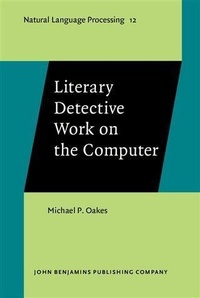
Literary Detective Work on the Computer
1st Edition
Published on 8. May 2014
X, 283 pages
978-90-272-7013-9 (ISBN)
Description

Computational linguistics can be used to uncover mysteries in text which are not always obvious to visual inspection. For example, the computer analysis of writing style can show who might be the true author of a text in cases of disputed authorship or suspected plagiarism. The theoretical background to authorship attribution is presented in a step by step manner, and comprehensive reviews of the field are given in two specialist areas, the writings of William Shakespeare and his contemporaries, and the various writing styles seen in religious texts. The final chapter looks at the progress computers have made in the decipherment of lost languages. This book is written for students and researchers of general linguistics, computational and corpus linguistics, and computer forensics. It will inspire future researchers to study these topics for themselves, and gives sufficient details of the methods and resources to get them started.
More details
Other editions
Additional editions
Michael P. Oakes
Literary Detective Work on the Computer
Book
05/2014
John Benjamins Publishing Co
€104.94
Shipment within 10-15 days
Person
Content
- Literary Detective Work on the Computer
- Editorial page
- Title page
- LCC data
- Table of contents
- Preface
- 1. Author identification
- 1. Introduction
- 2. Feature selection
- 2.1 Evaluation of feature sets for authorship attribution
- 3. Inter-textual distances
- 3.1 Manhattan distance and Euclidean distance
- 3.2 Labbé and Labbé's measure
- 3.3 Chi-squared distance
- 3.4 The cosine similarity measure
- 3.5 Kullback-Leibler Divergence (KLD)
- 3.6 Burrows' Delta
- 3.7 Evaluation of feature-based measures for inter-textual distance
- 3.8 Inter-textual distance by semantic similarity
- 3.9 Stemmatology as a measure of inter-textual distance
- 4. Clustering techniques
- 4.1 Introduction to factor analysis
- 4.2 Matrix algebra
- 4.3 Use of matrix algebra for PCA
- 4.4 PCA case studies
- 4.5 Correspondence analysis
- 5. Comparisons of classifiers
- 6. Other tasks related to authorship
- 6.1 Stylochronometry
- 6.2 Affect dictionaries and psychological profiling
- 6.3 Evaluation of author profiling
- 7. Conclusion
- 2. Plagiarism and spam filtering
- 1. Introduction
- 2. Plagiarism detection software
- 2.1 Collusion and plagiarism, external and intrinsic
- 2.2 Preprocessing of corpora and feature extraction
- 2.3 Sequence comparison and exact match
- 2.4 Source-suspicious document similarity measures
- 2.5 Fingerprinting
- 2.6 Language models
- 2.7 Natural Language Processing
- 2.8 Intrinsic plagiarism detection
- 2.9 Plagiarism of program code
- 2.10 Distance between translated and original text
- 2.11 Direction of plagiarism
- 2.12 The search engine-based approach used at PAN-13
- 2.13 Case study 1: Hidden influences from printed sources in the Gaelic tales
- 2.14 Case study 2: General George Pickett and related writings
- 2.15 Evaluation methods
- 2.16 Conclusion
- 3. Spam filters
- 3.1 Content-based techniques
- 3.2 Building a labelled corpus for training
- 3.3 Exact matching techniques
- 3.4 Rule-based methods
- 3.5 Machine learning
- 3.5.1 Naïve Bayes
- 3.5.2 Logistic regression
- 3.5.3 Boosting
- 3.6 Unsupervised machine learning approaches
- 3.7 Other spam-filtering problems
- 3.8 Evaluation of spam filters
- 3.9 Non-linguistic techniques
- 3.9.1 Safelists
- 3.9.2 Human challenges
- 3.9.3 Reputation analysis
- 3.9.4 Networking considerations
- 3.9.5 Web harvesting
- 3.9.6 Payment and legislation
- 3.10 Conclusion
- 4. Recommendations for further reading
- 3. Computer studies of Shakespearean authorship
- 1. Introduction
- 2. Shakespeare, Wilkins and Pericles
- 2.1 Correspondence analysis for "Pericles" and related texts
- 3. Shakespeare, Fletcher and The Two Noble Kinsmen
- 4. King John
- 5. The Raigne of King Edward III
- 5.1 Neural networks in stylometry
- 5.2 Cusum charts in stylometry
- 5.3 Burrows' Zeta and Iota
- 6. Hand D in "Sir Thomas More"
- 6.1 Elliott, Valenza and the Earl of Oxford
- 6.2 Elliott and Valenza: Hand D
- 6.3 Bayesian approach to questions of Shakespearian authorship
- 6.4 Bayesian analysis of Shakespeare's second-person pronouns
- 6.5 Vocabulary differences, LDA and the authorship of Hand D
- 6.6 Hand D: Conclusions
- 7. The three parts of Henry VI
- 8. Timon of Athens
- 9. The "Puritan" and the "Yorkshire Tragedy"
- 10. Arden of Faversham
- 11. Estimation of the extent of Shakespeare's vocabulary and the authorship of the "Taylor" poem
- 12. The chronology of Shakespeare
- 13. Conclusion
- 4. Stylometric analysis of religious texts
- 1. Introduction
- 1.1 Overview of the New Testament by correspondence analysis
- 1.2 Q
- 1.2.1 The work of Tony Honoré
- 1.2.2 Correspondence analysis of Luke
- 1.2.3 Correspondence analysis of the Synoptic Gospels
- 1.2.4 Correspondence analysis of Matthew
- 5. Conclusion
- 5. Computers and decipherment
- 1. Introduction
- 1.1 Differences between cryptography and decipherment
- 1.2 Cryptological techniques for automatic language recognition
- 1.3 Dictionary approaches to language recognition
- 1.4 Sinkov's test
- 1.5 Index of coincidence
- 1.6 The Log-Likelihood ratio
- 1.7 The Chi-Squared test statistic
- 1.8 Entropy of language
- 1.9 Zipf's Law and Heaps' Law coefficients
- 1.10 Modal token length
- 1.11 Autocorrelation analysis
- 1.12 Vowel identification
- 2. Rongorongo
- 2.1 History of Rongorongo
- 2.2 Characteristics of Rongorongo
- 2.3 Obstacles to decipherment
- 2.4 Encoding of RongRongo symbols
- 2.5 The "Mamari" lunar calendar
- 2.6 Basic statistics of the Rongorongo corpus
- 2.7 Alignment of the Rongorongo corpus
- 2.8 A concordance for Rongorongo
- 2.9 Collocations and collostructions
- 2.10 Classification by genre
- 2.11 Vocabulary richness
- 2.12 Podzniakov's approach to matching frequency curves
- 3. The Indus Valley texts
- 3.1 Why decipherment of the Indus texts is difficult
- 3.2 Are the Indus texts writing?
- 3.3 Other evidence for the Indus Script being writing
- 3.4 Determining the order of the Markov model
- 3.5 Missing symbols
- 3.6 Text segmentation and the Log-likelihood measure
- 3.7 Network analysis of the Indus Signs
- 4. Linear A
- 5. The Phaistos disk
- 6. Iron Age Pictish symbols
- 7. Mayan glyphs
- 8. Conclusion
- References
- Index
