

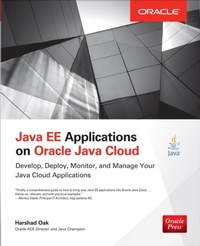
Java EE Applications on Oracle Java Cloud:
Develop, Deploy, Monitor, and Manage Your Java Cloud Applications
1st Edition
Published on 5. September 2014
299 pages
978-0-07-181716-5 (ISBN)
Available for download
Description

Master Java EE Application Development on Oracle Java Cloud Build highly available, scalable, secure, distributed applications on Oracle Java Cloud. In this Oracle Press guide, Oracle ACE Director and Java Champion Harshad Oak leads you through the entire Java EE cloud-based application lifecycle from development to deployment. Filled with real-world examples, ready-to-use code, and best practices, Java EE Applications on Oracle Java Cloud is an invaluable resource for anyone looking to meet the growing demand for cloud-based development skills. Set up an Oracle Java Cloud instance and manage users and roles Build an application with NetBeans IDE and deploy it on Oracle Java Cloud Extend application functionality using servlets, filters, and listeners Streamline application development with JavaServer Pages, JSP Standard Tag Library, and expression language Create and deploy feature-rich JavaServer Faces applications on Oracle Java Cloud Use Enterprise JavaBeans to effectively run business logic code in enterprise applications Develop and deploy SOAP and RESTful web services on Oracle Java Cloud Take advantage of the persistence capabilities of Oracle Java Cloud via Oracle Database Cloud Code examples from the book are available for download.
More details
Other editions
Additional editions
Harshad Oak
Java EE Applications on Oracle Java Cloud:
Develop, Deploy, Monitor, and Manage Your Java Cloud Applications
Book
09/2014
Osborne/McGraw-Hill
€61.50
Article not available at the moment
Content
- Cover
- Title Page
- Copyright Page
- Dedication
- About the Author
- Contents at a Glance
- Contents
- Foreword
- Acknowledgments
- Introduction
- 1 Java EE and Cloud Computing
- Java Editions
- Java EE Applications
- Application Servers
- Open Source vs. Commercial
- Reference Implementation
- API and Technology Specification
- Java Community Process (JCP) and Java EE
- Java EE Compatible
- Profiles
- Web Profile
- Cloud Computing
- Going Around in Circles
- What Is Cloud Computing?
- Why Cloud Computing?
- Concerns About Cloud Computing
- Private, Public, and Hybrid Clouds
- Cloud as a Leveler
- Java EE on the Cloud
- Competing Technologies: Alternatives to Java on the Cloud
- Standards and Java EE 7
- Java EE Vendors and Alternatives
- Summary
- 2 The Oracle Java Cloud
- Oracle's Cloud Foray
- Oracle Cloud Constituents
- SaaS
- IaaS
- PaaS
- Java Cloud
- Pricing
- Trial Signup
- My Services
- IDE Integration
- Oracle Java Cloud Service SDK
- Users and Roles
- Summary
- 3 Build and Deploy with NetBeans
- Development IDE
- Why NetBeans?
- Building with Java EE Technologies
- First NetBeans Project
- What Happened?
- Files and Directories Generated
- The Cloud Deployment
- Clean and Build, Verify
- Web Application Structure
- Directories
- Packaging the Application
- We Are at WAR
- Summary
- 4 Servlets, Filters, and Listeners
- Servlets
- Servlet Interface
- HttpServlet
- Servlet One
- Servlet Class
- HttpServletRequest
- HttpServletResponse
- web.xml
- weblogic.xml
- Sharing Data
- Session Management
- HttpSession
- RequestDispatcher
- WebLogic-Specific Servlet Capabilities on OJC
- Filters
- Listeners
- View Java Logs
- Summary
- 5 JavaServer Pages, JSTL, and Expression Language
- The Origin of JSP
- JSP on the Oracle Java Cloud
- JSP Internals
- JSP Lifecycle
- Servlet Code
- JSP Directives
- JSP Declaration
- JSP Scriptlets
- JSP Expressions
- Implicit Objects
- JSP Comments
- Tags and Expressions
- Custom Tags
- Expression Language
- JSTL Libraries
- Using Tags in a JSP
- Summary
- 6 JavaServer Faces
- From JSP to Struts to JSF
- JSF on the Oracle Java Cloud
- Facelets
- JSF Managed Beans
- Validation
- Ajax
- Templates
- Summary
- 7 Enterprise JavaBeans (Session Beans)
- Containers
- EJB in OJC
- Why EJB?
- Session Beans
- Stateless
- Stateful
- Interfaces: Local or Remote
- Developing an Enterprise Application with EJBs
- New Session Bean
- Inject the Session Bean into the Servlet
- Package and Run from NetBeans
- Deploy Using the Java Cloud Services Control
- Lifecycle of a Session Bean
- Transaction Management
- Rollback and Exception Handling
- Summary
- 8 Web Services
- Developing a SOAP Web Service
- WSDL
- Web Service Client
- RESTful Web Services Using JAX-RS API
- Building RESTful Web Services on the OJC
- JAX-RS 1.1 Fix
- Modify the REST Resource
- RESTful Web Service Client
- Summary
- 9 Persistence Using the Oracle Database Cloud Service
- Persistence on the Oracle Cloud
- Oracle Database Cloud Service
- Explore Database Cloud
- Oracle Apex
- Java Cloud: Database Cloud Integration
- JPA
- Persistence Providers
- Entity
- Developing an Entity Application
- Add Entity from a Servlet
- Find and Update Entity
- Java Persistence Query Language
- CRUD JSF for Entity
- Summary
- A Java EE Technologies and JSRs
- Java Platform, Enterprise Edition 5 (Java EE 5) JSR 244
- Java Platform, Enterprise Edition 6 (Java EE 6) JSR 316
- Java Platform, Enterprise Edition 6 (Java EE 6) Web Profile
- Java Platform, Enterprise Edition 7 (Java EE 7) JSR 342
- Java Platform, Enterprise Edition 7 (Java EE 7) Web Profile
- B Application Servers Compatible with Java EE 5, 6, and 7
- Java EE 5-Compatible Implementations
- Java EE 6 Full Platform-Compatible Implementations
- Java EE 6 Web Profile-Compatible Implementations
- Java EE 7 Full Platform-Compatible Implementations
- Java EE 7 Web Profile-Compatible Implementations
- C Supported and Unsupported Technologies, Services, and APIs . . .
- Technologies and Services Supported
- Java EE 5 and 6 Specifications Supported
- Public WebLogic Server 10.3. APIs and Capabilities Supported
- Unsupported Features and APIs
- Unsupported WebLogic Server 10.3. APIs and Capabilities
- Whitelist Violations
- Index

