

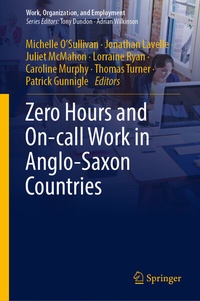
Zero Hours and On-call Work in Anglo-Saxon Countries
1st Edition
Published on 25. April 2019
IX, 250 pages
978-981-13-6613-0 (ISBN)
Description

This book focuses on zero hours and on-call work as an extreme form of casual and precarious employment. It includes country studies of the USA, Canada, Australia, the UK, New Zealand and Ireland, where there has been increasing concern about the prevalence of such work, and working time uncertainty, as well as varying levels of public policy debate on regulation. The book incorporates a comparative review of zero hours work based on the findings of the country studies. This pays particular attention to state regulatory responses to zero hours work, and incorporates the sociological concepts of accumulation and legitimation functions of the state.
Exploring the regulation of zero hours work beyond individual countries, the book includes an analysis of external regulation of zero hours work at the supranational level, namely the European Union and ILO.
Further, it assesses the implications of zero hours for workers in new sectors ofeconomic activity, particularly the impact of the platform or 'gig' economy on the fundamental nature of the employment relationship. It also considers the societal implications of zero hours work and the ethical responsibilities of employers and governments towards workers as citizens.
Exploring the regulation of zero hours work beyond individual countries, the book includes an analysis of external regulation of zero hours work at the supranational level, namely the European Union and ILO.
Further, it assesses the implications of zero hours for workers in new sectors ofeconomic activity, particularly the impact of the platform or 'gig' economy on the fundamental nature of the employment relationship. It also considers the societal implications of zero hours work and the ethical responsibilities of employers and governments towards workers as citizens.
More details
Series
Language
English
Place of publication
Singapore
Singapore
Publishing group
Springer Singapore
Target group
Professional and scholarly
Product notice
Reflowable
Illustrations
IX, 250 p. 6 illus., 5 illus. in color.
File size
3,07 MB
ISBN-13
978-981-13-6613-0 (9789811366130)
DOI
10.1007/978-981-13-6613-0
Schweitzer Classification
Other editions
Additional editions
Michelle O'Sullivan | Jonathan Lavelle | Juliet McMahon
Zero Hours and On-call Work in Anglo-Saxon Countries
Book
05/2019
Springer
€160.49
Shipment within 15-20 days
Persons
Michelle O'Sullivan
is Senior Lecturer at the Kemmy Business School, University of Limerick, Ireland. Her expertise is primarily on precarious work with particular attention on wage setting and public policy in low-wage jobs. Her current research interests are on zero-hours work, government policy on working hours, working time schedules of retail workers, and freelance work.
Jonathan Lavelle is a Senior Lecturer at the Kemmy Business School, University of Limerick, Ireland. His main research interests are international and comparative employment relations, with a particular interest in trade union recognition and avoidance, and employee representative issues within multinational companies.
Juliette McMahon is Lecturer at the Kemmy Business School, University of Limerick, Ireland. Current research interests include HRM/employment relations in healthcare organisations, bullying and harassment, occupational change in Ireland, aspects of employment legislation, and HR/employment relations in small Irish enterprises.
Lorraine Ryan is Lecturer at the Kemmy Business School, University of Limerick, Ireland. Her main research interests currently centre on precarious work and working time, democracy in the workplace, corporate social responsibility and the future of work.
Caroline Murphy is Lecturer at the Kemmy Business School, University of Limerick, Ireland. Her current research interests include precarious employment, female labour market participation, formal and informal care work, and employee representation.
Thomas Turner is a Professor at the Kemmy Business School, University of Limerick, Ireland. His main areas of research include developments in employment relations in Ireland at workplace and national level, trade union trends, and the impact of immigrants in the Irish labour market. Patrick Gunnigle is Professor at the Kemmy Business School, University of Limerick, Ireland. His research interests include international business/multinational companies, human resource management (HRM), trade union membership and recognition, management strategies in industrial relations, and the role of HRM specialists.
Jonathan Lavelle is a Senior Lecturer at the Kemmy Business School, University of Limerick, Ireland. His main research interests are international and comparative employment relations, with a particular interest in trade union recognition and avoidance, and employee representative issues within multinational companies.
Juliette McMahon is Lecturer at the Kemmy Business School, University of Limerick, Ireland. Current research interests include HRM/employment relations in healthcare organisations, bullying and harassment, occupational change in Ireland, aspects of employment legislation, and HR/employment relations in small Irish enterprises.
Lorraine Ryan is Lecturer at the Kemmy Business School, University of Limerick, Ireland. Her main research interests currently centre on precarious work and working time, democracy in the workplace, corporate social responsibility and the future of work.
Caroline Murphy is Lecturer at the Kemmy Business School, University of Limerick, Ireland. Her current research interests include precarious employment, female labour market participation, formal and informal care work, and employee representation.
Thomas Turner is a Professor at the Kemmy Business School, University of Limerick, Ireland. His main areas of research include developments in employment relations in Ireland at workplace and national level, trade union trends, and the impact of immigrants in the Irish labour market. Patrick Gunnigle is Professor at the Kemmy Business School, University of Limerick, Ireland. His research interests include international business/multinational companies, human resource management (HRM), trade union membership and recognition, management strategies in industrial relations, and the role of HRM specialists.
Content
Chapter 1: Introduction.- Chapter 2: Ireland.- Chapter 3: UK.- Chapter 4: Australia.- Chapter 5: New Zealand.- Chapter 6: USA.- Chapter 7: Canada.- Chapter 8: Implications for Workers in New Sectors of Economic Activity.- Chapter 9: Implications for Society - Between the Profit Imperative and Citizenship.- Chapter 10: Effective Responses to Zero Hours Work - Examples of the Role of Social Dialogue and Government Regulation.- Chapter 11: The Space for Regulation Beyond Borders? The Role of the EU in Regulating Zero Hours Work.- Chapter 12: The Space for Regulation Beyond Borders? The Role of the ILO and International Framework Agreements in Regulating Zero Hours Work.- Chapter 13: Conclusion.
