

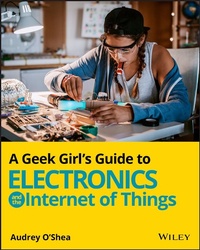
A Geek Girl's Guide to Electronics and the Internet of Things
1st Edition
Published on 16. September 2020
464 pages
978-1-119-68369-8 (ISBN)
Description

A straightforward demystification of electronics and the Internet of Things
A Geek Girl's Guide to Electronics and the Internet of Things breaks down and simplifies electronics and the Internet of Things for the layperson. Written by a leading technical school instructor with a talent for bringing complex topics to everyday people, this book provides concrete examples and practical advice for anyone interested in building, repairing, or studying electronics and functional Internet of Things (IoT) devices.
A Geek Girl's Guide to Electronics and the Internet of Things explores a wide range of topics including, among others:
* Ohm's and Watt's Law
* Series and Parallel Circuits
* Diodes, transistors, capacitors and relays
* Motors and Pulse with Modulation
* Using light to control electricity
* Photovoltaic Cells and Transducers
* Enhancing circuits with Arduino
* Connecting circuits to networks
The distinguished author's website includes videos to help you build and enhance projects, along with deeper information to enrich your learning. Additionally, the book goes beyond theory and teaches readers how circuit components become IoT devices and provide the data that drive our modern world. The combination of hands-on activities and solid pedagogy ensures long-lasting retention of the material for everyone.
A Geek Girl's Guide to Electronics and the Internet of Things breaks down and simplifies electronics and the Internet of Things for the layperson. Written by a leading technical school instructor with a talent for bringing complex topics to everyday people, this book provides concrete examples and practical advice for anyone interested in building, repairing, or studying electronics and functional Internet of Things (IoT) devices.
A Geek Girl's Guide to Electronics and the Internet of Things explores a wide range of topics including, among others:
* Ohm's and Watt's Law
* Series and Parallel Circuits
* Diodes, transistors, capacitors and relays
* Motors and Pulse with Modulation
* Using light to control electricity
* Photovoltaic Cells and Transducers
* Enhancing circuits with Arduino
* Connecting circuits to networks
The distinguished author's website includes videos to help you build and enhance projects, along with deeper information to enrich your learning. Additionally, the book goes beyond theory and teaches readers how circuit components become IoT devices and provide the data that drive our modern world. The combination of hands-on activities and solid pedagogy ensures long-lasting retention of the material for everyone.
More details
Other editions
Additional editions
Book
10/2020
Wiley
€37.50
Shipment within 15-20 days
Person
Audrey O'Shea is a professional educator. Her fascination with how things work began as a child and in high school she found herself as the only girl in what would now be called the electronics club. After a successful career in information technology, she turned to teaching and has taught courses in computer technology, electrical theory and practice for energy workers, general electronics, and other related fields. She holds a variety of computer industry certifications and is a member of the Phi-Kappa-Phi honor society, and active in helping young women prepare for STEM careers.
Content
- Cover
- Title Page
- Copyright Page
- About the Author
- About the Technical Editor
- Acknowledgments
- Contents
- Introduction
- Who Will Benefit Most from This Book
- Sourcing Parts and Supplemental Materials
- Special Features
- Part I IoT and Electricity Basics
- Chapter 1 IoT and Electronics
- IoT in a Nutshell
- Parts of an IoT System
- Devices
- Communication
- Data Analytics and Management
- The User Experience
- Challenges in Implementing IoT
- IoT into the Future
- Chapter 2 Electricity: Its Good and Bad Behavior
- Try This: Creating Some Static
- Levitate a Styrofoam Plate
- Bend Water
- Creating Light with Static
- Magically Move a Styrofoam Ball
- Electricity at an Atomic Level
- Conductors and Insulators
- Characteristics of Electricity
- Current
- Voltage
- Resistance
- Induction and Conduction
- Try This: Creating a Simple Breadboard Circuit
- Light-Emitting Diodes
- Jumper Wires
- Building the Circuit
- The Basic Circuit
- Ohm's Law
- Resistor Values and Voltage Dividers
- Opens and Shorts
- Circuit Protection Devices
- Fuses
- Circuit Breakers
- Bigger Is Not Better
- Chapter 3 Symbols and Diagrams
- Types of Diagrams
- Schematic Symbols
- So Many Switches!
- Drawing Your Circuit
- Try This: Adding a Switch and Creating a Schematic
- Chapter 4 Introduction to the Arduino Uno
- What Is Arduino?
- The Arduino Board
- Analog vs. Digital
- The Arduino IDE
- Try This: Creating a Simple Arduino-Controlled Circuit
- What Went Wrong?
- What Does the Code Mean?
- Try This: Changing Pins
- Try This: Creating Arduino Running Lights
- Try This: Adding a Switch to Your Circuit
- Try This: Using the Serial Monitor
- Chapter 5 Dim the Lights
- Using a Multimeter
- Try This: Repurposing a Power Supply
- Measuring Voltage, Current, and Resistance
- Measuring Voltage
- Measuring Current
- Measuring Resistance
- Continuity
- Try This: Dimming the Lights
- Try This: Measuring Circuit Values
- Using Arduino to Measure Electricity
- Try This: Using an Arduino Voltmeter
- Try This: Using an Arduino Ohmmeter
- Try This: Using an Arduino Ammeter
- Try This: Using an Arduino Continuity Tester
- Try This: Building a Dimmable Arduino Camp Light
- Soldering, Perfboards, and Shrink Tubing
- Soldering
- Perfboards
- Shrink Tubing
- Chapter 6 Feel the Power
- Watt's Law and the Power Wheel
- Datasheets
- The Power Wheel
- Watts and Horsepower
- Horsepower
- Efficiency
- Battery Power
- The Other Resistor Value
- Wattmeters
- Wattmeter
- Power Distribution
- Try This: Using an Arduino Wattmeter
- Setting Up the LCD Screen
- Building the Wattmeter
- Chapter 7 Series and Parallel Circuits
- Series, Parallel, and Complex Circuits
- Try This: Testing Series and Parallel Configurations
- Calculating Values in Series and in Parallel
- Current
- Voltage
- Resistance
- Power
- Resistance of a Conductor
- Sources in Series and Parallel
- Sources in Series
- Sources in Parallel
- Aiding and Opposing Sources
- Try This: Calculating Circuit Values
- Calculating the Series Circuit
- What Went Wrong
- Calculating the Parallel Circuit
- What Size Resistor Is Needed?
- Calculating the Complex Circuit
- Part II Using Common Components
- Chapter 8 Diodes: The One-Way Street Sign
- Try This: Creating a Simple Polarity Tester
- Determining Polarity Tester Maximum Voltage
- Determining Resistor Needs
- Typical LED Voltages
- Putting It on a Perfbord
- LED Features
- The Inner Workings of Diodes
- Determining Anode and Cathode
- Types of Diodes
- Diode Uses
- Try This: Using a Seven-Segment LED
- Seven-Segment LED
- Bar LED
- Chapter 9 Transistors
- Try This: Using a Transistor as an Amplifier
- The Purpose of Transistors
- Types of Transistors
- Distinguishing Transistor Types
- Determining Transistor Connections
- Try This: Using a Transistor as a Switch
- Verifying the Data
- Building the Circuit
- Troubleshooting
- Chapter 10 Capacitors
- A Quick Look at Capacitors
- Try This: Creating a Time Delay Circuit
- Capacitor Uses
- Try This: Creating an Astable Multivibrator
- Try This: Using Capacitors in Series and Parallel
- Capacitors in Parallel
- Capacitors in Series
- Chapter 11 The Magic of Magnetism
- The Electricity/Magnetism Relationship
- Magnetism
- Magnetism's Relationship with Electricity
- Try This: Building an Electromagnet
- Magnetism in Circuits
- Motors and Generators
- Inductors
- Doorbells
- Relays
- Parts of a Relay
- Try This: Building a Relay Oscillator
- Try This: Setting Up an Emergency Lighting System
- Chapter 12 Electricity's Changing Forms
- Try This: Creating a Water Alarm
- Common Transducers
- Speakers and Microphones
- Light
- Other Transducers
- Try This: Creating a Night-Light Circuit
- Try This: Creating an Arduino Laser Security System
- Building the Circuit
- How the Voltage Divider Works
- Other Considerations
- Chapter 13 Integrated Circuits and Digital Logic
- Integrated Circuits
- Try This: Creating an Astable Multivibrator
- Determining Circuit Timing
- Examining the IC
- Building the Circuit
- Operational Amplifiers
- Digital Logic
- Logic Chip Construction
- The Binary Number System
- Logic Gates
- Try This: Exploring AND and OR Gates
- The AND Gate
- The OR Gate
- Logic Probes and Oscilloscopes
- Part III More Please
- Chapter 14 Pulse Width Modulation
- Pulse Width Modulation Explained
- Try This: Using a PWM LED Dimmer
- PWM vs. Potentiometer
- Building the Circuit
- Observing the Changing Duty Cycle
- Try This: Using a PWM Motor Control
- Try This: Trying PWM and an Arduino
- Chapter 15 Sources of Electricity
- Chemical Reactions
- Simple Experiment: Making a Voltaic Cell
- Types of Batteries
- Try This: Making a Thermocouple
- Light
- Try This: Displaying PV Output on an Arduino
- Friction
- Magnetism
- Pressure
- Wrapping It Up
- Chapter 16 Transformers and Power Distribution
- What Is a Transformer?
- Phase Relationships
- Power and Turns Ratio
- Transformer Losses
- Taps, Autotransformers, and Variacs
- Try This: Verifying Transformer Output
- Alternating Current Values
- Power Distribution Using Transformers
- Chapter 17 Inverters and Rectifiers
- Inverters vs. Rectifiers and Their Uses
- Inverters and PV Systems
- Other Inverter Uses
- Rectifier Uses
- Construction of Inverters
- Try This: Filtering a Circuit
- Setting Up the Circuit
- Filtering the Circuit
- Construction of Rectifiers
- Single-Phase vs. Three-Phase Power
- Try This: Building a Small Variable Power Supply
- Chapter 18 Radio Waves and Tuned Circuits
- Radio Waves
- Try This: Building a Radio Receiver
- Making Waves
- Transmitting Radio Waves
- Receiving Radio Waves
- AM vs. FM
- Try This: Building an Arduino FM Radio
- The Shield
- The Libraries
- Verifying the Radio Works
- Adding Station Tuning
- Tuned Circuits
- Part IV Putting the I in IoT
- Chapter 19 Connecting Your Circuits to the Cloud
- The Arduino IoT Cloud
- Try This: Setting Up Your Device
- Try This: Using Things, Properties, and Widgets
- Chapter 20 Just for Fun
- Electronic Fabrics and Wearables
- Try This: Lighting Up a Teddy Bear
- Paper Circuits
- Try This: Creating a Conductive Paint Circuit
- Try This: Creating a Copper Tape Circuit
- Try This: Building Squishy Circuits
- Chapter 21 What's Next?
- The World Is Your Oyster
- Recommended Reading and Resources
- Words of Encouragement
- Index
- EULA
