

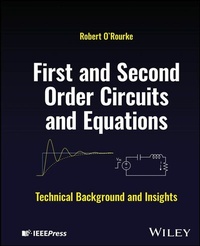
First and Second Order Circuits and Equations
Description

First and second order electric and electronic circuits contain energy storage elements, capacitors and inductors, fundamental to both time and frequency domain circuit response behavior, including exponential decay, overshoot, ringing, and frequency domain resonance.
First and Second Order Circuits and Equations provides an insightful and detailed learning and reference resource for circuit theory and its many perspectives and duals, such as voltage and current, inductance and capacitance, and serial and parallel. Organized and presented to make each information topic immediately accessible, First and Second Order Circuits and Equations offers readers the opportunity to learn circuit theory faster and with greater understanding.
First and Second Order Circuits and Equations readers will also find:
- Root locus charts of second order characteristic equation roots both in terms of damping factor ¿ as well as damping constant a.
- Detailed treatment of quality factor Q and its relationship to bandwidth and damping in both frequency and time domains.
- Inductor and capacitor branch relationship step response insights in terms of calculus intuition.
- Derivations of voltage divider and current divider formulae in terms of Kirchhoff's laws.
First and Second Order Circuits and Equations is an essential tool for electronic industry professionals learning circuits on the job, as well as for electrical engineering, mechanical engineering, and physics students learning circuits and their related differential equations.
More details
Other editions
Additional editions
Person
Robert O'Rourke is an electronic engineer and independent Technical Learning Architect, with experience creating and teaching electronic circuits and electromagnetics simulation for high speed digital signal integrity, power circuits, multiphysics differential equations, and antenna applications.
Content
About the Author xvii
Acknowledgments xix
Part 1 Circuit Elements and Resistive Circuits 1
1 Ohm's Law, Branch Relationships, and Sources 3
1.1 Chapter Summary and Polarity Reference 3
1.2 Branch Relationships and I-V Characteristics 5
1.3 Ohm's Law, Resistance, and Resistors 8
1.4 Current, Voltage, and Sources Overview 11
1.5 Voltage Sources 12
1.6 Current and Current Sources 14
2 Kirchhoff's Laws and Resistive Dividers 17
2.1 Kirchhoff's Laws and Dividers Comparison Summary 17
2.2 Kirchhoff's Laws Physical Analogies 18
2.3 Source Polarity in KVL - Time and Frequency Domains 19
2.4 Formulae Summary for Resistors in Series and Parallel 26
2.5 Resistors in Series 27
2.6 Voltage Dividers 32
2.7 Parallel Circuit Element Formulae 33
2.8 Current Dividers 36
2.9 Current and Voltage Intuitions 37
3 Opamp Models and Resistive Circuits 39
3.1 Introduction and Ideal Opamp Model Results Overview 39
3.2 Ideal Opamp Resistive Amplifier Circuits 41
4 Reactive Circuit Elements 45
4.1 Capacitor and Inductor Comparison Summary 45
4.2 Capacitors 47
4.3 Inductors 51
Part 2 First-Order Circuits 57
5 First-Order RC and RL Circuits Introduction 59
5.1 What are First-Order Circuits? 59
5.2 Intuitive First-Order Circuit Frequency Domain Examples 61
5.3 First-Order Natural and Step Response Overview 62
6 First-Order Frequency Domain Response 65
6.1 First-Order Frequency Response Overview 65
6.2 Series RC High-pass Filter Frequency Response 71
6.3 Series RL Low-pass Filter Frequency Response 89
6.4 Series RC Low-pass Filter Frequency Response 108
6.6 Parallel RL Low-pass Filter Frequency Response 128
6.7 Parallel RC High-pass Filter Frequency Response 139
7 Discharging and Charging First-Order RC and RL Circuits 149
7.1 Discharging RC and RL Circuits - Natural Response 149
7.2 Charging RC and RL Circuits - Step Response 153
7.3 The Exponential Time Constant t (Tau) 155
7.4 Pulse Train Time Constants Simulation Example 156
8 Natural Response of RC and RL Circuits 159
8.1 RC and RL Circuits Natural Response Summary 159
8.2 RC and RL Natural Response Derivation 160
8.3 RC Natural Response (ZIR) Time Constants and Initial Current 166
8.4 Natural Response of Series RL with Voltage Source 167
8.5 First-Order RC and RL Natural Response Summary 171
9 First-Order Step Response of RC and RL Circuits 173
9.1 First-Order Step Response Summary Overview 173
9.2 Intuitive Analysis of RC and RL Step Response 177
9.3 Series RC Step Response Solution Using a Particular Solution 181
9.4 Series RL Step Response Solution Using a Particular Solution 184
9.5 Series RL Step Response with Voltage Source 188
9.6 First-Order Step Response Summary 190
10 Complete Response of First-Order RC and RL Circuits 191
10.1 First-Order Complete Response Summary Overview 191
10.2 Series RC Complete Response Examples 192
10.3 RL Complete Response Example and Intuitive Analysis 195
10.4 Complete Response with Switches 199
10.5 Complete Response General Derivation and Formulae 202
11 First-Order Opamp Integrator and Differentiator Circuits 207
11.1 RC Integrator Circuit Step Response 207
11.2 Opamp Integrator Circuit 208
11.3 Opamp Inverting Differentiator Circuit 210
Part 3 Second-Order Circuits 211
12 Second-Order RLC Circuits Overview 213
12.1 What are Second-Order Circuits? 213
12.2 Resonance in the Frequency Domain 215
12.3 Second-Order RLC Transfer Functions and Q 216
12.4 Two Time Domain Responses 217
13 Second-Order RLC Frequency Response 219
13.1 Series and Parallel RLC Impedance 219
13.2 Second-Order RLC Frequency Response 229
13.3 Second-Order RLC Bandwidth and Quality Factor 238
14 Second-Order RLC Circuit Natural Response 251
14.1 Second-Order Natural Response Introduction 251
14.2 Second-order Natural Response in Terms of R, L, and c 254
14.3 Second-order Damping Variables a and ¿ 0 283
14.4 Second-order Damping Ratio ¿ - Zeta 291
15 Second-Order RLC Step and Complete Response 299
15.1 RLC Step Response Intuitive Overview 299
15.2 RLC Step Response Detailed Analyses 301
15.3 Parallel RLC Intuitive Step Response Example 303
15.4 Complete RLC Time Domain Response 305
Part 4 Technical Background Topics 307
16 Complex Numbers, Exponentials, and Phasors 309
16.1 Imaginary and Complex Numbers 309
16.2 Exponentials, Complex Numbers, and Trigonometry 311
16.3 Phasors and Sinusoidal Steady State 314
Index 319
1
Ohm's Law, Branch Relationships, and Sources
1.1 Chapter Summary and Polarity Reference
1.1.1 Chapter Summary
Ohm's law describes the relationship between voltage, current, and resistance for resistive circuits. This chapter describes Ohm's law and the related circuit elements, resistors, current sources, and voltage sources. This chapter also covers the more general idea of branch relationships, the relation between the voltage across a circuit element and the current through a circuit element, for resistors, voltage sources, and current sources.
Current source and resistor Voltage source and resistorFigure 1.1a Current source driving a resistor.
Figure 1.1b Voltage source across a resistor.
In Figure 1.1a, the current source drives current through the resistor causing a voltage drop across the resistor. In Figure 1.1b, the voltage source across the resistor causes current to flow through the resistor. The ideal independent current source supplies a fixed amount of current I through the resistor R regardless of the amount of voltage across the source. The ideal independent voltage source supplies a fixed amount of voltage V across the resistor R regardless of the amount of current through the source. The resistor R resists the flow of current through it. The amount of voltage V, that develops across the resistor R, as a result of the current I flowing through the resistor R, is determined by Ohm's law, V equals IR, shown in Equation 1.1a The resistor R resists the flow of current through it. The amount of current, that flows through the resistor, as a result of the voltage V across the resistor R, is determined by Ohm's law, I equals V over R, shown in Equation 1.1b.1.1.1.1 Ohm's Law
Figure 1.2 Resistor schematic symbol with passive sign convention.
The voltage across a resistor, shown in Figure 1.2, equals the current through the resistor times the resistance of the resistor.
(1.1a)The current through a resistor equals the voltage across the resistor divided by the resistance of the resistor.
(1.1b)1.1.1.2 Branch Relationships
The branch relationship is the equation describing the relationship between current through a circuit element (in a branch of a circuit) and the voltage across the circuit element. For example, Ohm's law V = IR or I = V/R is the branch relationship of a resistor. Figure 1.3, with a simple square shape, is a generic, non-specific circuit element.
Figure 1.3 Passive sign convention on a generic fictitious schematic symbol.
1.1.2 Polarity Reference
In Figure 1.4a, 1 V divided by 5 O equals 200 mA (0.2 A).
Figure 1.4a 1 volt DC voltage source across a 5 ohm resistor.
In each of these two direct current (DC) examples, Figures 1.4a and 1.4b, the current in the loop is 200 mA DC, going down through the resistor from + to -, and the voltage across the 5 O resistor is 1 V DC.
Figure 1.4b 200 mA DC current source driving a 5 ohm resistor.
In Figure 1.4b, 0.2 A multiplied by 5 O equals 1 V.
1.1.2.1 DC Voltage Source Polarity Example
The voltage source in Figure 1.4a applies voltage across the resistor, and the + (plus) and - (minus) signs on the resistor indicate the polarity of the voltage.
Figure 1.5 shows a circuit simulation schematic corresponding to the circuit in Figure 1.4a. The voltage source symbol in Figure 1.5 is specific to DC voltage sources.
Figure 1.5 Circuit simulation schematic with avoltage source and a resistor.
There is a current meter in the right-hand leg of the circuit, just below the resistor. The downward arrow in the current meter symbol indicates a reference direction pointing down; the current meter considers clockwise flow of current in the circuit to be positive.
For the DC circuit simulation, there is a table of results in Figure 1.5. VR, measured at the top of the circuit, is positive 1 V, and the current Pr1.I, measured by the current meter, is 200 mA, verifying that current flows downward through the resistor.
1.1.2.2 DC Current Source Polarity Example
The arrow, pointing up in the current source in Figure 1.4b, indicates the direction of a positive current from the source. Applying Ohm's law, multiplying the current times the resistance, tells us the voltage across the resistor, both the amount and the polarity of the voltage. The + (plus) and - (minus) signs on the resistor indicate the polarity of the voltage.
Figure 1.6 shows a circuit simulation schematic corresponding to the circuit in Figure 1.4b. The downward arrow in the current meter symbol indicates a reference direction pointing down; the current meter considers clockwise flow of current in the circuit to be positive.
Figure 1.6 Circuit simulation schematic with a current source and a resistor.
In Figure 1.6, the current source arrow points up, telling us that current flows up and out of the current source, and then down through the resistor. As expected from Ohm's law, 200 mA multiplied by 5 O yields 1 mV across the resistor. This 1 V result appears in the table under V1.V. The current direction of the current source and the current meter are the same, and the measured current, under Pr1.I, is positive 200 mA.
At the top of the schematic in Figure 1.6, there is a V1 marker, indicating a voltage measurement. This voltage is referenced to ground, so it is equivalent to the way schematics show a + (plus) sign above the resistor and a - (minus) sign below the resistor.
In Figure 1.7 the current source arrow points down, telling us that current flows down and out of the current source, and then up through the resistor, the opposite direction from the current source in Figure 1.6.
Figure 1.7 Circuit simulation schematic with a DC current source, pointed down, and a resistor.
This makes the measured voltage V2.V -1 V, as it is referenced from the top V2 voltage reference.
As expected from Ohm's law, -0.2 A multiplied by 5 O yields - 1 V across the resistor. This result appears under V2.V in units of volts.
In Figure 1.8, the current source arrow indicates counterclockwise circulation of current around the loop. The meter, pointing the same direction in Figure 1.8 as it does in Figure 1.7, indicates opposite circulation direction from the current source and correspondingly the current measured under Pr2.1 is negative 0.2 A.
Figure 1.8 Schematic with a current source, pointed up, and a resistor.
1.1.2.3 Reference Polarity versus Physical Current Flow Direction
It is important to distinguish between actual current flow direction and reference polarity. If we reversed the direction of the current meter in Figure 1.7, the simulation would indicate a positive current value for Pr2.1, but the current still flows counterclockwise in the circuit.
The arrow pointing down, in the current source in Figure 1.8, indicates positive current going down from the current source and then up through the resistor. Using the same + (plus) and - (minus) signs on the resistor as a reference polarity for the resistor, we would get a negative voltage.
In Figure 1.7 the reference direction for the current is down, indicated by an arrow, in both schematics (Figures 1.7 and 1.8). The current polarity will be measured relative to this counter clockwise reference direction.
1.2 Branch Relationships and I-V Characteristics
1.2.1 Circuit Element Branch Relationships
1.2.1.1 Ohm's Law is a Resistor's Branch Relationship
Ohm's law V = IR, describing the behavior of a resistor, is the branch relationship for a resistor. Figure 1.9 shows how voltage V can be expressed as a function of I (voltage as a dependent variable) or current can be expressed as a function of V (current as the dependent variable).
Figure 1.9 Resistor schematic diagram and ohm's law expressions where current or voltage are dependent.
