

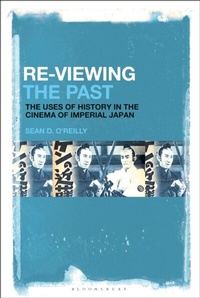
Re-Viewing the Past
The Uses of History in the Cinema of Imperial Japan
1st Edition
Published on 23. August 2018
320 pages
978-1-5013-3604-1 (ISBN)
Description

Re-Viewing the Past: The Uses of History in the Cinema of Imperial Japan analyzes the complicated relationship between history films, audiences, reviewers and censors in Japan for the critically important years from 1925-1945. First contextualizing the history of the popular "Bakumatsu" period (1853-1868), the moment of Japan's emergence as a modern nation, Sean O'Reilly paves the way for a reinterpretation of Japanese pre and postwar cinema. Setting a film in the Bakumatsu period offered 'cultural breathing room' to both filmmakers and viewers, offering a cinematic space where apolitical entertainment and now-forbidden themes like romance still reigned. Some filmmakers-and viewers-even conceived of these films as being a form of resistance against Japan's growing militarism.
As comparisons between the popularity of such films versus that of state-sponsored propaganda films show, audiences responded enthusiastically to these glimmers of resistance. O'Reilly argues that we should turn our attention to the much more popular films of the time that were major hits with audiences in order to understand what resonated with wartime spectators, and to speculate about why this might have been the case. Including clips of these rare films, a so-far neglected area of Japanese film history is now firmly situated in context to offer a thought-provoking, multidisciplinary approach.
As comparisons between the popularity of such films versus that of state-sponsored propaganda films show, audiences responded enthusiastically to these glimmers of resistance. O'Reilly argues that we should turn our attention to the much more popular films of the time that were major hits with audiences in order to understand what resonated with wartime spectators, and to speculate about why this might have been the case. Including clips of these rare films, a so-far neglected area of Japanese film history is now firmly situated in context to offer a thought-provoking, multidisciplinary approach.
Reviews / Votes
"O'Reilly re-views the films produced in transwar Japan through a unique analytical lens. The result is brisk and brilliant; he deciphers an intricate process whereby popular attitudes toward historicity were formulated by filmmakers, filmgoers, politicians, and foreigners-an unparalleled contribution to the scholarship on the history of Japan." * Dr. Tomoko L. Kitagawa, author of The Creation of Intelligence: A History of Passion without Borders (2015), The Visions (2013) and Japanese History Abroad (2012) * In Re-Viewing the Past, Sean O'Reilly lucidly introduces us to the barely discussed but deeply formative popular cinema of interwar and wartime Japan. Not content with simply mapping an immensely influential body of film, the book expertly re-directs us towards the complex encounters these films offered to audiences at the times. From the bloody tales of assassination, the parodies of patriotism and the adventures of masked heroes emerges a kaleidoscope of possible viewing positions that provides us with a rich view of how film in Japan functioned in negotiating the wrenching present through a specific framing of the tumultuous past. * Alexander Zahlten, Associate Professor of East Asian Languages and Civilizations, Harvard University, USA * Re-Viewing the Past makes a long-awaited contribution to the scholarship on Japanese period cinema, and Bakumatsu films in particular. Taking a Cultural Studies approach, Sean O'Reilly brilliantly conjures the multifaceted experiences of contemporary audiences, showing us that interwar/wartime Japan was not, in fact, a gloomy, 'dark valley' as is often claimed. O'Reilly's analysis is witty and elegantly sharp. With its innovative 'revisionist' approach, the book makes a major contribution to both the study of Japanese cinema and audience studies. * Mitsuyo Wada-Marciano, Professor of Film Studies, Kyoto University, Graduate School of Letters, Japan * Our image of a monolithic, fascist Japan during WWII was partly the product of propaganda cinema from both Japan and the West; the reality was far more complex. Sean O'Reilly uncovers this complexity by looking at interwar and wartime films representing the Bakumatsu period, the 19th century transition from feudalism to the nation state system. His compelling analyses reveal the wide spectrum of relationships spectators held toward tradition, nation and war. Bakumatsu has recently made a comeback in film and television. O'Reilly invites us to use the insights of his study to understand how present-day audiences are also re-viewing their collective past. * Markus Nornes, Professor of Asian Cinema, University of Michigan, USA *More details
Edition
1. Auflage
Language
English
Place of publication
New York
United States
Publishing group
Bloomsbury Publishing PLC (Digital)
Target group
Professional and scholarly
Illustrations
31 bw illus
ISBN-13
978-1-5013-3604-1 (9781501336041)
Copyright in bibliographic data and cover images is held by Nielsen Book Services Limited or by the publishers or by their respective licensors: all rights reserved.
Schweitzer Classification
Other editions
Additional editions
Sean D. O'Reilly | Sean O'Reilly
Re-Viewing the Past
The Uses of History in the Cinema of Imperial Japan
Book
02/2020
Bloomsbury Academic
€62.08
Shipment within 15-20 days
Sean D. O'Reilly | Sean O'Reilly
Re-Viewing the Past
The Uses of History in the Cinema of Imperial Japan
Book
08/2018
Bloomsbury Academic
€207.98
Shipment within 15-20 days
Persons
Sean D. O'Reilly is Assistant Professor at Akita International University, Japan, where he teaches courses on Japanese history, cinema, and popular culture. He graduated from Harvard University's History and East Asian Languages program with a secondary field in Film and Visual Studies.
Content
1. Introduction
2. Valorizing the Villains: the First Bakumatsu Boom and 1927's Sonno joi
3. History as Nonsense: Historical Parodies of the Bakumatsu
4. Serial History: the Case of Kurama Tengu
5. Consuming History, Hating the Enemy
6. Romancing History
7. Transwar Japan
Bibliography
Index
2. Valorizing the Villains: the First Bakumatsu Boom and 1927's Sonno joi
3. History as Nonsense: Historical Parodies of the Bakumatsu
4. Serial History: the Case of Kurama Tengu
5. Consuming History, Hating the Enemy
6. Romancing History
7. Transwar Japan
Bibliography
Index
