

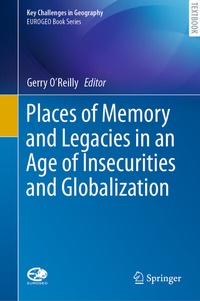
Places of Memory and Legacies in an Age of Insecurities and Globalization
Published on 3. December 2020
XIX, 533 pages
978-3-030-60982-5 (ISBN)
Description

In this book, practitioners and students discover perspectives on landscape, place, heritage, memory, emotions and geopolitics intertwined in evolving citizenship and democratization debates. This volume shows how memorialization can contribute to wider inclusive interpretations of history, tourism and human rights promoted by the European Project. It's geographies of memories can foster cooperation as witnessed throughout Europe during the 2014-18 WWI commemorations.
Due to new world orders, geopolitical reconfigurations and ideals that emerged after 1918, many countries ranging from the Baltic and Russia to the Balkans, Turkey and Greece, eastern and central Europe to Ireland are continuing with commemorations regarding their specific memories in the wider Europe. Shared memorial spaces can act in post conflict areas as sites of reconciliation; nonetheless `the peace' cannot be taken for granted with insecurities, globalization, and nationalisms in the USA and Russia; the UK's Brexit stress and populist movements in Western Europe, Visegrád and Balkan countries. Citizen-fatigue is reflected in socio-political malaise mirrored in France's Yellow Vest movement and elsewhere. Empathy with other peoples' places of memory can assist citizens learn from the past. Memory sites promoted by the EU, Council of Europe and UNESCO may tend to homogenize local memories; nevertheless, they act as vectors in memorialization, stimulating debate and re-evaluating narratives.
This textbook combines geographical, inter-cultural and inter-disciplinary approaches and perspectives on spaces of memory by a range of authors from different countries and traditions offers the reader diverse and holistic perspectives on cultural geography, dynamic geopolitics, globalization and citizenship.
Due to new world orders, geopolitical reconfigurations and ideals that emerged after 1918, many countries ranging from the Baltic and Russia to the Balkans, Turkey and Greece, eastern and central Europe to Ireland are continuing with commemorations regarding their specific memories in the wider Europe. Shared memorial spaces can act in post conflict areas as sites of reconciliation; nonetheless `the peace' cannot be taken for granted with insecurities, globalization, and nationalisms in the USA and Russia; the UK's Brexit stress and populist movements in Western Europe, Visegrád and Balkan countries. Citizen-fatigue is reflected in socio-political malaise mirrored in France's Yellow Vest movement and elsewhere. Empathy with other peoples' places of memory can assist citizens learn from the past. Memory sites promoted by the EU, Council of Europe and UNESCO may tend to homogenize local memories; nevertheless, they act as vectors in memorialization, stimulating debate and re-evaluating narratives.
This textbook combines geographical, inter-cultural and inter-disciplinary approaches and perspectives on spaces of memory by a range of authors from different countries and traditions offers the reader diverse and holistic perspectives on cultural geography, dynamic geopolitics, globalization and citizenship.
More details
Series
Language
English
Place of publication
Cham
Switzerland
Publishing group
Springer International Publishing
Product notice
Reflowable
Illustrations
XIX, 533 p. 158 illus., 137 illus. in color.
File size
14,62 MB
ISBN-13
978-3-030-60982-5 (9783030609825)
DOI
10.1007/978-3-030-60982-5
Schweitzer Classification
Other editions
Additional editions
Book
12/2020
Springer
€53.49
Shipment within 7-9 days
Person
Gerry O'Reilly is Associate Professor in Geography, and International Coordinator for the School of History and Geography, with research and teaching interests in geopolitics, political, economic and cultural geography, sustainable development and education. Modules include: Geopolitics and Humanitarian Action; Middle East and North Africa (MENA), Europe and Spaces of Memory. He obtained his PhD from Durham University, MA from the National University of Ireland (University College Cork), HDipEd and BA, Maynooth University. Post-doctoral research was undertaken in political geography and sustainable development at University College Dublin. Before joining SPC - DCU in 1997, Gerry held lectureship and research posts at UCD, and Universities of Durham, Tunis, and Algeria-Annaba, and Visiting Professorship at the Ohio State University, Columbus. Regarding Humanitarian Action and Geopolitics and as Faculty member of ECHO (EU Humanitarian Office) - sponsored NOHA (Network on Humanitarian Action), he was Erasmus Mundus Visiting Fellow at the Western Cape University (2009), Toronto York University (2008) and Columbia University NY (2007).
Gerry is Vice President of EUROGEO - EAG (European Association of Geographers); and International Geographical Union, National Representative for the Commission on Population and Vulnerability. Representative for L'Association Comenius and NETT that operate within the EU LLP/ERASMUS framework. Representative on the National Steering Committee of the CGDE: Centre for Global Development through Education (MI-UL); and CHRCE - Centre for Human Rights and Citizenship Education. He recently authored the book "Aligning Geopolicts, Humanitarian Aciton and Geography in Times of Conflict", published by Springer in 2019.
Gerry is Vice President of EUROGEO - EAG (European Association of Geographers); and International Geographical Union, National Representative for the Commission on Population and Vulnerability. Representative for L'Association Comenius and NETT that operate within the EU LLP/ERASMUS framework. Representative on the National Steering Committee of the CGDE: Centre for Global Development through Education (MI-UL); and CHRCE - Centre for Human Rights and Citizenship Education. He recently authored the book "Aligning Geopolicts, Humanitarian Aciton and Geography in Times of Conflict", published by Springer in 2019.
Content
Part I: Landscape, Place, Heritage and Memory.- Part II: Geography and Inter-disciplinarity: Perspectives from Different Places.- Part III: Conclusions.
