

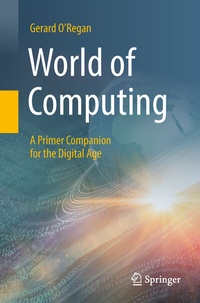
World of Computing
Description

This engaging work provides a concise introduction to the exciting world of computing, encompassing the theory, technology, history, and societal impact of computer software and computing devices. Spanning topics from global conflict to home gaming, international business, and human communication, this text reviews the key concepts unpinning the technology which has shaped the modern world.
Topics and features: introduces the foundations of computing, the fundamentals of algorithms, and the essential concepts from mathematics and logic used in computer science; presents a concise history of computing, discussing the historical figures who made important contributions, and the machines which formed major milestones; examines the fields of human-computer interaction, and software engineering; provides accessible introductions to the core aspects of programming languages, operating systems, and databases; describes the Internet revolution, the invention of the smartphone, and the rise of social media, as well as the Internet of Things and cryptocurrencies; explores legal and ethical aspects of computing, including issues of hacking and cybercrime, and the nature of online privacy, free speech and censorship; discusses such innovations as distributed systems, service-oriented architecture, software as a service, cloud computing, and embedded systems; includes key learning topics and review questions in every chapter, and a helpful glossary.
Offering an enjoyable overview of the fascinating and broad-ranging field of computing, this easy-to-understand primer introduces the general reader to the ideas on which the digital world was built, and the historical developments that helped to form the modern age.
More details
Other editions
Additional editions
Person
Dr. Gerard O'Regan is a CMMI software process improvement consultant with research interests including software quality and software process improvement, mathematical approaches to software quality, and the history of computing. He is the author of such Springer titles as Concise Guide to Formal Methods , Concise Guide to Software Engineering , Guide to Discrete Mathematics , Introduction to the History of Computing , Pillars of Computing , Introduction to Software Quality , Giants of Computing , and Mathematics in Computing .
Content
What is a Computer?.- Foundations of Computing.- A Concise History of Computing.- Overview Mathematics in Computing.- Introduction to Algorithms.- A Concise Introduction to Logic.- Human Computer Interaction.- Introduction to Programming Languages.- Overview of Software Engineering.- Overview of Operating Systems.- Overview of Databases.- Overview of Telecommunications.- The Internet and World Wide Web.- The Smartphone and Social Media.- Legal Aspects of Computing.- Ethics and Professional Responsibility.- Innovation in the Computing Field.- Epilogue.
