

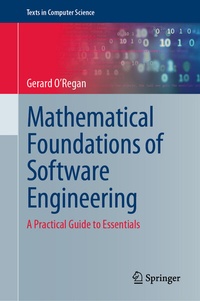
Mathematical Foundations of Software Engineering
Description

This textbook presents an introduction to the mathematical foundations of software engineering. It presents the rich applications of mathematics in areas such as error-correcting codes, cryptography, the safety and security critical fields, the banking and insurance fields, as well as traditional engineering applications.
Topics and features:
- Addresses core mathematics for critical thinking and problem solving
- Discusses propositional and predicate logic and various proof techniques to demonstrate the correctness of a logical argument.
- Examines number theory and its applications to cryptography
- Considers the underlying mathematics of error-correcting codes
- Discusses graph theory and its applications to modelling networks
- Reviews tools to support software engineering mathematics, including automated and interactive theorem provers and model checking
- Discusses financial software engineering, including simple and compound interest, probability and statistics, and operations research
- Discusses software reliability and dependability and explains formal methods used to derive a program from its specification
- Discusses calculus, matrices, vectors, complex numbers, and quaternions, as well as applications to graphics and robotics
- Includes key learning topics, summaries, and review questions in each chapter, together with a useful glossary
This practical and easy-to-follow textbook/reference is ideal for computer science students seeking to learn how mathematics can assist them in building high-quality and reliable software on time and on budget. The text also serves as an excellent self-study primer for software engineers, quality professionals, and software managers.
More details
Other editions
Additional editions
Person
Dr. Gerard O'Regan is a CMMI software process improvement consultant with research interests including software quality and software process improvement, mathematical approaches to software quality, and the history of computing. He is the author of such Springer titles as Introduction to the History of Computing , Pillars of Computing , Introduction to Software Quality , Giants of Computing , and Mathematics in Computing .
Content
1. Fundamentals of Software Engineering.- 2. Software Engineering Mathematics.- 3. Mathematical Prerequisites.- 4. Introduction to Algorithms.- 5.- Algebra.- 6. Mathematical Induction and Recursion.- 7. Graph Theory.- 8. Sequences, Series and Permutations and Combinations.- 9. A Short History of Logic.- 10. Propositional and Predicate Logic.- 11. Advanced Topics in Logic.- 12. Language Theory and Semantics.- 13. Automata Theory.- 14. Computability and Decidability.- 15. Software Reliability and Dependability.
