

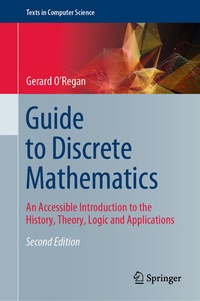
Guide to Discrete Mathematics
Description

This stimulating textbook presents a broad and accessible guide to the fundamentals of discrete mathematics, highlighting how the techniques may be applied to various exciting areas in computing. The text is designed to motivate and inspire the reader, encouraging further study in this important skill.
Features: This book provides an introduction to the building blocks of discrete mathematics, including sets, relations and functions; describes the basics of number theory, the techniques of induction and recursion, and the applications of mathematical sequences, series, permutations, and combinations; presents the essentials of algebra; explains the fundamentals of automata theory, matrices, graph theory, cryptography, coding theory, language theory, and the concepts of computability and decidability; reviews the history of logic, discussing propositional and predicate logic, as well as advanced topics such as the nature of theorem proving; examines the field of software engineering, including software reliability and dependability and describes formal methods; investigates probability and statistics and presents an overview of operations research and financial mathematics.
More details
Other editions
Additional editions
Previous edition
Person
Dr. Gerard O'Regan is a CMMI software process improvement consultant with research interests including software quality and software process improvement, mathematical approaches to software quality, and the history of computing. He is the author of such Springer titles as Introduction to the History of Computing , Pillars of Computing , Introduction to Software Quality , Giants of Computing , and Mathematics in Computing .
Content
1. Mathematics in Civilization.- 2. Sets, Relations and Functions.- 3. Number Theory.- 4. Mathematical Induction and Recursion.- 5. Sequences, Series and Permutations and Combinations.- Algebra.- 6. Automata Theory.- 7. Matrix Theory.- 8. Graph Theory.- 9. Cryptography.- 10. Coding Theory.- 11. Language Theory and Semantics.- 12. Computability and Decidability.- 13. A Short History of Logic.- 14. Propositional and Predicate Logic.- 15. Advanced Topics in Logic.- 16. Software Engineering Mathematics.- 17. Formal Methods.- 18. Z Formal Specification Language.- 19. Probability, Statistics and Applications.
