

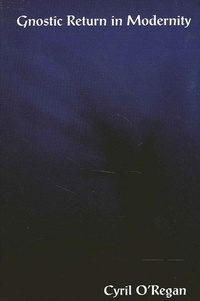
Gnostic Return in Modernity
Description

Gnostic Return in Modernity demonstrates the possibility that Gnosticism haunts certain modern discourses. Studying Gnosticism of the first centuries of the common era and utilizing narrative analysis, the author shows how Gnosticism returns in a select band of narrative discourses that extends from the seventeenth century German mystic Jacob Boehme through Hegel and Blake down into the contemporary period. The key concept is that of narrative grammar. Unlike the hypothesis of an invariant narrative, a Gnostic narrative grammar allows room for the differences between modern and ancient forms of Gnosticism, and respects the dignity of both periods.
Cyril O'Regan is Associate Professor of Theology at the University of Notre Dame. He is the author of The Heterodox Hegel, also published by SUNY Press.
More details
Other editions
Additional editions
Person
Cyril O'Regan is Associate Professor of Theology at the University of Notre Dame. He is the author of The Heterodox Hegel, also published by SUNY Press.
Content
Acknowledgments
Introduction
Part I. Baurian Model of Gnostic Return and Its Challenges
Chapter 1. Redeeming and Reconstructing Baur's Model of Gnostic Return
Summary
Chapter 2. Baurian Gnostic Genealogical Model and Its Contestation
2.1. Historicist Challenge: Hans Blumenberg and Epochal Shift
2.2. Agon between Gnostic Baurian and Non-Gnostic Genealogies
Summary
Part II. Toward Valentinian Narrative Grammar
Chapter 3. Classical Valentinian Narratives: Variety and Unity
3.1. Ptolemy's Valentinian Gnostic System
3.2. The Gospel of Truth3.3 The Tripartite Tractate
Summary
Chapter 4. Valentinian Narrative Grammar: Irenaean Gestures and the Phenomenon of Valentinian Enlisting
4.1. The Contributions of Irenaeus: Developing the Grammatical Hints
4.2. Valentinianism's Relation to Other Narrative Discourses
Chapter 5. Genealogical Capability of Valentinian Narrative Grammar
5.1. Justifying the Protestant Identification of the Baurian Line
5.2. Baurian Line and Rule-Governed Deformation of Classical Valentinian Genres
5.3. Valentinian Enlisting of Non-Valentinian Narrative Discourses
Summary
Conclusion
Notes
Index
