

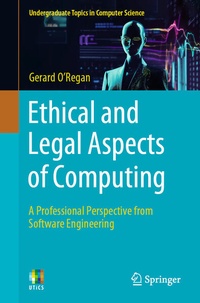
Ethical and Legal Aspects of Computing
Description

This textbook presents an overview of the critically important ethical and legal issues that arise in the computing field and provides a professional perspective from software engineering. The author gained exposure to these aspects of computing while working as a software engineer at Motorola in Ireland, where he coordinated the patent programme and worked with several software suppliers.
Topics and features:
- Presents a broad overview of ethics and the law
- Includes key learning topics, summaries, and review questions in each chapter, together with a useful glossary
- Discusses the professional responsibility of computer professionals
- Explores ethics in various civilisations and religious traditions
- Discusses ethical software engineering and ethical outsourcing
- Considers what is fair and ethical in data science
- Describes ethical challenges that arise in social media and the AI field
- Reviews intellectual property including patents, copyright and trademarks
This practical and easy-to-follow textbook/reference is ideal for computer science students seeking to understand legal and ethical aspects of computing. The text also serves as a concise self-study primer for software engineers and software managers.
Reviews / Votes
"With this book, O'Regan efficiently addresses a wide range of ethical and legal issues in computing. It is well crafted, organized, and reader friendly, featuring many recent, relevant examples like tweets, fake news, disinformation, and artificial intelligence (AI), which are especially pertinent for undergraduate students." (Michael Oudshoorn, Computing Reviews, October 17, 2024)
More details
Other editions
Additional editions
Person
Dr. Gerard O'Regan is an international lecturer in Maths/Computing with research interests including software quality and software process improvement, mathematical approaches to software quality, and the history of computing. He is the author of such Springer titles as Introduction to the History of Computing , Introduction to Software Quality , Mathematics in Computing, and Mathematical Foundations of Software Engineering .
Content
1. Introduction to Ethics and the Law in Computing.- 2. A Short History of Ethics.- 3. Professional Responsibility of Computer Professionals.- 4. Ethical Software Engineering.- 5. Ethical and Legal Aspects of Data Science.- 6. Ethical Social Media.- 7. Ethics and AI.- 8. Introduction to Law.- 9. Legal and Ethical Aspects of Outsourcing.- 10. Intellectual Property Law.- 11. E-commerce Law.- 12. Cybercrime and Cybersecurity.- 13. Epilogue.
