

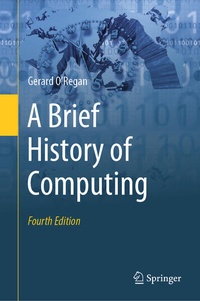
A Brief History of Computing
Description

This lively and fascinating text traces the key developments in computation - from 3000 B.C. to the present day - in an easy-to-follow and concise manner.
The book embarks upon a journey from ancient Egypt to modern times-- taking in mechanical calculators, early digital computers, to software engineering, to the first personal computers and mobile phones, and the invention of the World Wide Web, among other topics. This expanded and revised 4th edition examines legal and ethical issues that arise in the computing field, as well as innovations such as quantum computing and Bitcoin.
Topics and features:
- Offers many pedagogical features such as chapter-opening key topics, chapter introductions and summaries, exercises, and a glossary
- Discusses major figures such as Boole, Babbage, Shannon, Turing, and Von Neumann
- Reviews early computers developed in the United States, Germany and Britain
- Explores the development of the IBM 360 and the birth of the software industry
- Reviews the history of software engineering, programming languages, and operating systems, and examines ethical software engineering
- Investigates progress of the field of artificial intelligence, including ethical AI
- Reviews the introduction of the personal computer, the World Wide Web, mobile phone technology, and ethical social media
- Discusses innovations such as Bitcoin, quantum computing and nanotechnology
- Examines legal and ethical aspects of computing, computer crime and cybersecurity
This clearly written and broad-ranging text gives the reader a flavour of the history and stimulates further study in the subject. As such, it will be of benefit to students of computer science, while also capturing the interest of the more casual reader.
Dr. Gerard O'Regan is an independent researcher and visiting professor with research interests in software quality and software process improvement, mathematical approaches to software quality, and the history of computing. He is the author of several Springer books including Concise Guide to Software Engineering , Mathematical Foundations of Software Engineering , and Ethical and Legal Aspects of Computing.
More details
Other editions
Additional editions
Previous edition
Person
Dr. Gerard O'Regan
is a CMMI software process improvement consultant with research interests including software quality and software process improvement, mathematical approaches to software quality, and the history of computing. He is the author of such Springer textbooks as
Concise Guide to Formal Methods
,
Concise Guide to Software Engineering
,
Guide to Discrete Mathematics
, and
Introduction to Software Quality
Content
Preface.- What is a Computer?.- Computing in Early Civilisations.- Foundations of Computing.- The First Digital Computers.- The First Commercial Computers.- Early Commercial Computers and the Invention of the Transistor.- Integrated Circuit and Silicon Valley.- The IBM System/360.- Minicomputers and Later Mainframes.- The Microprocessor Revolution.- Home Computers.- The IBM Personal Computer.-History of Operating Systems.- Birth of Software Industry and Human Computer Interaction.- History of Programming Languages.- History of Software Engineering.- A Short History of Telecommunications.- The Internet Revolution.- The Smartphone and Social Media.- A Miscellany of Innovation.- History of Databases.- History of Artificial Intelligence.- Ethics and Professional Responsibility.- Legal Aspects of Computing.-Computer Crime and Cybersecurity.- Epilogue.- References.- Glossary.- Index.
