

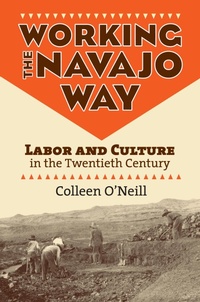
Working the Navajo Way
Description

Winner: Gaspar Perez de Villagra Award
The Diné have been a pastoral people for as long as they can remember; but when livestock reductions in the New Deal era forced many into the labor market, some scholars felt that Navajo culture would inevitably decline. Although they lost a great deal with the waning of their sheep-centered economy, Colleen O'Neill argues that Navajo culture persisted.
O'Neill's book challenges the conventional notion that the introduction of market capitalism necessarily leads to the destruction of native cultural values. She shows instead that contact with new markets provided the Navajos with ways to diversify their household-based survival strategies. Through adapting to new kinds of work, Navajos actually participated in the ?reworking of modernity? in their region, weaving an alternate, culturally specific history of capitalist development.
O'Neill chronicles a history of Navajo labor that illuminates how cultural practices and values influenced what it meant to work for wages or to produce commodities for the marketplace. Through accounts of Navajo coal miners, weavers, and those who left the reservation in search of wage work, she explores the tension between making a living the Navajo way and ?working elsewhere.?
Focusing on the period between the 1930s and the early 1970s?a time when Navajos saw a dramatic transformation of their economy?O'Neill shows that Navajo cultural values were flexible enough to accommodate economic change. She also examines the development of a Navajo working class after 1950, when corporate development of Navajo mineral resources created new sources of wage work and allowed former migrant workers to remain on the reservation.
Focusing on the household rather than the workplace, O'Neill shows how the Navajo home serves as a site of cultural negotiation and a source for affirming identity. Her depiction of weaving particularly demonstrates the role of women as cultural arbitrators, providing mothers with cultural power that kept them at the center of what constituted ?Navajo-ness.?
Ultimately, Working the Navajo Way offers a new way to think about Navajo history, shows the essential resilience of Navajo lifeways, and argues for a more dynamic understanding of Native American culture overall.
More details
Other editions
Additional editions
Person
Content
Illustrations
Acknowledgments
Acronyms
Introduction: Navajo History and Western Capitalist Development
1. The Diné and the Diné Bkeyah: Navajo History and Navajoland
2. Mining Coal like Herding Sheep: Navajo Coal Operators in the mid-Twentieth Century
3. Weaving a Living: Navajo Weavers and the Trading Post Economy
4. Working for Wages the Navajo Way: Navajo Households and Off-Reservation Wage Work
5. Navajo Workers and White Man's Ways: Race, Sovereignty, and Organized Labor on the Navajo Reservation
6. Rethinking Modernity and the Discourse of Development in American Indian History: A Navajo Example
Notes
Index
