

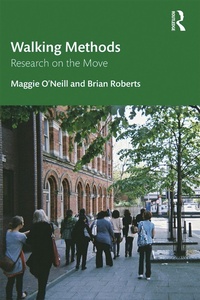
Walking Methods
Research on the Move
1st Edition
Published on 9. July 2019
290 pages
978-1-317-29503-7 (ISBN)
Description

This book introduces and critically explores walking as an innovative method for doing social research, showing how its sensate and kinaesthetic attributes facilitate connections with lived experiences, journeys and memories, communities and identities. The book situates walking methods historically, sociologically, and in relation to biographical and arts-based research, as well as new work on mobilities, the digital, spatial, and the sensory.
The book is organised into three sections: theorising; experiencing; and imagining walking as a new method for doing biographical research. There is a key focus upon the Walking Interview as a Biographical Method (WIBM) on the move to usefully explore migration, memory, and urban landscapes, as part of participatory, visual, and ethnographic research with marginalised communities and artists and as re-formative and transgressive. The book concludes with autobiographical walks taken by the authors and a discussion about the future of the walking interview as biographical method.
Walking Methods combines theory with a series of original ethnographic and participatory research examples. Practical exercises and a guide to using walking as a method help to make this a rich resource for social science researchers, students, walking artists, and biographical researchers.
The book is organised into three sections: theorising; experiencing; and imagining walking as a new method for doing biographical research. There is a key focus upon the Walking Interview as a Biographical Method (WIBM) on the move to usefully explore migration, memory, and urban landscapes, as part of participatory, visual, and ethnographic research with marginalised communities and artists and as re-formative and transgressive. The book concludes with autobiographical walks taken by the authors and a discussion about the future of the walking interview as biographical method.
Walking Methods combines theory with a series of original ethnographic and participatory research examples. Practical exercises and a guide to using walking as a method help to make this a rich resource for social science researchers, students, walking artists, and biographical researchers.
Reviews / Votes
"This superb book explores the intersections between walking and ethnography, narrative and biographic methods, visual and participatory methods. The authors' enthusiasm is infectious and will surely inspire researchers to get walking!"Jennifer Fleetwood, Senior Lecturer in Criminology, Goldsmiths College, UK
"Walking Methods is an important contribution to the field of walking studies through a critical new method - the Walking Interview as a Biographical Method (WIBM). The book is comprehensive in scope, detailing the history and current iterations of 'methods on the move' across the arts and social sciences. WIBM is significant because it considers how people's biographies and life stories are shaped through perambulation that takes place through various durations and movements. Rich in examples, exercises, and (auto)biographical reflections this book makes a unique contribution to walking methods."
Stephanie Springgay, Associate Professor, Ontario Institute for Studies in Education, The University of Toronto, Canada
"A learned, revealing and absorbing route one guide to the sociology of walking and using the self as a sociological resource. Essential."
Chris Rojek, Professor of Sociology, City University of London, UK
"This book is the first complex composition of theoretical and empirical approaches to the different aspects of 'research on the move'. Deeply inspiring for sociologists, anthropologists, psychologists, and researchers of cultural studies. The high quality pedagogue supports qualitative researchers, especially those working and representing biographical studies."
Prof. Kaja Kazmierska, Director of the Institute of Sociology, and Chair of the ESA Research Network 3 on Biographical Perspectives on European Societies, University of Lodz, Poland
More details
Edition
1. Auflage
Language
English
Place of publication
London
United Kingdom
Publishing group
Taylor & Francis Ltd
Target group
College/higher education
Illustrations
20 Halftones, black and white
ISBN-13
978-1-317-29503-7 (9781317295037)
Copyright in bibliographic data and cover images is held by Nielsen Book Services Limited or by the publishers or by their respective licensors: all rights reserved.
Schweitzer Classification
Other editions
Additional editions
Book
07/2019
1st Edition
Routledge
€208.00
Shipment within 10-20 days
Book
07/2019
1st Edition
Routledge
€63.60
Shipment within 10-20 days
Persons
Maggie O'Neill is Professor in Sociology at the University of Cork. She has a long history of doing critical theory/feminist research and conducting walking, participatory and biographical methods with communities and artists, as well as marginalised groups on topics such as sex work, migration, and participatory, creative, and arts-based methodologies.
Brian Roberts taught and researched at several UK universities and was a visiting academic at institutions in a number of countries. He was closely associated with the early work of the Centre for Contemporary Cultural Studies, University of Birmingham, UK. He has written widely on biographical research, social theory, and research practice.
Brian Roberts taught and researched at several UK universities and was a visiting academic at institutions in a number of countries. He was closely associated with the early work of the Centre for Contemporary Cultural Studies, University of Birmingham, UK. He has written widely on biographical research, social theory, and research practice.
Content
Introduction Part I: Theorizing/Observing/Thinking 1. Methods on the Move: Moving Methods 2. Theorizing Walking in the Sociological Imagination - Walking in Context 3. Walking, Art-Making and Biographical Research Exercise One: Walking and Theorizing - Observing/Thinking Part II: Experiencing 4. Migration, Memory and Place - Connecting with Memory and Place in Urban Landscapes 5. Walking as Re-Formative and Transgressive: Health, Pilgrimage, Trespass, Marching 6. Walking in the Downtown Eastside - Experiencing the WIBM as Participatory, Visual and Ethnographic Exercise Two: Walking, Sensing, Experiencing Part III: Imagining 7. Walking, Sex Work, and Community: Towards a Radical Democratic and Imaginative Space for addressing Sexual and Social Inequalities 8. The Phenomenology of Walking in a Garden 9. Walking Artists: Critical Dialogues and Imaginaries 10. Auto/Biographical Encounters in Time and Space - Roots and Routes Exercise Three: Walking and Imagining - Time/Memory/Making Conclusion: The Future of the Walking Interview as a Biographical Method Exercise Four: WIBM Exercise - Observing, Experiencing, Imagining The Walking Interview as a Biographical Method - Principles and Practice: A Framework
