

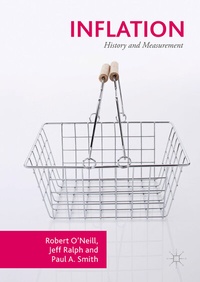
Inflation
Description

This book is an introduction to the history of - and current measurement practice of - inflation for the United Kingdom. The authors describe the historical development of inflation measures in a global context, and do so without using formal mathematical language and related jargon that relates only to a few specialist scholars. Although inflation is a widely used and quoted statistic, and despite the important role inflation plays in real people's lives - through pension uprating, train tickets, interest rates and the work of economists - few people understand how it is created. O'Neill, Ralph and Smith mix historical data with a description of practices inside the UK statistical system and abroad, which will aid understanding of how this important economic statistic is produced, and the important and controversial choices that statisticians have made over time.
Reviews / Votes
"This book is a very well-researched history of the development of measures of inflation in the UK over the past three hundred years. It is also a source of technical information for anybody wanting to delve into the detail of how consumer price indices are compiled." (John Astin, Significance Magazine, Vol. 15 (05), October, 2018)More details
Other editions
Additional editions
Persons
Robert O'Neill is Lecturer at the University of Huddersfield, UK, where he has been since 2013. Previously he worked at the Office for National Statistics working primarily in the area of index numbers methodology. His current role includes both research and teaching related to quantitative economics, which includes teaching students at various levels.
Jeff Ralph has worked for the Office for National Statistics, UK, for 13 years. Much of that time has been spent working on price statistics and the measurement of inflation; this has included research and teaching. Jeff has been joint author on a number of research papers and lead author on a recent student textbook on index numbers.
Paul A. Smith is Associate Professor in Official Statistics, University of Southampton, UK. He worked for 25 years in the Office for National Statistics, UK, where he gained extensive experience in the theory and practice of sample surveys applied to businesses, households and the population census. He undertakes consultancy and research in topics related to official statistics, and coordinates the MSc in Official Statistics.
Content
Chapter 1. Introduction.- Chapter 2. What is Inflation?.- Chapter 3. The Origins of Inflation Measurement: 1700-1879.- Chapter 4. What is a Price Index?.- Chapter 5. Developments in the Period 1880-1945.- Chapter 6. The Development of the Retail Prices Index: 1947-1989.- Chapter 7. What's in the Basket?.- Chapter 8. Price Collection.- Chapter 9. Estimating Household Expenditure Shares.- Chapter 10. Years of Change: 1990-2010.- Chapter 11. Measuring Inflation at a Detailed Level.- Chapter 12. What Should we be Measuring?.- Chapter 13. Recent Developments: 2009-2016.- Chapter 14. Other Price Indices.- Chapter 15. A Look to the Future.
