

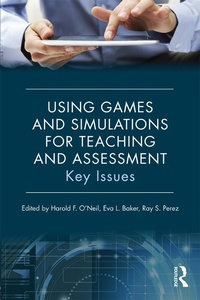
Using Games and Simulations for Teaching and Assessment
Key Issues
Published on 31. March 2016
336 pages
978-1-317-81467-2 (ISBN)
Description

Using Games and Simulations for Teaching and Assessment: Key Issues comprises a multidisciplinary investigation into the issues that arise when using games and simulations for educational purposes. Using both theoretical and empirical analyses, this collection examines cognitive, motivational, and psychometric issues with a focus on STEM content. Unlike other research-based volumes that focus solely on game design or the theoretical basis behind gaming, this book unites previously disparate communities of researchers-from civilian to military contexts as well as multiple disciplines-to critically explore current problems and illustrate how instructionally effective games and simulations should be planned and evaluated.
While computer-based simulations and games have the potential to improve the quality of education and training, Using Games and Simulations for Teaching and Assessment: Key Issues shows how the science of learning should underlie the use of such technologies. Through a wide-ranging yet detailed examination, chapter authors provide suggestions for designing and developing games, simulations, and intelligent tutoring systems that are scientifically-based, outcomes-driven, and cost-conscious.
While computer-based simulations and games have the potential to improve the quality of education and training, Using Games and Simulations for Teaching and Assessment: Key Issues shows how the science of learning should underlie the use of such technologies. Through a wide-ranging yet detailed examination, chapter authors provide suggestions for designing and developing games, simulations, and intelligent tutoring systems that are scientifically-based, outcomes-driven, and cost-conscious.
Reviews / Votes
"This volume comprehensively traverses the exciting but complex issues associated with the use of games and simulations for teaching and assessment. Covering issues related to theory, design, cognition, motivation, validation, psychometrics, and evaluation, it offers an invaluable resource for those needing to understand approaches that will inevitably become centerpieces in the future of education, training, and assessment."--Randy Bennett, Norman O. Frederiksen Chair in Assessment Innovation in the Research & Development Division at Educational Testing Service in Princeton, New Jersey, USA
"What a rich diversity of perspectives on the design, use, and evaluation of games and simulations for teaching and assessment. The book's authors span the worlds of K-12, higher education, medical, and military training and provide a wealth of research-based frameworks, practical examples, and learning sciences applications. Game and simulation designers, intelligent tutor system developers, and curriculum designers and evaluators should find much food for thought!"
--Joan Herman, Co-Director Emeritus of the National Center for Research on Evaluation, Standards, and Student Testing (CRESST) at University of California, Los Angeles, USA
"The editors of this remarkable volume have brought together the perspectives of leading researchers in both K-16 education and workforce training. Although centered on game and simulation applications and technology, the substantial contributions of its authors illustrate how much both communities have to offer each other, as well as the rest of us, in realizing the substantial promise of advanced technologies for learning."
--J D Fletcher, Research Staff Member, Institute for Defense Analyses, USA
More details
Language
English
Place of publication
London
United Kingdom
Publishing group
Taylor & Francis Ltd
Target group
College/higher education
Illustrations
32 s/w Abbildungen, 17 s/w Tabellen
17 Tables, black and white; 32 Illustrations, black and white
File size
5,65 MB
ISBN-13
978-1-317-81467-2 (9781317814672)
Copyright in bibliographic data and cover images is held by Nielsen Book Services Limited or by the publishers or by their respective licensors: all rights reserved.
Schweitzer Classification
Other editions
Additional editions
Harold F. O'Neil | Eva L. Baker | Ray S. Perez
Using Games and Simulations for Teaching and Assessment
Key Issues
Book
04/2016
1st Edition
Routledge
€83.20
Shipment within 15-20 days
Harold F. O'Neil | Eva L. Baker | Ray S. Perez
Using Games and Simulations for Teaching and Assessment
Key Issues
Book
03/2016
1st Edition
Routledge
€242.50
Shipment within 15-20 days
Persons
Harold F. O'Neil is Professor of Education Psychology and Technology at the University of Southern California and Project Director at the National Center for Research on Evaluation, Standards, and Student Testing (CRESST).
Eva L. Baker is Distinguished Research Professor at the Graduate School of Education and Information Studies, University of California, Los Angeles. She is also co-director of CRESST.
Ray S. Perez is Program Officer at the Office of Naval Research (ONR), where he manages a cognitive science of learning research program.
Eva L. Baker is Distinguished Research Professor at the Graduate School of Education and Information Studies, University of California, Los Angeles. She is also co-director of CRESST.
Ray S. Perez is Program Officer at the Office of Naval Research (ONR), where he manages a cognitive science of learning research program.
Content
List of Contributors
Preface by Harold F. O'Neil, Eva L. Baker, and Ray S. Perez
Section 1: Theory/Framework/Context
Chapter 1: A Framework to Create Effective Learning Games and Simulations by Eva L. Baker and Girlie C. Delacruz
Chapter 2: Computational Issues in Modeling User Behavior in Serious Games by Markus R. Iseli and Rajesh Jha
Chapter 3: A Framework for Validating 21st Century Assessment Tools by Roy Stripling, John J. Lee, and Joseph V. Cohn
Chapter 4: Intelligent Tutoring Systems, Serious Games, and the Generalized Intelligent by Arthur C. Graesser, Xiangen Hu, Benjamin D. Nye, and Robert A. Sottilare
Section 2: Assessment
Chapter 5: Using Crowdsourcing as a Formative Evaluation Technique for Game Icons by Ayesha Madni, Gregory K. W. K. Chung, Eva L. Baker, and Noelle C. Griffin
Chapter 6: Lessons Learned From Intelligent Tutoring Research for Simulation by Ray S. Perez, Anna Skinner, and Paul Chatelier
Chapter 7: Measuring Learning in Simulations and Games by Allen Munro
Chapter 8: The Role of Neurobiology in Teaching and Assessing Games by Ray S. Perez, Jason Ralph, and James Niehaus
Section 3: Cognitive/Motivational Issues
Chapter 9: Role of Metacognition in STEM Games and Simulations by Richard E. Mayer
Chapter 10: The Role of Motivation, Affect, and Engagement in Simulation/Game Environments: A Proposed Model by Robert Rueda, Harold F. O'Neil, and Elena Son
Chapter 11: Can Games Facilitate Access to College? By Zoe B. Corwin, Robert W. Danielson, Gisele Ragusa, and William G. Tierney
Section 4: Psychometric Issues
Chapter 12: Inference in Game-Based Assessment by Kristen E. DiCerbo, Robert J. Mislevy, and John T. Behrens
Chapter 13: On the Role of Multilevel Item Response Models in Multisite Evaluation Studies for Serious Games by Li Cai, Kilchan Choi, and Megan Kuhfeld
Index
Preface by Harold F. O'Neil, Eva L. Baker, and Ray S. Perez
Section 1: Theory/Framework/Context
Chapter 1: A Framework to Create Effective Learning Games and Simulations by Eva L. Baker and Girlie C. Delacruz
Chapter 2: Computational Issues in Modeling User Behavior in Serious Games by Markus R. Iseli and Rajesh Jha
Chapter 3: A Framework for Validating 21st Century Assessment Tools by Roy Stripling, John J. Lee, and Joseph V. Cohn
Chapter 4: Intelligent Tutoring Systems, Serious Games, and the Generalized Intelligent by Arthur C. Graesser, Xiangen Hu, Benjamin D. Nye, and Robert A. Sottilare
Section 2: Assessment
Chapter 5: Using Crowdsourcing as a Formative Evaluation Technique for Game Icons by Ayesha Madni, Gregory K. W. K. Chung, Eva L. Baker, and Noelle C. Griffin
Chapter 6: Lessons Learned From Intelligent Tutoring Research for Simulation by Ray S. Perez, Anna Skinner, and Paul Chatelier
Chapter 7: Measuring Learning in Simulations and Games by Allen Munro
Chapter 8: The Role of Neurobiology in Teaching and Assessing Games by Ray S. Perez, Jason Ralph, and James Niehaus
Section 3: Cognitive/Motivational Issues
Chapter 9: Role of Metacognition in STEM Games and Simulations by Richard E. Mayer
Chapter 10: The Role of Motivation, Affect, and Engagement in Simulation/Game Environments: A Proposed Model by Robert Rueda, Harold F. O'Neil, and Elena Son
Chapter 11: Can Games Facilitate Access to College? By Zoe B. Corwin, Robert W. Danielson, Gisele Ragusa, and William G. Tierney
Section 4: Psychometric Issues
Chapter 12: Inference in Game-Based Assessment by Kristen E. DiCerbo, Robert J. Mislevy, and John T. Behrens
Chapter 13: On the Role of Multilevel Item Response Models in Multisite Evaluation Studies for Serious Games by Li Cai, Kilchan Choi, and Megan Kuhfeld
Index
