

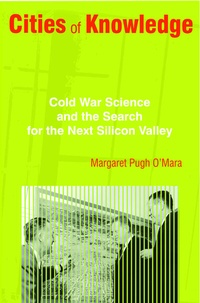
Cities of Knowledge
Cold War Science and the Search for the Next Silicon Valley
1st Edition
Published on 25. September 2015
320 pages
978-1-4008-6688-5 (ISBN)
Description

What is the magic formula for turning a place into a high-tech capital? How can a city or region become a high-tech powerhouse like Silicon Valley? For over half a century, through boom times and bust, business leaders and politicians have tried to become "the next Silicon Valley," but few have succeeded. This book examines why high-tech development became so economically important late in the twentieth century, and why its magic formula of people, jobs, capital, and institutions has been so difficult to replicate. Margaret O'Mara shows that high-tech regions are not simply accidental market creations but "cities of knowledge"--planned communities of scientific production that were shaped and subsidized by the original venture capitalist, the Cold War defense complex.
At the heart of the story is the American research university, an institution enriched by Cold War spending and actively engaged in economic development. The story of the city of knowledge broadens our understanding of postwar urban history and of the relationship between civil society and the state in late twentieth-century America. It leads us to further redefine the American suburb as being much more than formless "sprawl," and shows how it is in fact the ultimate post-industrial city. Understanding this history and geography is essential to planning for the future of the high-tech economy, and this book is must reading for anyone interested in building the next Silicon Valley.
At the heart of the story is the American research university, an institution enriched by Cold War spending and actively engaged in economic development. The story of the city of knowledge broadens our understanding of postwar urban history and of the relationship between civil society and the state in late twentieth-century America. It leads us to further redefine the American suburb as being much more than formless "sprawl," and shows how it is in fact the ultimate post-industrial city. Understanding this history and geography is essential to planning for the future of the high-tech economy, and this book is must reading for anyone interested in building the next Silicon Valley.
All prices
More details
Other editions
Additional editions
Book
06/2015
Princeton University Press
€26.80
Shipment within 10-20 days
Book
10/2004
Princeton University Press
€76.75
Article exhausted; check different version
Person
Margaret Pugh O'Mara teaches history at Stanford University. The dissertation this book is based upon won the Urban History Association's award for Best Dissertation in Urban History completed in 2002.
Content
List of Illustrations and Tables ix
Acknowledgments xi
Introduction Discovering the City of Knowledge 1
PART ONE: INTENT
1. Cold War Politics 17
Frameworks, 1945-1950 18
Policy and Geography, 1950-1965 36
Conclusion 55
2. "Multiversities," Cities, and Suburbs 58
The Scientist in the Garden 60
Economic Development Solutions 75
Conclusion 92
PART TWO: IMPLEMENTATION
3. From the Farm to the Valley: Stanford University and the San Francisco Peninsula 97
A Western Retreat 99
Hot and Cold Wars 103
Land Development 110
A Model City 127
"The Battle of the Hills" 132
Conclusion 139
4. Building" Brainsville": The University of Pennsylvania and Philadelphia 142
Franklin's University and Its City 143
From Computers to Medicine 146
Industrial Decline and Urban Renewal 151
Building University City 158
Scientific Industry Comes to West Philadelphia 166
Controversy and Protest 172
Conclusion 180
5. Selling the New South: Georgia Tech and Atlanta 182
The New Industrial South 185
Postwar Growth and Postwar Power 190
Expansion and Entrepreneurship at Georgia Tech 201
Selling Atlanta in the Space Age 207
Research Parks, Office Parks, and Another Stanford? 216
Conclusion 221
PART THREE LEGACY Conclusion The Next Silicon Valley 225
Notes 235
Index 291
Acknowledgments xi
Introduction Discovering the City of Knowledge 1
PART ONE: INTENT
1. Cold War Politics 17
Frameworks, 1945-1950 18
Policy and Geography, 1950-1965 36
Conclusion 55
2. "Multiversities," Cities, and Suburbs 58
The Scientist in the Garden 60
Economic Development Solutions 75
Conclusion 92
PART TWO: IMPLEMENTATION
3. From the Farm to the Valley: Stanford University and the San Francisco Peninsula 97
A Western Retreat 99
Hot and Cold Wars 103
Land Development 110
A Model City 127
"The Battle of the Hills" 132
Conclusion 139
4. Building" Brainsville": The University of Pennsylvania and Philadelphia 142
Franklin's University and Its City 143
From Computers to Medicine 146
Industrial Decline and Urban Renewal 151
Building University City 158
Scientific Industry Comes to West Philadelphia 166
Controversy and Protest 172
Conclusion 180
5. Selling the New South: Georgia Tech and Atlanta 182
The New Industrial South 185
Postwar Growth and Postwar Power 190
Expansion and Entrepreneurship at Georgia Tech 201
Selling Atlanta in the Space Age 207
Research Parks, Office Parks, and Another Stanford? 216
Conclusion 221
PART THREE LEGACY Conclusion The Next Silicon Valley 225
Notes 235
Index 291

