

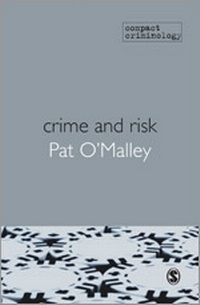
Crime and Risk
1st Edition
Published on 22. April 2010
120 pages
978-0-85702-698-9 (ISBN)
Description

Over recent years, the governance of crime - from policing and crime prevention to sentencing and prison organization - has moved away from a focus on reforming offenders toward preventing crime and managing behaviour using predictive and distributional (such as risk) techniques.
Crime and Risk presents an engaging discussion of risk strategies and risk-taking in the domain of crime and criminal justice. It outlines the broad theoretical issues and political approaches involved, relating risk in contemporary crime governance to risk in criminal activity. Taking a broad and discursive approach, it covers:
Risk-taking and contemporary culture
The excitement associated with risk-taking and the impact of criminal activity
The application of risk-oriented developments in crime prevention and control
The use of genetic and related biotechnologies to assess and react to perceived threats
The conceptualization of risk in relation to race and gender
The influence of excitement upon criminal activity
Evidence and accountability.
?
Compact Criminology is an exciting series that invigorates and challenges the international field of criminology.
Books in the series are short, authoritative, innovative assessments of emerging issues in criminology and criminal justice - offering critical, accessible introductions to important topics. They take a global rather than a narrowly national approach. Eminently readable and first-rate in quality, each book is written by a leading specialist.
Compact Criminology provides a new type of tool for teaching, learning and research, one that is flexible and light on its feet. The series addresses fundamental needs in the growing and increasingly differentiated field of criminology.
Crime and Risk presents an engaging discussion of risk strategies and risk-taking in the domain of crime and criminal justice. It outlines the broad theoretical issues and political approaches involved, relating risk in contemporary crime governance to risk in criminal activity. Taking a broad and discursive approach, it covers:
Risk-taking and contemporary culture
The excitement associated with risk-taking and the impact of criminal activity
The application of risk-oriented developments in crime prevention and control
The use of genetic and related biotechnologies to assess and react to perceived threats
The conceptualization of risk in relation to race and gender
The influence of excitement upon criminal activity
Evidence and accountability.
?
Compact Criminology is an exciting series that invigorates and challenges the international field of criminology.
Books in the series are short, authoritative, innovative assessments of emerging issues in criminology and criminal justice - offering critical, accessible introductions to important topics. They take a global rather than a narrowly national approach. Eminently readable and first-rate in quality, each book is written by a leading specialist.
Compact Criminology provides a new type of tool for teaching, learning and research, one that is flexible and light on its feet. The series addresses fundamental needs in the growing and increasingly differentiated field of criminology.
Reviews / Votes
It is into this muddy conceptual terrain that Pat O'Malley treks, unabashedly pairing 'crime' and 'risk' in the title of his book, and undertaking to untangle their ambiguous meanings and contradictory connections... O'Malley carefully demonstrates, risk and its relation to crime are not self-evident at all; they are defined differently by neo-conservatives and neo-liberals, by risk-takers and those who would govern them, and in turn attributed variously to individual decision making, social dysfunction, or the logic of the market. Once defined in a particular way, risky situations are then policed through particular forms of measurment that produce data sets and statistical predictions, all seeming to confirm that such risk is indeed a real and measurable phenomenon.Jeff Ferrell
Theoretical Criminology
Pat O'Malley has produced an important book... In just four chapters, he offers a critically informed 'tour de force' of the criminological embrace of risk... O'Malley's book has provided a fertile breeding ground for pursuing questions such as these and challenging the powerful presence of the concept of risk within criminology.
Sandra Walklate
Theoretical Criminology
In this remarkably short and readable volume, O'Malley delineates with precision what has been so productive about the largely dystopian pictures of risk-based crime governance, while identifying the complex shades of gray so often overlooked by others, and ultimately points to 'lines of flight'.
Jonathan Simon
Theoretical Criminology
In his well-researched, balanced, and thoroughly engaging book, Crime and Risk, Pat O'Malley takes on some of these big-picture questions about risk as they apply to the nature of modern day (personal and property) crime and crime policy. The starting point for this analysis is the idea that risk is a dynamic, fluid concept, not something that should be simply cast as perpetuating a 'culture of control'.
Brandon C. Welsh
Theoretical Criminology "O'Malley, in this beautifully simple, insightful and erudite book, locates risk within a variety of mentalities that have been, and are being, deployed to "govern crime" -- in doing so he places risk, where it should be, at the very centre of criminological thought and practice. This is an important book." -- Clifford Shearing Pat O'Malley's approach to risk, crime and criminal justice is stimulating and provocative. He points out that in criminology risk is seen almost entirely in negative terms, in marked contrast to other social spheres, where risk is regarded much more positively, as for example in business innovation and entrepreneurship. O'Malley says that risk-taking is an aspect of criminal behaviour that is generally overlooked by criminology, and directs his readers' attention to Katz and to the cultural criminologists who look at risk-taking as a source of excitement for offenders. O'Malley's highly original 'risky criminology' reconnects risk with criminological theory, and challenges those concerned with punishment and crime prevention to develop constructive, imaginative measures and strategies concerned with the reducing harm caused by criminal and anti-social risk-taking behaviour rather than trying to control risk through repression and exclusion. -- Barbara Hudson
More details
Series
Language
English
Place of publication
London
United Kingdom
Target group
College/higher education
Professional and scholarly
ISBN-13
978-0-85702-698-9 (9780857026989)
Copyright in bibliographic data and cover images is held by Nielsen Book Services Limited or by the publishers or by their respective licensors: all rights reserved.
Schweitzer Classification
Other editions
Additional editions
Patrick T. O'Malley
Crime and Risk
Book
04/2010
1st Edition
SAGE Publications Ltd
€172.33
Shipment within 15-20 days
Patrick T. O'Malley
Crime and Risk
Book
04/2010
1st Edition
SAGE Publications Ltd
€68.20
Shipment within 15-20 days
Person
Content
Risk, Crime and Criminal Justice
Risk and Crime Control
Crime, Risk and Excitement
A Risk-taking Criminology
Risk and Crime Control
Crime, Risk and Excitement
A Risk-taking Criminology
