

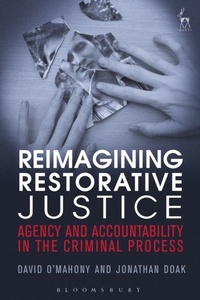
Reimagining Restorative Justice
Agency and Accountability in the Criminal Process
1st Edition
Published on 21. September 2017
240 pages
978-1-5099-0106-7 (ISBN)
Description

"Restorative justice theory has largely failed to keep pace with the rapid expansion of restorative practices worldwide - indeed, it is remarkable how much support RJ has when so few advocates can even define what it is. As such, this insightful and comprehensive new contribution from two of the top scholars on the frontlines of restorative justice research is hugely welcome."
Professor Shadd Maruna, Centre for Criminology and Criminal Justice, University of Manchester
"Reimagining Restorative Justice is a reflective and balanced reconsideration of restorative justice. It deftly sweeps across the large literature on the subject, putting it in perspective, seeing anew through its wide-angle lens. Empowerment and accountability provide a fertile framework for this richly reimagined justice."
Professor John Braithwaite, Australian National University
"David O'Mahony and Jonathan Doak have made a significant contribution to the confusing and over-complicated field of restorative justice theory. They do so through their use of empowerment theory to bring conceptual and operational clarity to the concepts of agency and accountability in restorative processes and outcomes. As a result they develop a convincing argument for face to face dialogue between victim and perpetrator within the core of the criminal justice system. Their emphasis upon ethical and skilful practice is a welcome riposte to the rapid spread of 'restorative justice lite' driven by managerialism and the need to cut costs."
Tim Chapman, Lecturer at the University of Ulster.
"O'Mahony and Doak convincingly argue that rapid developments in the practice of restorative interventions have outstripped restorative justice theory. They provide both an outstandingly helpful review of the literature and a fresh theoretical approach based on empowerment theory. Everyone seriously interested in restorative justice will want to reflect carefully on the authors' conclusions."
Anthony Bottoms, Emeritus Wolfson Professor of Criminology at the University of Cambridge.
In recent years, restorative-based interventions have expanded rapidly and are increasingly viewed as a legitimate, and even superior means of delivering justice. The result of this swift but piecemeal development has been that restorative justice practice has outpaced the development of restorative justice theory. This book takes up this challenge by 'reimagining' a new framework for the operation of restorative justice within criminal justice. In essence, it is contended that the core empowering values of 'agency' and 'accountability' provide a lens for reimagining how restorative justice works and the normative goals it ought to encompass.
Professor Shadd Maruna, Centre for Criminology and Criminal Justice, University of Manchester
"Reimagining Restorative Justice is a reflective and balanced reconsideration of restorative justice. It deftly sweeps across the large literature on the subject, putting it in perspective, seeing anew through its wide-angle lens. Empowerment and accountability provide a fertile framework for this richly reimagined justice."
Professor John Braithwaite, Australian National University
"David O'Mahony and Jonathan Doak have made a significant contribution to the confusing and over-complicated field of restorative justice theory. They do so through their use of empowerment theory to bring conceptual and operational clarity to the concepts of agency and accountability in restorative processes and outcomes. As a result they develop a convincing argument for face to face dialogue between victim and perpetrator within the core of the criminal justice system. Their emphasis upon ethical and skilful practice is a welcome riposte to the rapid spread of 'restorative justice lite' driven by managerialism and the need to cut costs."
Tim Chapman, Lecturer at the University of Ulster.
"O'Mahony and Doak convincingly argue that rapid developments in the practice of restorative interventions have outstripped restorative justice theory. They provide both an outstandingly helpful review of the literature and a fresh theoretical approach based on empowerment theory. Everyone seriously interested in restorative justice will want to reflect carefully on the authors' conclusions."
Anthony Bottoms, Emeritus Wolfson Professor of Criminology at the University of Cambridge.
In recent years, restorative-based interventions have expanded rapidly and are increasingly viewed as a legitimate, and even superior means of delivering justice. The result of this swift but piecemeal development has been that restorative justice practice has outpaced the development of restorative justice theory. This book takes up this challenge by 'reimagining' a new framework for the operation of restorative justice within criminal justice. In essence, it is contended that the core empowering values of 'agency' and 'accountability' provide a lens for reimagining how restorative justice works and the normative goals it ought to encompass.
More details
Edition
1. Auflage
Language
English
Place of publication
London
United Kingdom
Publishing group
Bloomsbury Publishing PLC
Target group
Professional and scholarly
ISBN-13
978-1-5099-0106-7 (9781509901067)
Copyright in bibliographic data and cover images is held by Nielsen Book Services Limited or by the publishers or by their respective licensors: all rights reserved.
Schweitzer Classification
Other editions
Additional editions
David O'Mahony | Jonathan Doak
Reimagining Restorative Justice
Agency and Accountability in the Criminal Process
Book
09/2017
1st Edition
Hart Publishing
€57.19
Shipment within 15-20 days
Persons
Content
1. An Alternative Paradigm of Justice
I. Introduction
II. Trailblazing and Standard-Setting
III. Bridging Theory and Practice
IV. Structure and Argument of this Book
2. Restorative Justice Theory: Concepts, Processes and Outcomes
I. Introduction
II. Criminal Justice: A Paradigm in Crisis?
III. Refining Restorative Justice Theory
IV. Mainstreaming Restorative Justice within Criminal Justice: The Challenge Ahead
V. Conclusions
3. Theorising Restorative Justice in Criminal Justice
I. Introduction
II. Empowerment Theory
III. Conclusions
4. Victims and Offenders: Agency and Accountability in Practice
I. Victims and Restorative Justice
II. Offenders and Restorative Justice
III. Conclusions
5. Restorative Practices at the Periphery of Criminal Justice
I. Introduction
II. Community-based Programmes
III. Restorative Policing
IV. Youth Offender Panels
V. Schemes for Adult Offenders
VI. Prison-based Restorative Programmes
VII. Conclusions
6. Mediation and Restorative Justice in Continental Europe
I. Introduction
II. Background and Context
III. Administration and Referral
IV. Process and Agreement
V. Evaluation
VI. Developing Restorative Justice in Continental Europe
VII. Conclusions
7. Mainstreamed Restorative Justice: Youth Conferencing
I. Introduction
II. The Process of Youth Conferencing
III. Participation in Youth Conferencing
IV. Satisfaction and Procedural Justice
V. Agreement: Restoration and Apology
VI. Conclusions
8. Restorative Justice and Recidivism
I. Introduction
II. Conclusions
9. Reimagining Restorative Justice: Towards Empowerment
I. Introduction
II. Agency and Accountability as Keys to Empowerment
III. From Theory to Practice
IV. Extending the Reach of Restorative Justice
V. Challenges Ahead
VI. Effecting Change
I. Introduction
II. Trailblazing and Standard-Setting
III. Bridging Theory and Practice
IV. Structure and Argument of this Book
2. Restorative Justice Theory: Concepts, Processes and Outcomes
I. Introduction
II. Criminal Justice: A Paradigm in Crisis?
III. Refining Restorative Justice Theory
IV. Mainstreaming Restorative Justice within Criminal Justice: The Challenge Ahead
V. Conclusions
3. Theorising Restorative Justice in Criminal Justice
I. Introduction
II. Empowerment Theory
III. Conclusions
4. Victims and Offenders: Agency and Accountability in Practice
I. Victims and Restorative Justice
II. Offenders and Restorative Justice
III. Conclusions
5. Restorative Practices at the Periphery of Criminal Justice
I. Introduction
II. Community-based Programmes
III. Restorative Policing
IV. Youth Offender Panels
V. Schemes for Adult Offenders
VI. Prison-based Restorative Programmes
VII. Conclusions
6. Mediation and Restorative Justice in Continental Europe
I. Introduction
II. Background and Context
III. Administration and Referral
IV. Process and Agreement
V. Evaluation
VI. Developing Restorative Justice in Continental Europe
VII. Conclusions
7. Mainstreamed Restorative Justice: Youth Conferencing
I. Introduction
II. The Process of Youth Conferencing
III. Participation in Youth Conferencing
IV. Satisfaction and Procedural Justice
V. Agreement: Restoration and Apology
VI. Conclusions
8. Restorative Justice and Recidivism
I. Introduction
II. Conclusions
9. Reimagining Restorative Justice: Towards Empowerment
I. Introduction
II. Agency and Accountability as Keys to Empowerment
III. From Theory to Practice
IV. Extending the Reach of Restorative Justice
V. Challenges Ahead
VI. Effecting Change
