

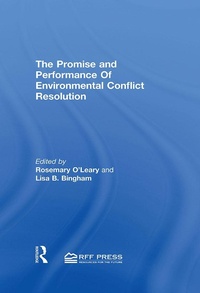
Promise and Performance Of Environmental Conflict Resolution
Published on 1. August 2003
398 pages
978-1-136-52297-0 (ISBN)
Description

Environmental conflict resolution (ECR) is a process of negotiation that allows stakeholders in a dispute to reach a mutually satisfactory agreement on their own terms. The tools of ECR, such as facilitation, mediation, and conflict assessment, suggest that it fits well with other ideas for reforming environmental policy. First used in 1974, ECR has been an official part of policymaking since the mid 1990s. The Promise and Performance of Environmental Conflict Resolution is the first book to systematically evaluate the results of these efforts.
The Promise and Performance of Environmental Conflict Resolution presents empirical research along with insights from some of ECR's most experienced practitioners. Beginning with a primer about concepts and methods, the book describes the kinds of disputes where ECR has been applied, making it clear that 'despite the faith of proponents in the power and usefulness of ECR, it is not applicable to all environmental conflicts.' The contributions that follow critically investigate the record and potential of ECR, drawing on perspectives from political science, public administration, regional planning, philosophy, psychology, anthropology, and law. ECR is being extended to almost every area of environmental policy. Rosemary O'Leary and Lisa Bingham argue that truly effective use of ECR requires something more than advocacy. The Promise and Performance of Environmental Conflict Resolution provides scholars, policymakers, students, and practitioners with critical assessments, so that ECR can be used to its best advantage.
The Promise and Performance of Environmental Conflict Resolution presents empirical research along with insights from some of ECR's most experienced practitioners. Beginning with a primer about concepts and methods, the book describes the kinds of disputes where ECR has been applied, making it clear that 'despite the faith of proponents in the power and usefulness of ECR, it is not applicable to all environmental conflicts.' The contributions that follow critically investigate the record and potential of ECR, drawing on perspectives from political science, public administration, regional planning, philosophy, psychology, anthropology, and law. ECR is being extended to almost every area of environmental policy. Rosemary O'Leary and Lisa Bingham argue that truly effective use of ECR requires something more than advocacy. The Promise and Performance of Environmental Conflict Resolution provides scholars, policymakers, students, and practitioners with critical assessments, so that ECR can be used to its best advantage.
Reviews / Votes
'The editors have a distinguished record of following environmental conflicts, and provide a retrospective on the relative success of unconventional participatory techniques... The editors have provided a much needed reminder that we cannot simply accept consensual approaches as a panacea to resolving conflicts, especially when larger societal goals such as environmental conservation are at stake.'Environmental Conservation
More details
Language
English
Place of publication
London
United Kingdom
Publishing group
Taylor & Francis Ltd
Target group
College/higher education
Product notice
Reflowable
File size
6,19 MB
ISBN-13
978-1-136-52297-0 (9781136522970)
Copyright in bibliographic data and cover images is held by Nielsen Book Services Limited or by the publishers or by their respective licensors: all rights reserved.
Schweitzer Classification
Other editions
Additional editions
Rosemary O'Leary | Lisa Bingham
Promise and Performance Of Environmental Conflict Resolution
Book
08/2003
Resources for the Future Press (RFF Press)
€75.50
Shipment within 3-4 weeks
Rosemary O'Leary | Lisa Bingham
Promise and Performance Of Environmental Conflict Resolution
Book
08/2003
1st Edition
Resources for the Future Press (RFF Press)
€242.90
Shipment within 3-4 weeks
Persons
Rosemary O Leary is professor of Public Administration and director of the Ph.D. program at the Maxwell School of Citizenship and Public Affairs at Syracuse University. O Leary co-founded and co-directed of the Indiana Conflict Resolution Institute.
Lisa B. Bingham is Keller-Runden Professor of Public Service and director of the Indiana Conflict Resolution Institute at the Indiana University School of Public and Environmental Affairs. Professor Bingham co-founded the Indiana Conflict Resolution Institute.
Lisa B. Bingham is Keller-Runden Professor of Public Service and director of the Indiana Conflict Resolution Institute at the Indiana University School of Public and Environmental Affairs. Professor Bingham co-founded the Indiana Conflict Resolution Institute.
Content
Foreword
Gail Bingham
Preface
About the Contributors
Part I
Introduction
1. The Challenges of Environmental Conflict Resolution
Lisa Bingham, Kirk Emerson, Tina Nabatchi, Rosemary O Leary, and John Stephens
2. Whose Reality Counts?
Juliana E. Birkhoff and Kem Lowry
Part II
Upstream Environmental Conflict Resolution
3. Dispute Resolution as a Method of Public Participation
Thomas C. Beierle and Jerry Cayford
4. Is Satisfaction Success? Evaluating Public Participation in Regulatory Policymaking
Cary Coglianese
Part III
Midstream Environmental Conflict Resolution
5. Intractable Conflict
Marcia Caton Campbell
6. Achievement of Relationship Change
Tamra Pearson D Estree
7. Retrospective and Prospective Frame Elicitation
Sanda Kaufman and Barbara Gray
8. Facilitators, Coordinators, and Outcomes
William Leach and Paul Sabatier
Part IV
Downstream Environmental Conflict Resolution at the State and Federal Levels
9. Evaluation of Environmental Dispute Resolution Programs
Andy Rowe
10. An Evaluation System for State and Federal Conflict Resolution Programs: The Policy Consensus Initiative
Kirk Emerson and Chris Carlson
11. State Agency Administrative Mediation: A Florida Trial
Frances Stokes Berry, Bruce Stiftel, and Aysin Dedkorkut
12. Court-Annexed Environmental Mediation: The District of Oregon Pilot Project
Lisa A. Kloppenberg
13. Dispute Resolution at the U.S. Environmental Protection Agency
Rosemary O Leary and Susan Raines
Part V
Downstream Environmental Conflict Resolution and Outcome Measures
14. The Assessment of Environmental Outcomes
Mette Brogden
15. Economic Characteristics of Successful Outcomes
Bonnie Colby
Part VI
Conclusion
16. Fulfilling the Promise of Environmental Conflict Resolution
Lisa Bingham, David Fairman, Dan Fiorino, and Rosemary O Leary
Index
Gail Bingham
Preface
About the Contributors
Part I
Introduction
1. The Challenges of Environmental Conflict Resolution
Lisa Bingham, Kirk Emerson, Tina Nabatchi, Rosemary O Leary, and John Stephens
2. Whose Reality Counts?
Juliana E. Birkhoff and Kem Lowry
Part II
Upstream Environmental Conflict Resolution
3. Dispute Resolution as a Method of Public Participation
Thomas C. Beierle and Jerry Cayford
4. Is Satisfaction Success? Evaluating Public Participation in Regulatory Policymaking
Cary Coglianese
Part III
Midstream Environmental Conflict Resolution
5. Intractable Conflict
Marcia Caton Campbell
6. Achievement of Relationship Change
Tamra Pearson D Estree
7. Retrospective and Prospective Frame Elicitation
Sanda Kaufman and Barbara Gray
8. Facilitators, Coordinators, and Outcomes
William Leach and Paul Sabatier
Part IV
Downstream Environmental Conflict Resolution at the State and Federal Levels
9. Evaluation of Environmental Dispute Resolution Programs
Andy Rowe
10. An Evaluation System for State and Federal Conflict Resolution Programs: The Policy Consensus Initiative
Kirk Emerson and Chris Carlson
11. State Agency Administrative Mediation: A Florida Trial
Frances Stokes Berry, Bruce Stiftel, and Aysin Dedkorkut
12. Court-Annexed Environmental Mediation: The District of Oregon Pilot Project
Lisa A. Kloppenberg
13. Dispute Resolution at the U.S. Environmental Protection Agency
Rosemary O Leary and Susan Raines
Part V
Downstream Environmental Conflict Resolution and Outcome Measures
14. The Assessment of Environmental Outcomes
Mette Brogden
15. Economic Characteristics of Successful Outcomes
Bonnie Colby
Part VI
Conclusion
16. Fulfilling the Promise of Environmental Conflict Resolution
Lisa Bingham, David Fairman, Dan Fiorino, and Rosemary O Leary
Index
