

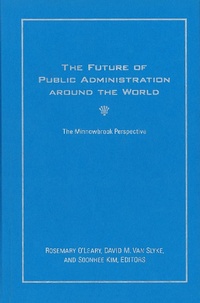
The Future of Public Administration around the World
Description

A once-in-a-generation event held every twenty years, the Minnowbrook conference brings together the top scholars in public administration and public management to reflect on the state of the field and its future. This unique volume brings together a group of distinguished authors-both seasoned and new-for a rare critical examination of the field of public administration yesterday, today, and tomorrow.
The book begins by examining the ideas of previous Minnowbrook conferences, such as relevance and change, which are reflective of the 1960s and 1980s. It then moves beyond old Minnowbrook concepts to focus on public administration challenges of the future: globalism, twenty-first century collaborative governance, the role of information technology in governance, deliberative democracy and public participation, the organization of the future, and teaching the next generation of leaders. The book ends by coming full circle to examine the current challenge of remaining relevant. There is no other book like this-nor is there ever likely to be another-in print. Simply put, the ideas, concepts, and spirit of Minnowbrook are one-of-a-kind. This book captures the soul of public administration past, present, and future, and is a must-read for anyone serious about the theory and practice of public administration.
More details
Other editions
Additional editions
Persons
Rosemary O'Leary is Distinguished Professor of Public Administration and Howard G. and Louise S. Phanstiel Chair in Strategic Management and Leadership at Syracuse University.
David M. Van Slyke is an associate professor of public administration at the Maxwell School of Citizenship and Public Affairs at Syracuse University.
Soonhee Kim is an associate professor of public administration at the Maxwell School of Citizenship and Public Affairs at Syracuse University.
Content
Preface
Introduction: The Legacy of Minnowbrook
Soonhee Kim, Rosemary O'Leary, David Van Slyke, H. George Frederickson, and W. Henry Lambright
Part I. Studying and Managing Public Organizations of the Future
From Performance Management to Democratic Performance Governance
Donald P. Moynihan
An Argument for Fully Incorporating Nonmission-Based Values into Public Administration
Suzanne J. Piotrowski
Are We There Yet? From Taylor's Triangle to Follett's Web; From Knowledge Work to Emotion Work
Mary E. Guy, Meredith A. Newman, and Sharon H. Mastracci
The Raised Fist and the Magic Negro: Public Administration and the Black Public Administrator
Domonic Bearfield
Social Equity in Public Administration: The Need for Fire
Susan T. Gooden
. . . And the Pendulum Swings: A Call for Evidence-Based Public Organizations
Kimberley R. Isett
Public Administration: The Central Discipline in Homeland Security
Dale Jones and Austen Givens
Part II. Globalization
The Study of Comparative Public Administration: Future Trajectories and Prospects
Bidhya Bowornwathana
Reinventing Public Administration for the Twenty-First Century: Toward a More Global and Generic Paradigm
Yilin Hou
A Personal Memo from a Woman Teaching Public Administration in Asia
Ora-Orn Poocharoen
Part III. Collaboration
Collaborative Leadership and Local Governance
Soonhee Kim
The ?New Emergency Management?: Applying the Lessons of Collaborative Governance to Twenty-First-Century Emergency Planning
Michael McGuire, Jeffrey L. Brudney, and Beth Gazley
Collaborative Governance and Cross-Boundary Information Sharing: Envisioning a Networked and IT-Enabled Public Administration
Theresa A. Pardo, J. Ramon Gil-Garcia, and Luis F. Luna-Reyes
Collaborative Governance and Climate Change: Opportunities for Public Administration
Kirk Emerson and Peter Murchie
Part IV. Deliberative Democracy and Public Participation
Why Public Administration Should Take Deliberative Democracy Seriously
Tina Nabatchi
When Should the Public be Involved in Public Management? Design Principles with Case Applications
John Clayton Thomas
The Use of Social Media to Dissolve Knowledge Silos in Government
Ines Mergel
Part V. Teaching the Next Generation of Leaders
Rebranding Public Administration for a Postsector Age
Scott E. Robinson
Can the Study and Practice of Public Service Ethics Be Recovered in a New Governance Era?
Guy B. Adams and Danny L. Balfour
The Status of The Law in Contemporary Public Administrative Literature, Education, and Practice
David H. Rosenbloom and Katherine C. Naff
Adding Value in a World of Diffuse Power: Reintroducing Public Management and Public Financial Management
Justin Marlowe and Daniel L. Smith
Teaching Democracy in Public Administration: Trends and Future Prospects
Matt Leighninger
Part VI. Remaining Relevant
Making Public Administration Scholarship Matter
David M. Van Slyke
The Challenge of Remaining Relevant
Kristina Lambright
Has Public Administration "Repositioned" Itself?: Advances and Inertias in Transitioning to the Collaborative Governance Paradigm
Kelly LeRoux
Public Administration and Management Research: Evidence of Isolation and Unrealized Opportunity
Bradley E. Wright
Improving Collaboration Research by Emphasizing the Role of the Public Manager
Beth Gazley
Conclusion: Challenges and Opportunities, Crosscutting Themes, and Thoughts on the Future of Public Administration
David M. Van Slyke, Rosemary O'Leary and Soonhee Kim
List of Contributors
Index
