

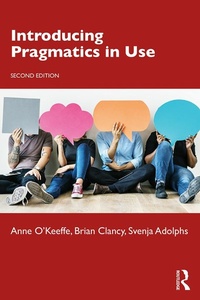
Introducing Pragmatics in Use
2nd Edition
Published on 8. October 2019
276 pages
978-1-000-69096-5 (ISBN)
Description

Introducing Pragmatics in Use is a lively and accessible introduction to pragmatics which both covers theory and applies it to real spoken and written data. This textbook systematically draws on a number of different language corpora and the corresponding software applications. Its primary focus is the application of a corpus methodology in order to examine core component areas such as deixis, politeness, speech acts, language variation and register. The main goal of the book is to contextualise pragmatics in the study of language through the analysis of different language contexts provided by spoken and written corpora.
Substantially revised and updated, this second edition covers a wider range of topics, corpora and software packages. It consistently demonstrates the benefits of innovative analytical synergies and extends this to how corpus pragmatics can be further blended with, for example, conversation analysis or variational pragmatics. The second edition also offers a new chapter specifically dedicated to corpus pragmatics which proposes a framework for both form-to-function and function-to-form approaches. The book also addresses the - sometimes thorny - area of the integration of the teaching of pragmatics into the language classroom. All chapters in the second edition include a number of cohesive, step-by-step tasks that can be done in small groups in class or can be used as self-study resources.
A wide range of illustrative language samples drawn from a number of English language corpora, coupled with instructive tasks and annotated further reading sections, make this an ideal textbook for advanced undergraduate or postgraduate students of pragmatics, discourse analysis and corpus linguistics within applied languages / linguistics or TESOL programmes.
Substantially revised and updated, this second edition covers a wider range of topics, corpora and software packages. It consistently demonstrates the benefits of innovative analytical synergies and extends this to how corpus pragmatics can be further blended with, for example, conversation analysis or variational pragmatics. The second edition also offers a new chapter specifically dedicated to corpus pragmatics which proposes a framework for both form-to-function and function-to-form approaches. The book also addresses the - sometimes thorny - area of the integration of the teaching of pragmatics into the language classroom. All chapters in the second edition include a number of cohesive, step-by-step tasks that can be done in small groups in class or can be used as self-study resources.
A wide range of illustrative language samples drawn from a number of English language corpora, coupled with instructive tasks and annotated further reading sections, make this an ideal textbook for advanced undergraduate or postgraduate students of pragmatics, discourse analysis and corpus linguistics within applied languages / linguistics or TESOL programmes.
Reviews / Votes
"Preserving the clear, well-paced writing of the first edition, this new edition has been thoroughly revised, updated and expanded. New material, notably in the areas of corpus pragmatics and variational pragmatics, reflects not only hot areas in pragmatics but the world-leading expertise of the authors".Jonathan Culpeper, Lancaster University, UK
"It has long been argued that pragmatics should be an empirical discipline. The second edition of this textbook fulfils that promise. The authors systematically draw on real-life examples from language corpora to illustrate complex theoretical concepts in a clear and accessible manner. In so doing they lay a solid foundation for students of pragmatics to further advance the field."
Michael Haugh, The University of Queensland, Australia
"This book represents an important contribution to the introductory literature on pragmatics. It is a reference for learners, teachers and researchers. The real data that prevail throughout the chapters make the book an interactive one that perfectly suits learners and teachers alike. In addition, the wide range of topics examined and the tasks included in each chapter provide insights for researchers."
Journal of Pragmatics 158 (2020), Sharif Alghazo
More details
Edition
2nd edition
Language
English
Place of publication
London
United Kingdom
Publishing group
Taylor & Francis Ltd
Target group
College/higher education
Product notice
Reflowable
Illustrations
59 Tables, black and white; 1 Illustrations, color; 106 Illustrations, black and white
ISBN-13
978-1-000-69096-5 (9781000690965)
Copyright in bibliographic data and cover images is held by Nielsen Book Services Limited or by the publishers or by their respective licensors: all rights reserved.
Schweitzer Classification
Other editions
Additional editions
Anne O'Keeffe | Brian Clancy | Svenja Adolphs
Introducing Pragmatics in Use
Book
10/2019
2nd Edition
Routledge
€176.30
Shipment within 10-20 days
Anne O'Keeffe | Brian Clancy | Svenja Adolphs
Introducing Pragmatics in Use
Book
10/2019
2nd Edition
Routledge
€51.40
Shipment within 10-20 days
Persons
Anne O'Keeffe is Senior Lecturer in Applied Linguistics, Department of English Language and Literature, Mary Immaculate College, University of Limerick, Ireland.
Brian Clancy is Lecturer in Academic Writing and Research Methods, Academic Learning Centre, and Lecturer in Applied Linguistics, Department of English Language and Literature, Mary Immaculate College, University of Limerick, Ireland.
Svenja Adolphs is Professor of English Language and Linguistics and Head of School at the School of English, University of Nottingham, UK.
Brian Clancy is Lecturer in Academic Writing and Research Methods, Academic Learning Centre, and Lecturer in Applied Linguistics, Department of English Language and Literature, Mary Immaculate College, University of Limerick, Ireland.
Svenja Adolphs is Professor of English Language and Linguistics and Head of School at the School of English, University of Nottingham, UK.
Content
List of Figures
List of Tables
Acknowledgements
Chapter 1 Introduction
Chapter 2 Researching Pragmatics
Chapter 3 Corpus Pragmatics
Chapter 4 Reference
Chapter 5 Politeness
Chapter 6 Speech Acts
Chapter 7 Pragmatics and Language Variation
Chapter 8 Pragmatics and Variation at the Level of Register
Chapter 9 Pragmatics and Language Teaching
Appendix 1
References
Index
List of Tables
Acknowledgements
Chapter 1 Introduction
Chapter 2 Researching Pragmatics
Chapter 3 Corpus Pragmatics
Chapter 4 Reference
Chapter 5 Politeness
Chapter 6 Speech Acts
Chapter 7 Pragmatics and Language Variation
Chapter 8 Pragmatics and Variation at the Level of Register
Chapter 9 Pragmatics and Language Teaching
Appendix 1
References
Index
