

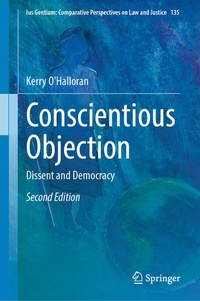
Conscientious Objection
Description

This book traces, assesses and compares the history of conscientious objection - in the cultural context of eight developed democratic nations - from refusal of military service and a range of similar moral dilemmas, to objecting to abortion, to vaccination hesitancy and contemporary warfare.
It considers the impact of this form of dissent in relation to social movements, social activists and whistle blowers. It reflects on the relationships between the sacred and the secular, the state and the citizen, in order to better understand the responsibilities of citizenship in our increasingly secular societies. It analyses what defines the conscientiousness of an objection from both legal and ethical standpoints. It explores the increased reliance on "grounds of religion, belief or conscience" as providing justification for excusing some citizens from complying with certain responsibilities - mandated by equality and non-discrimination legislation - that are binding for all others.
By conducting a comparative evaluation of national law and judicial rulings on a fixed agenda of issues, this book identifies key jurisdictional differences concerning conscientious objection. In so doing, it highlights the importance of cultural context and constructs a jurisdiction-specific overview of legislation, policies and case law. By tracking policy developments and highlighting crucial judicial rulings - particularly in the US - it provides insights into the probable future direction of developments in national law relating to conscientious objection.
Lastly, the book draws attention to some of the potential consequences of manifesting dissent by opting out of performing public services: the possible local breakdown of specific service availability (e.g. abortion); prompting population movements as established democratic civil rights are locally negated; fragmenting society into a geographic patchwork of regions in which some citizens are branded as conservative/reactionary and others as progressive. Conscientious objections carry profound implications for a coherent democratic society.
More details
Other editions
Additional editions
Person
Kerry O'Halloran , a professionally qualified lawyer and social worker, has been an academic at several UK universities and most recently was Adjunct Professor at QUT in Brisbane (2004-2018). Author of some 200 publications, including 41 books such as Charity Law & Social Inclusion (Routledge, 2006,) Religious Discrimination and Cultural Context (CUP, 2018) and Conscientious Objection: Dissent and Democracy in a Common Law Context (Springer, 2022), he has served on government bodies and advised on government law reform programs.
Content
Part I Citizen and State.- 1 Conscience and Conscientiousness: Principles, Concepts and Parameters.- 2 Dissent & Democracy: Objecting Conscientiously in Civil Law and Common Law Countries.- Part II Conscientious Objection and Contemporary International Law.- 3 The International Legal Framework for Conscientious Objection and Themes for Comparative Jurisdictional Analysis.- Part III Jurisdictional Survey.- 4 England and Wales.- 5 Ireland.- 6 United States of America.- 7 Canada.- 8 Australia.- 9 New Zealand.- 10 Israel.- 11 France.- Part IV Equality, Exemption and Democracy.- 12 Themes of Jurisdictional Commonality and Difference.- 13 A Democratic Society: Equality, Exemption & Dissent.- 14 Conclusion.
