

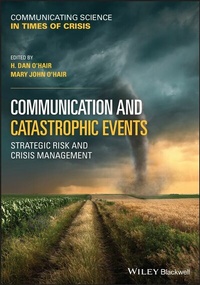
Communication and Catastrophic Events
Description

An authoritative compendium of new research findings and case studies in the application of communication theory during catastrophic events
Communicating Science in Times of Crisis: Communication and Catastrophic Events addresses the practical application and research implications of communication theory in the context of man-made and natural catastrophes. Bringing together contributions by leading experts in crisis management and strategic communication, this timely collection of resources links scientific issues with public policy while discussing the challenges and opportunities for using communication to manage extreme events in the evolving media landscape of the 21st century.
In this second volume of the Wiley-Blackwell Communicating Science in Times of Crises series, 15 substantial chapters explore a varied range of catastrophic conditions, such as mass violence incidents, disease outbreaks, catastrophic mudslides, cascading and simultaneous disasters, extreme weather events, diffusion of misinformation during crises, students traveling internationally during a global health crisis, and more. Each chapter focuses on a particular issue or concern, revealing the difficult choices that confront academics and practitioners across communication disciplines and presenting original frameworks and models alongside ongoing research programs.
- Discusses approaches for balancing scientific findings with social and cultural issues
- Highlights the ability of legacy and digital media to facilitate science in mitigating the effects of adverse events
- Examines the ethical repercussions of communication during unfolding and unpredictable events
- Addresses the use of social media communication during a crisis and navigating an increasingly media-savvy society with multiple levels of science literacy
- Covers key theoretical and practical aspects of the associated fields of risk management and crisis management
Available as a standalone book or as part of a two-volume set, Communicating Science in Times of Crisis: Communication and Catastrophic Events is essential reading for scholars, researchers, practitioners, and advanced students in the fields of crisis communication, risk and emergency management, disaster studies, policy management, social media communication, and healthcare communication.
More details
Other editions
Additional editions
Persons
H. DAN O'HAIR is Professor of Communication at the University of Kentucky. He is a past editor of the Journal of Applied Communication Research and has served as an associate editor for more than three dozen scholarly journals. Dr. O'Hair has authored and co-authored over 100 research articles and scholarly book chapters in the fields of communication, risk sciences, applied communication research, health, medicine, and business.
MARY JOHN O'HAIR is Professor of Educational Leadership Studies at the University of Kentucky. Dr. O'Hair served as Dean of the UK College of Education and as Vice-Provost and K20 Center Director at the University of Oklahoma. She was the founding editor of Teacher Education Yearbook and has served as co-editor and associate editor for multiple publications in communication and education disciplines.
Content
1 Addressing Catastrophes Through Communication Science 1 H. Dan O'Hair and Mary John O'Hair
2 Where is it Safe? Questioning Education Policy, Safety, and Choices for Students Traveling Internationally During a Global Health Crisis 11
Ellie Holliday, Jason Hope, and Amanda U. Potterton
3 Addressing the Role of Prior Experience in the Development of Risk Perceptions, Information Seeking and Processing Behaviors During Natural Disasters 29
Laura M. Fischer, Cara Lawson, and Taylor K. Ruth
4 Enhancing Catastrophic Event Preparedness and Response: The Inoculation Approach 49
Bobi Ivanov, , Lindsay L. Dillingham, Erin B. Hester, and Kimberly A. Parker
5 Communication Strategies to Initiate and Sustain Catastrophe Compassion 65
Erin B. Hester, Bobi Ivanov, Kimberly A. Parker, and Mehroz Sajjad
6 Social Marketing Strategy: Enhancing Preparedness for Catastrophic Events 84
Kimberly A. Parker, Sarah A. Geegan, Erin B. Hester, and Bobi Ivanov
7 Building Risk Communication Infrastructure by Bolstering Emergency Managers' Formal and Informal Communication Networks 103
Bradley A. Trefz, David H. Bierling, Andrew Christjoy, and Joshua B. Barbour
8 Individual Disaster Communication Following Catastrophic Mass Violence: The Case of the Pulse Nightclub Shooting 120
Matthew L. Spialek and J. Brian Houston
9 Social Media Misinformation about Extreme Weather Events and Climate Change: Structures, Communication Processes, and Individual Factors that Influence the Diffusion of Misinformation 137
Kevin B. Wright
10 "The Princeton Outbreak": A Case Study of a University Health Crisis and Implications for Communicating Science 155
Judy F. Jarvis, Ralph A. Gigiotti, and John Kolligian
11 Blue or Stormy Skies?: The Roles of Strategic Risk Communication in Protecting Communities Before, During, and After Severe Weather 174
Anita Atwell Seate, Brooke Fisher Liu, Ji Youn Kim, Xin Ma, Saymin Lee, and Daniel Hawblitzel
12 Risk and Crisis Communication: Considering Catastrophic Mudslides in Uganda's Bududa District 191
Angella Napakol, Anne Neville Miller, Timothy L. Sellnow, Deanna D. Sellnow, Ann Mugunga, and Johnny Khaukha
13 Risk, Science, and Health Collaborations during Cascading and Simultaneous Disasters 206
Rebecca M. Rice and Megan E. Cullinan
14 Communicating Inclusively and Reliably about Climatological and Meteorological Events: Social Network Analysis, Message Framing, and Communication Competence 219
William T. Howe and Maria Shpeer
15 How Government Leaders Use Social Media During Disasters. A Scoping Review 239
Lauren B. Cain Index 255
