

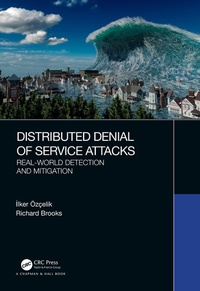
Distributed Denial of Service Attacks
Real-world Detection and Mitigation
1st Edition
Published on 3. August 2020
422 pages
978-1-351-81764-6 (ISBN)
Description

Distributed Denial of Service (DDoS) attacks have become more destructive, wide-spread and harder to control over time. This book allows students to understand how these attacks are constructed, the security flaws they leverage, why they are effective, how they can be detected, and how they can be mitigated. Students use software defined networking (SDN) technology to created and execute controlled DDoS experiments. They learn how to deploy networks, analyze network performance, and create resilient systems.
This book is used for graduate level computer engineering instruction at Clemson University. It augments the traditional graduate computing curricula by integrating: Internet deployment, network security, ethics, contemporary social issues, and engineering principles into a laboratory based course of instruction. Unique features of this book include:
A history of DDoS attacks that includes attacker motivations
Discussion of cyber-war, censorship, and Internet black-outs
SDN based DDoS laboratory assignments
Up-to-date review of current DDoS attack techniques and tools
Review of the current laws that globally relate to DDoS
Abuse of DNS, NTP, BGP and other parts of the global Internet infrastructure to attack networks
Mathematics of Internet traffic measurement
Game theory for DDoS resilience
Construction of content distribution systems that absorb DDoS attacks
This book assumes familiarity with computing, Internet design, appropriate background in mathematics, and some programming skills. It provides analysis and reference material for networking engineers and researchers. By increasing student knowledge in security, and networking; it adds breadth and depth to advanced computing curricula.
This book is used for graduate level computer engineering instruction at Clemson University. It augments the traditional graduate computing curricula by integrating: Internet deployment, network security, ethics, contemporary social issues, and engineering principles into a laboratory based course of instruction. Unique features of this book include:
A history of DDoS attacks that includes attacker motivations
Discussion of cyber-war, censorship, and Internet black-outs
SDN based DDoS laboratory assignments
Up-to-date review of current DDoS attack techniques and tools
Review of the current laws that globally relate to DDoS
Abuse of DNS, NTP, BGP and other parts of the global Internet infrastructure to attack networks
Mathematics of Internet traffic measurement
Game theory for DDoS resilience
Construction of content distribution systems that absorb DDoS attacks
This book assumes familiarity with computing, Internet design, appropriate background in mathematics, and some programming skills. It provides analysis and reference material for networking engineers and researchers. By increasing student knowledge in security, and networking; it adds breadth and depth to advanced computing curricula.
More details
Edition
1. Auflage
Language
English
Place of publication
London
United Kingdom
Publishing group
Taylor & Francis Ltd
Target group
Professional and scholarly
Product notice
Reflowable
Illustrations
23 Tables, black and white; 192 Illustrations, black and white
ISBN-13
978-1-351-81764-6 (9781351817646)
Copyright in bibliographic data and cover images is held by Nielsen Book Services Limited or by the publishers or by their respective licensors: all rights reserved.
Schweitzer Classification
Other editions
Additional editions
Ilker OEzcelik | Richard Brooks
Distributed Denial of Service Attacks
Real-world Detection and Mitigation
Book
08/2020
1st Edition
CRC Press
€92.00
Shipment within 10-20 days
Ilker OEzcelik | Richard Brooks
Distributed Denial of Service Attacks
Real-world Detection and Mitigation
Book
08/2020
1st Edition
Chapman & Hall/CRC
€185.00
Shipment within 15-20 days
Persons
Dr. Ilker OEzcelik's background includes both researching network security and teaching University classes in the electrical engineering program. He has organized many cyber security awareness workshops and has given speeches to attendees from both government agencies and private industries in Turkey. He also served as a member of the Cyber Security Working Group at Council of Higher Education in Turkey and Information and Cyber Security National Science and Advisory Board at Information Security Association of Turkey.
Dr. OEzcelik has a B.S. in Electronics and Communication Education from Marmara University, M.S. in Electrical Engineering from the Syracuse University, and Ph.D. from Electrical Engineering in the Holcombe Department of Electrical and Computer Engineering, Clemson University.
He worked as an Assistant Professor with the Department of Electrical and Electronics Engineering of Recep Tayyip Erdogan University for three years. He is currently an Assistant Professor and Department Chair of Information Systems Engineering at Recep Tayyip
Erdogan University.
Dr. Brooks' background includes managing computer networks that span continents, performing sponsored research, and teaching university classes. His research has been sponsored by both government and industry, including:
The Office of Naval Research (ONR),
The Air Force Office of Scientific Research (AFOSR),
The National Institute of Standards and Technology (NIST),
The National Science Foundation (NSF),
The Army Research Office (ARO),
The United States Department of State,
The Defense Advanced Research Projects Agency (DARPA), and
BMW Manufacturing Corporation.
He has a B.A. in Mathematical Sciences from The Johns Hopkins University Whiting School of Engineering, and a Ph.D. in Computer Science from The Louisiana State University. He has worked in the United States, France, Germany, Africa, Eastern Europe and the Former Soviet Union. His consulting clients include the World Bank and French stock exchange authority. Dr. Brooks was head of the Distributed Systems Department of The Pennsylvania State University Applied Research Laboratory (PSU/ARL) for seven years. He has been an Associate Professor with the Holcombe Department of Electrical and Computer Engineering of Clemson University since 2004.
Dr. OEzcelik has a B.S. in Electronics and Communication Education from Marmara University, M.S. in Electrical Engineering from the Syracuse University, and Ph.D. from Electrical Engineering in the Holcombe Department of Electrical and Computer Engineering, Clemson University.
He worked as an Assistant Professor with the Department of Electrical and Electronics Engineering of Recep Tayyip Erdogan University for three years. He is currently an Assistant Professor and Department Chair of Information Systems Engineering at Recep Tayyip
Erdogan University.
Dr. Brooks' background includes managing computer networks that span continents, performing sponsored research, and teaching university classes. His research has been sponsored by both government and industry, including:
The Office of Naval Research (ONR),
The Air Force Office of Scientific Research (AFOSR),
The National Institute of Standards and Technology (NIST),
The National Science Foundation (NSF),
The Army Research Office (ARO),
The United States Department of State,
The Defense Advanced Research Projects Agency (DARPA), and
BMW Manufacturing Corporation.
He has a B.A. in Mathematical Sciences from The Johns Hopkins University Whiting School of Engineering, and a Ph.D. in Computer Science from The Louisiana State University. He has worked in the United States, France, Germany, Africa, Eastern Europe and the Former Soviet Union. His consulting clients include the World Bank and French stock exchange authority. Dr. Brooks was head of the Distributed Systems Department of The Pennsylvania State University Applied Research Laboratory (PSU/ARL) for seven years. He has been an Associate Professor with the Holcombe Department of Electrical and Computer Engineering of Clemson University since 2004.
Content
Table of Contents
List of Figures
List of Tables
Foreword
About the Authors
Acknowledgements
Preface
Contributors
Introduction
What is DDoS?
History and Motivation
Legal Considerations
DDoS Research: Traffic
DDoS Research: Testing
DDoS Research: Evaluation
Attack Detection
Deceiving DDoS Detection
Detecting DDoS Attack Traffic
Attack Mitigation
Security and DDoS in SDN: Opportunities and Challenges
Denial of Service Attack in Control Systems
Denial of Service Attack on Phasor Measurement Unit
DDoS Lab
Conclusion
Appendix
Bibliography
Index
List of Figures
List of Tables
Foreword
About the Authors
Acknowledgements
Preface
Contributors
Introduction
What is DDoS?
History and Motivation
Legal Considerations
DDoS Research: Traffic
DDoS Research: Testing
DDoS Research: Evaluation
Attack Detection
Deceiving DDoS Detection
Detecting DDoS Attack Traffic
Attack Mitigation
Security and DDoS in SDN: Opportunities and Challenges
Denial of Service Attack in Control Systems
Denial of Service Attack on Phasor Measurement Unit
DDoS Lab
Conclusion
Appendix
Bibliography
Index
