

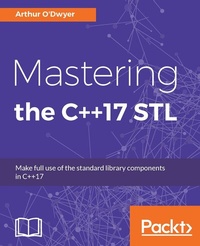
Mastering the C++17 STL
Make full use of the standard library components in C++17
Published on 8. July 2025
384 pages
978-1-78728-823-2 (ISBN)
Description

No detailed description available for "Mastering the C++17 STL".
More details
Edition
Digital original
Language
English
Place of publication
Birmingham
United Kingdom
Target group
Professional and scholarly
US School Grade: College Graduate Student
Edition type
Digital original
File size
2,12 MB
ISBN-13
978-1-78728-823-2 (9781787288232)
Copyright in bibliographic data and cover images is held by Nielsen Book Services Limited or by the publishers or by their respective licensors: all rights reserved.
Schweitzer Classification
Other editions
Additional editions
Book
09/2017
Packt Publishing
€56.80
Shipment within 3-4 weeks
Person
O'Dwyer Arthur :
Arthur O'Dwyer has used modern C++ in his day job for about ten years--since the days when "modern C++" meant "classic C++." Between 2006 and 2011 he worked on the Green Hills C++ compiler. Since 2014 he has organized a weekly C++ meetup in the San Francisco Bay Area, and he speaks regularly on topics such as those to be found in this book. Later this year, he will attend an ISO C++ committee meeting for the second time. This is his first book.
Arthur O'Dwyer has used modern C++ in his day job for about ten years--since the days when "modern C++" meant "classic C++." Between 2006 and 2011 he worked on the Green Hills C++ compiler. Since 2014 he has organized a weekly C++ meetup in the San Francisco Bay Area, and he speaks regularly on topics such as those to be found in this book. Later this year, he will attend an ISO C++ committee meeting for the second time. This is his first book.
Content
- Cover
- Copyright
- Credits
- About the Author
- About the Reviewer
- www.PacktPub.com
- Customer Feedback
- Table of Contents
- Preface
- Chapter 1: Classical Polymorphism and Generic Programming
- Concrete monomorphic functions
- Classically polymorphic functions
- Generic programming with templates
- Summary
- Chapter 2: Iterators and Ranges
- The problem with integer indices
- On beyond pointers
- Const iterators
- A pair of iterators defines a range
- Iterator categories
- Input and output iterators
- Putting it all together
- The deprecated std::iterator
- Summary
- Chapter 3: The Iterator-Pair Algorithms
- A note about headers
- Read-only range algorithms
- Shunting data with std::copy
- Variations on a theme - std::move and std::move_iterator
- Complicated copying with std::transform
- Write-only range algorithms
- Algorithms that affect object lifetime
- Our first permutative algorithm: std::sort
- Swapping, reversing, and partitioning
- Rotation and permutation
- Heaps and heapsort
- Merges and mergesort
- Searching and inserting in a sorted array with std::lower_bound
- Deleting from a sorted array with std::remove_if
- Summary
- Chapter 4: The Container Zoo
- The notion of ownership
- The simplest container: std::array&T, N&
- The workhorse: std::vector&T&
- Resizing a std::vector
- Inserting and erasing in a std::vector
- Pitfalls with vector&bool&
- Pitfalls with non-noexcept move constructors
- The speedy hybrid: std::deque&T&
- A particular set of skills: std::list&T&
- What are the special skills of std::list?
- Roughing it with std::forward_list&T&
- Abstracting with std::stack&T& and std::queue&T&
- The useful adaptor: std::priority_queue&T&
- The trees: std::set&T& and std::map&K, V&
- A note about transparent comparators
- Oddballs: std::multiset&T& and std::multimap&K, V&
- The hashes: std::unordered_set&T& and std::unordered_map&K, V&
- Load factor and bucket lists
- Where does the memory come from?
- Summary
- Chapter 5: Vocabulary Types
- The story of std::string
- Tagging reference types with reference_wrapper
- C++11 and algebraic types
- Working with std::tuple
- Manipulating tuple values
- A note about named classes
- Expressing alternatives with std::variant
- Visiting variants
- What about make_variant? and a note on value semantics
- Delaying initialization with std::optional
- Revisiting variant
- Infinite alternatives with std::any
- std::any versus polymorphic class types
- Type erasure in a nutshell
- std::any and copyability
- Again with the type erasure: std::function
- std::function, copyability, and allocation
- Summary
- Chapter 6: Smart Pointers
- The origins of smart pointers
- Smart pointers never forget
- Automatically managing memory with std::unique_ptr&T&
- Why C++ doesn't have the finally keyword
- Customizing the deletion callback
- Managing arrays with std::unique_ptr&T[]&
- Reference counting with std::shared_ptr&T&
- Don't double-manage!
- Holding nullable handles with weak_ptr
- Talking about oneself with std::enable_shared_from_this
- The Curiously Recurring Template Pattern
- A final warning
- Denoting un-special-ness with observer_ptr&T&
- Summary
- Chapter 7: Concurrency
- The problem with volatile
- Using std::atomic&T& for thread-safe accesses
- Doing complicated operations atomically
- Big atomics
- Taking turns with std::mutex
- Taking locks" the right way
- Always associate a mutex with its controlled data
- Special-purpose mutex types
- Upgrading a read-write lock
- Downgrading a read-write lock
- Waiting for a condition
- Promises about futures
- Packaging up tasks for later
- The future of futures
- Speaking of threads...
- Identifying individual threads and the current thread
- Thread exhaustion and std::async
- Building your own thread pool
- Improving our thread pool's performance
- Summary
- Chapter 8: Allocators
- An allocator is a handle to a memory resource
- Refresher - Interfaces versus concepts
- Defining a heap with memory_resource
- Using the standard memory resources
- Allocating from a pool resource
- The 500 hats of the standard allocator
- Carrying metadata with fancy pointers
- Sticking a container to a single memory resource
- Using the standard allocator types
- Setting the default memory resource
- Making a container allocator-aware
- Propagating downwards with scoped_allocator_adaptor
- Propagating different allocators
- Summary
- Chapter 9: Iostreams
- The trouble with I/O in C++
- Buffering versus formatting
- Using the POSIX API
- Using the standard C API
- Buffering in the standard C API
- Formatting with printf and snprintf
- The classical iostreams hierarchy
- Streaming and manipulators
- Streaming and wrappers
- Solving the sticky-manipulator problem
- Formatting with ostringstream
- A note on locales
- Converting numbers to strings
- Converting strings to numbers
- Reading a line or word at a time
- Summary
- Chapter 10: Regular Expressions
- What are regular expressions?
- A note on backslash-escaping
- Reifying regular expressions into std::regex objects
- Matching and searching
- Pulling submatches out of a match
- Converting submatches to data values
- Iterating over multiple matches
- Using regular expressions for string replacement
- A primer on the ECMAScript regex grammar
- Non-consuming constructs
- Obscure ECMAScript features and pitfalls
- Summary
- Chapter 11: Random Numbers
- Random numbers versus pseudo-random numbers
- The problem with rand()
- Solving problems with &random&
- Dealing with generators
- Truly random bits with std::random_device
- Pseudo-random bits with std::mt19937
- Filtering generator outputs with adaptors
- Dealing with distributions
- Rolling dice with uniform_int_distribution
- Generating populations with normal_distribution
- Making weighted choices with discrete_distribution
- Shuffling cards with std::shuffle
- Summary
- Chapter 12: Filesystem
- A note about namespaces
- A very long note on error-reporting
- Using &system_error&
- Error codes and error conditions
- Throwing errors with std::system_error
- Filesystems and paths
- Representing paths in C++
- Operations on paths
- Statting files with directory_entry
- Walking directories with directory_iterator
- Recursive directory walking
- Modifying the filesystem
- Reporting disk usage
- Summary
- Index
