

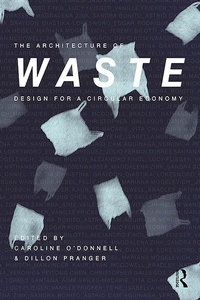
The Architecture of Waste
Design for a Circular Economy
1st Edition
Published on 16. November 2020
306 pages
978-1-000-19182-0 (ISBN)
Description

Global material crises are imminent. In the very near future, recycling will no longer be a choice made by those concerned about the environment, but a necessity for all. This means a paradigm shift in domestic behavior, manufacturing, construction, and design is inevitable. The Architecture of Waste provides a hopeful outlook through examining current recycling practices, rethinking initial manufacturing techniques, and proposing design solutions for second lives of material-objects.
The book touches on a variety of inescapable issues beyond our global waste crisis including cultural psyches, politics, economics, manufacturing, marketing, and material science. A series of crucial perspectives from experts cover these topics and frames the research by providing a past, present, and future look at how we got here and where we go next: the historical, the material, and the design. Twelve design proposals look beyond the simple application of recycled and waste materials in architecture-an admirable endeavor but one that does not engage the urgent reality of a circular economy-by aiming to transform familiar, yet flawed, material-objects into closed-loop resources.
Complete with over 150 color images and written for both professionals and students, The Architecture of Waste is a necessary reference for rethinking the traditional role of the architect and challenging the discipline to address urgent material issues within the larger design process.
The book touches on a variety of inescapable issues beyond our global waste crisis including cultural psyches, politics, economics, manufacturing, marketing, and material science. A series of crucial perspectives from experts cover these topics and frames the research by providing a past, present, and future look at how we got here and where we go next: the historical, the material, and the design. Twelve design proposals look beyond the simple application of recycled and waste materials in architecture-an admirable endeavor but one that does not engage the urgent reality of a circular economy-by aiming to transform familiar, yet flawed, material-objects into closed-loop resources.
Complete with over 150 color images and written for both professionals and students, The Architecture of Waste is a necessary reference for rethinking the traditional role of the architect and challenging the discipline to address urgent material issues within the larger design process.
More details
Edition
1. Auflage
Language
English
Place of publication
London
United Kingdom
Publishing group
Taylor & Francis Ltd
Target group
College/higher education
Professional and scholarly
Product notice
Reflowable
Illustrations
56 Line drawings, color; 115 Halftones, color
ISBN-13
978-1-000-19182-0 (9781000191820)
Copyright in bibliographic data and cover images is held by Nielsen Book Services Limited or by the publishers or by their respective licensors: all rights reserved.
Schweitzer Classification
Other editions
Additional editions
Book
11/2020
1st Edition
Routledge
€45.00
Shipment within 15-20 days
Book
11/2020
1st Edition
Routledge
€179.81
Shipment within 15-20 days
Persons
Caroline O'Donnell is an Irish architect, educator, and writer. She is principal of CODA, winner of the MoMA PS1 Young Architects Program with Party Wall which was built at PS1 in 2013. CODA's work focuses on responsive, dynamic architectures, the misuse of materials, and the manipulation of perceptions. O'Donnell is Associate Professor, Edgar A. Tafel Professor of Architecture and director of the M.Arch program at Cornell University and has previously taught at The Cooper Union and Harvard GSD. She has a B.Arch. from Manchester University, England (2000) with a specialization in Bioclimatics and an M.Arch. from Princeton University (2004). She was editor-in-chief of the Cornell Journal of Architecture from 2009-2017, and co-founder of Pidgin magazine. Her book Niche Tactics: Generative Relationships between Architecture and Site was published with Routledge in 2016. This book describes a design agenda that looks toward natural and local resources to produce meaningful architecture.
Dillon Pranger is a licensed architect, fabricator, and academic. His current research involves unconventional building materials and construction techniques. These explorations have been realized through his involvement with various pavilion installations including the 2017 MoMA PS1 Young Architects Program installation, Lumen by Jenny Sabin Studio, the 2018 MoMA PS1 Young Architects Program installation, Hide and Seek by Dream the Combine, and Primitive Hut by OMG! His personal works have been featured in Cornell University's John Hartell Gallery, Association vol. 8, PLAT Journal, Residential Design vol. 2, and Architect Magazine, among others. Pranger has taught at institutions including, Harvard GSD, Cornell University, and Syracuse University. He holds a B.S. in Architecture from the University of Cincinnati (2012) and an M.Arch. from Cornell University (2015).
Dillon Pranger is a licensed architect, fabricator, and academic. His current research involves unconventional building materials and construction techniques. These explorations have been realized through his involvement with various pavilion installations including the 2017 MoMA PS1 Young Architects Program installation, Lumen by Jenny Sabin Studio, the 2018 MoMA PS1 Young Architects Program installation, Hide and Seek by Dream the Combine, and Primitive Hut by OMG! His personal works have been featured in Cornell University's John Hartell Gallery, Association vol. 8, PLAT Journal, Residential Design vol. 2, and Architect Magazine, among others. Pranger has taught at institutions including, Harvard GSD, Cornell University, and Syracuse University. He holds a B.S. in Architecture from the University of Cincinnati (2012) and an M.Arch. from Cornell University (2015).
Content
Introduction 1. Global Circularity 2. Waste of Space 3. Case Studies 4. New Deconstruction: The Rebirth of a Circular Architecture 5. Economics for a Circular Environment 6. World of Waste
