

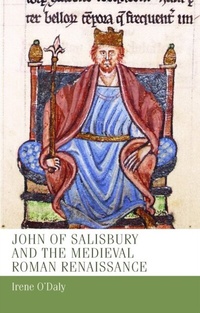
John of Salisbury and the Medieval Roman Renaissance
1st Edition
Published on 7. February 2018
256 pages
978-1-5261-0952-1 (ISBN)
Description

This book is a detailed but accessible treatment of the political thought of John of Salisbury, a twelfth-century author and educationalist who rose from a modest background to become Bishop of Chartres. It shows how aspects of John's thought - such as his views on political cooperation and virtuous rulership - were inspired by the writings of Roman philosophers, notably Cicero and Seneca. Investigating how John accessed and adapted the classics, the book argues that he developed a hybrid political philosophy by taking elements from Roman Stoic sources and combining them with insights from patristic writings. By situating his ideas in their political and intellectual context, it offers a reassessment of John's political thought, as well as a case study in classical reception of relevance to students and scholars of political philosophy and the history of ideas. -- .
Reviews / Votes
'O'Daly (Huygens Institute for the History of the Netherlands) offers a contextualized history of the political thought of John of Salisbury. She argues that he used ancient sources often filtered through Christian intermediaries to create unique ideas about political ethics, duty, and community. John was heavily influenced by ancient stoics, whose ideas he usually encountered through patristic writers, medieval compilations, and classical authors such as Cicero and Seneca. O'Daly uses methodologies developed by the Cambridge School of Intellectual History to reconstruct the most likely specific texts to which John had access. After a chapter exploring John's source material, the book turns to unpacking the key characteristics of John's thought. In chapters 2, 3, and 4, O'Daly shows how John combined Roman stoic thought with Christianity to create a rational conception of political duty that extended through entire communities. In the final two chapters, the book shows the application of these ideas to conceptions of just rule and practical examples through which John lived and on which he commented. This thoughtful study will interest specialists of medieval thought and politics.'B. J. Maxson, East Tennessee State University, Choice
Summing Up: Recommended. Advanced undergraduates and above
'The case made for John of Salisbury's Stoic influences is forceful throughout, and she makes a strong case that that topic has been understudied...It adds richly to the conversation on this important writer in general; going further, scholars concerned with the broader subjects of classical reception and the place of Cicero and Seneca in medieval intellectual history will appreciate its learned content.'
John Hosler (Command and General Staff College), H-Net November 2018
'students and scholars in other specialties will find in this book a clear and helpful introduction to John's ethical and political thought, and also to the diffusion of Roman ideas in the twelfth century. Not only that, but experienced scholars will be provoked to rethink assumptions about how received traditions subtly worked their way through medieval schools, manuscripts, and minds.'
The Medieval Review -- .
All prices
More details
Series
Language
English
Place of publication
United Kingdom
Target group
College/higher education
Professional and scholarly
ISBN-13
978-1-5261-0952-1 (9781526109521)
Copyright in bibliographic data and cover images is held by Nielsen Book Services Limited or by the publishers or by their respective licensors: all rights reserved.
Schweitzer Classification
Other editions
Additional editions
Irene O'Daly
John of Salisbury and the Medieval Roman Renaissance
Book
01/2018
Manchester University Press
€125.00
Shipment within 15-20 days
Person
Irene O'Daly is a Researcher at Huygens ING (De Koninklijke Nederlandse Akademie van Wetenschappen), Amsterdam -- .
Content
Introduction
1 The Roman inheritance
2 Nature and reason
3 Defining duties: The cooperative model of the polity
4 Political relationships in context: The body politic
5 Moderation and the virtuous life
6 The princely head
Conclusion
Index -- .
1 The Roman inheritance
2 Nature and reason
3 Defining duties: The cooperative model of the polity
4 Political relationships in context: The body politic
5 Moderation and the virtuous life
6 The princely head
Conclusion
Index -- .

