

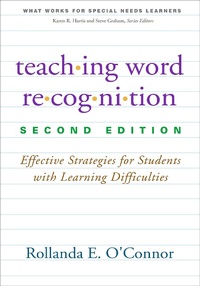
Teaching Word Recognition
Effective Strategies for Students with Learning Difficulties
2nd Edition
Published on 7. July 2014
206 pages
978-1-4625-1633-9 (ISBN)
Description

Classroom teachers and special educators in K-12; reading specialists, coaches, and speech-language professionals; teacher educators and graduate students. May serve as a supplemental text in such courses as Word Study, Early Literacy Instruction, Elementary Reading Methods, and Special Education Methods.
More details
Other editions
Additional editions
Rollanda E. O'Connor
Teaching Word Recognition, Second Edition
Effective Strategies for Students with Learning Difficulties
Book
08/2014
2nd Edition
Guilford Press
€37.00
Shipment within 15-20 days
Person
Rollanda E. O'Connor, PhD, is Professor and Eady/Hendrick Endowed Chair in Learning Disabilities in the Graduate School of Education at the University of California, Riverside. She taught reading in special and general education classrooms for many years. Dr. O'Connor has conducted numerous reading intervention studies in general and special education settings, examined procedures to predict the students most likely to develop reading disabilities, and followed the reading progress of students who have received early intervention. Her longitudinal studies of intervention and assessment led to the development of Ladders to Literacy, a collection of phonological and print awareness activities and scaffolding suggestions for children at risk for reading problems, and the Handbook of Reading Interventions,which describes evidence-based interventions for struggling readers in grades PreK-12. Her current research includes exploring the effects of early, continuous intervention across the first 4 years of reading development and developing research-based interventions for students with reading difficulties in the intermediate and middle school grades.
Content
Introduction
1. In the Beginning: Oral Language and Learning to Read Words
2. Phonemic Awareness
3. The Alphabetic Principle
4. Beginning to Decode
5. Word Patterns
6. Developing Sight Words
7. Reading Multisyllabic Words
8. Using Morphology to Read Words
9. Reading Words Fluently
10. Teaching Students Who Are English Learners
11. Older Students with Reading Difficulties
Appendix A. Resources
Appendix B. Reproducible Forms and Checklists
References
Index
1. In the Beginning: Oral Language and Learning to Read Words
2. Phonemic Awareness
3. The Alphabetic Principle
4. Beginning to Decode
5. Word Patterns
6. Developing Sight Words
7. Reading Multisyllabic Words
8. Using Morphology to Read Words
9. Reading Words Fluently
10. Teaching Students Who Are English Learners
11. Older Students with Reading Difficulties
Appendix A. Resources
Appendix B. Reproducible Forms and Checklists
References
Index
