

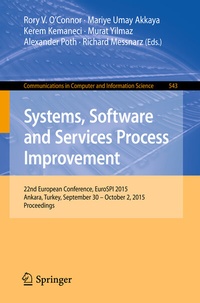
Systems, Software and Services Process Improvement
22nd European Conference, EuroSPI 2015, Ankara, Turkey, September 30 -- October 2, 2015. Proceedings
Published on 15. October 2015
XV, 337 pages
978-3-319-24647-5 (ISBN)
Description

This volume constitutes the refereed proceedings of the 22st EuroSPI conference, held in Ankara, Turkey, in September/October 2015.The 18 revised papers presented together with 9 selected key notes and workshop papers were carefully reviewed and selected from 49 submissions. They are organized in topical sections on SPI themed case studies; SPI approaches in safety-critical domains; SPI in social and organizational issues; software process improvement best practices; models and optimization approaches in SPI; SPI and process assessment; creating environments supporting innovation and improvement; social aspects of SPI: conflicts, games, gamification and other social approaches; risk management and functional safety management.
More details
Series
Edition
1st ed. 2015
Language
English
Place of publication
Cham
Switzerland
Publishing group
Springer International Publishing
Target group
Professional and scholarly
Illustrations
XV, 337 p. 82 illus.
File size
17,02 MB
ISBN-13
978-3-319-24647-5 (9783319246475)
DOI
10.1007/978-3-319-24647-5
Schweitzer Classification
Other editions
Additional editions
Rory V. O'Connor | Mariye Umay Akkaya | Kerem Kemaneci
Systems, Software and Services Process Improvement
22nd European Conference, EuroSPI 2015, Ankara, Turkey, September 30 -- October 2, 2015. Proceedings
Book
09/2015
Springer
€53.49
Shipment within 10-15 days
Content
- Intro
- Preface
- Recommended Further Reading
- Organization
- Contents
- SPI Themed Case Studies
- Towards an Understanding of Game Software Development Processes: A Case Study
- 1 Introduction
- 1.1 Software Development Processes in Game Development
- 2 Case Study Research Approach
- 2.1 Case Study Company
- 2.2 Data Collection
- 2.3 Data Analysis
- 3 Case Study Findings
- 3.1 The Theoretical Framework
- 4 Discussion
- 4.1 Future Work
- References
- A Case Study on Improvement of Incident Investigation Process
- 1 Introduction
- 1.1 Related Research
- 1.2 Our Contribution
- 2 Research Methods
- 2.1 Case Organization and Data Collection Methods
- 3 Results
- 4 Conclusions d and Future Work
- References
- An Industrial Experience in Cross Domain Assurance Projects
- 1 Introduction
- 2 Background
- 3 Use case
- 3.1 Business Case
- 3.2 Our Approach
- 4 Results
- 5 Conclusions and Future Work
- References
- SPI Approaches in Safety-Critical Domains
- A Lean Automotive E/E-System Design Approach with Open Toolbox Access
- 1 Introduction
- 2 Related Work
- 3 Approach
- 3.1 Domain-Specific Modeling Language
- 3.2 Traceability Between the Design and Other Artifacts
- 3.3 Open Toolbox Approach at the DSM
- 4 Application
- 5 Conclusions
- References
- Integration of Heterogeneous Tools to a Seamless Automotive Toolchain
- 1 Introduction
- 2 Related Works
- 2.1 Publications Related to Model-Based Development
- 2.2 Publications Related to Safety-Critical Development
- 3 Architectural Design Refinement Approach
- 3.1 SW Modeling Framework Addon
- 3.2 HW Modeling Framework Addon
- 3.3 Software Architecture Toolbridge
- 3.4 Runtime Environment Generator
- 3.5 Basic Software Configuration Generator
- 3.6 OS Configuration Generator
- 4 Prototypical Implementation and Application of the Proposed Approach
- 5 Conclusion
- References
- A Tool Suite for Assurance Cases and Evidences: Avionics Experiences
- 1 Introduction
- 2 Related Work
- 3 Conceptual Platform
- 4 Avionics Experi ience
- 5 Benefits from Using this Platform
- 6 Future work and Conclusions
- References
- SPI in Social and Organizational Issues
- A Machine-Based Personality Oriented Team Recommender for Software Development Organizations
- 1 Introduction
- 2 Background
- 2.1 Neural Networks
- 2.2 Machine Learning in Personality Assessment Literature
- 3 Method
- 4 Results
- 4.1 Limitations
- 5 Conclusions and Future Work
- References
- An ISO Compliant and Integrated Model for IT GRC (Governance, Risk Management and Compliance)
- 1 Introduction
- 2 Related Work
- 3 Overview of the ISO Standards for IT Governance, (IT) Risk Management and (IT) Compliance
- 3.1 IT Governance
- 3.2 IT Risk Management
- 3.3 IT Compliance
- 4 An ISO Compliant IT GRC Model
- 4.1 Common Activities Between Compliance Management and Risk Management
- 4.2 Governance Aspects of Compliance and Risk Management
- 5 Conclusion and Future Work
- References
- Changing Situational Contexts Present a Constant Challenge to Software Developers
- 1 Introduction
- 2 Study Details
- 2.1 Research Method
- 2.2 Situational Factors Survey Instrument
- 2.3 Study Timeframe and Participants
- 3 Data Analysis
- 3.1 Situational Factors Reporting Change
- 3.2 Situational Factors Reporting Little or No Change
- 4 Discussion
- 5 Conclusion
- References
- Software Process Improvement Best Practices
- Protocol to Design Techniques for Implementing Software Development Best Practices
- 1 Introduction
- 2 Overview
- 2.1 Process Improvement
- 2.2 Best Practices for Software Development
- 2.3 Techniques
- 3 Protocol for Creation of Techniques to Implementation of Best Practices
- 3.1 Protocol Phases
- 3.2 Protocol Description
- 4 Case Study
- 5 Conclusions
- References
- Gamiware: A Gamification Platform for Software Process Improvement
- 1 Introduction
- 2 Gamiware: The Underlying Process
- 3 Gamiware: Motivation
- 4 Gamiware: Game Elements
- 5 Gamiware: Roles
- 5.1 Admin Role
- 5.2 Gamification Master Role
- 5.3 User Role
- 6 Gamiware: A Pilot Study
- 6.1 The Study
- 6.2 Results
- 6.3 Discussion
- 7 Conclusions and Future Work
- References
- Providing a Starting Point to Help SMEs in the Implementation of Software Process Improvements
- 1 Introduction
- 2 Framework Background
- 3 Framework
- 3.1 Software Process Improvement Patterns
- 3.2 Selection Method
- 3.3 Software Tool
- 4 Framework Validation
- 5 Conclusions
- References
- Models and Optimization Approaches in SPI
- Optimizing Resource Utilization by Combining Activities Across Process Instances
- 1 Introduction
- 2 The Combined-Instance Approach
- 2.1 Business Processes with Data Objects and Constraints
- 2.2 Identifying Candidates for Process Instance Combinations
- 2.3 Determining the Optimization Potential
- 2.4 Combining Business Process Instances
- 3 Related Work
- 4 Discussion and Case Study
- 5 Conclusion
- References
- A Maturity Model for ISO/IEC 20000-1 Based on the TIPA for ITIL Process Capability Assessment Model
- Introduction
- Terminology
- process reference model
- process assessment model
- maturity model
- Related Work
- The ITIL-Based Maturity Model for ISO/IEC 20000
- 4.1 Main Design Choices
- 4.2 Maturity Level 1:
- 4.3 Maturity Level 2:
- 4.4 Maturity Level 3:
- Table 3.
- 4.5 Maturity Level 4:
- 4.6 Maturity Level 5:
- Discussions
- 5.1 Appropriate PAMs as Input?
- 5.2 Structure of the Maturity Model
- 5.3 Coverage of ISO/IEC 20000-1 Requirements
- 5.4 Rules for Deriving the Maturity Levels
- Conclusion
- References
- Applying Text Analyses and Data Mining to Support Process Oriented Multimodel Approaches
- 1 Introduction and Target Definition
- 2 State of Art and Related Literature
- 3 Approaches and Techniques
- 3.1 Natural Language Processing (NLP)
- 3.2 Data Mining Combined with Machine Learning
- 4 Results
- 4.1 Comparing Different Weighting Methods
- 4.2 Comparing Different Similarity and Distance Metrics
- 4.3 Single Words versus Multi Words as Input for Data Mining
- 4.4 Summary of Results
- 5 Conclusions and Next Steps
- 5.1 Conclusions
- 5.2 Next Steps
- References
- SPI and Process Assessment
- The Project Management SPICE (PMSPICE) Process Reference Model: Towards a Process Assessment Model
- 1 Introduction
- 2 The Project Management SPICE (PMSPICE) Framework
- 3 ISO Requirements for Process Reference Model Design and Associated Constraints
- 4 Development of the PMSPICE PRM
- 4.1 The TIPA Transformation Process
- 4.2 Application of the TIPA Transformation Process
- 4.3 Result: The PMSPICE PRM
- 5 Discussion
- 6 Conclusions and Future Work
- References
- Blending Process Assessment and Employees Competencies Assessment in Very Small Entities
- 1 Introduction
- 2 Background and Related Work
- 2.1 Standard Background
- 2.2 Related Work
- 3 Process Assessment Model
- 3.1 A Process Reference Model for VSEs
- 3.2 A Process Assessment Model for VSEs
- 4 Competency Assessment Model
- 4.1 Overview
- 4.2 Reference Models
- 4.3 Using the e-CF for ISO/IEC 29110
- 4.4 Performing a Proficiency Level Assessment
- 4.5 A Case Study
- 5 Perspectives and Conclusion
- References
- Extending SPICE for Safety Focused Systems Engineering Process Assessment
- 1 Introduction
- 2 Engineering Ap proach for Systems and Safety
- 3 Process Assessments in Safety-Critical Domains
- 3.1 Generic Assessment Requirements
- 3.2 Nuclear SPICE Assessment Model
- 3.3 Assessment Models in Other Domains
- 4 Stakeholder Requirements for a Process Assessment Model in Nuclear Domain
- 4.1 The Current Approach
- 4.2 Coverage of Regulatory Requirements
- 5 Nuclear SPICE Extended Use Cases
- 6 Conclusions
- References
- Creating Environments Supporting Innovation and Improvement
- The 10 Must Haves for Global Innovation and Networking. A New Strategic Approach
- 1 Introduction
- 2 Joy and Playfulness: Drivers of Innovation
- 3 Gratitude: Treat your Customers and Stakeholders Well
- 4 Serenity: Embrace Diversity and Change
- 5 Interest: A Conditio Sine Qua Non
- 6 Hope: There is a also Post-Traumatic Growth
- 7 Pride: Share your Success Story with your Community
- 8 Amusement: Share Laughter, Knowledge and Ideas
- 9 Inspiration: Cre eate the Urge to Excel
- 10 Awe: Be Part of the Bigger Picture and the Greater Good
- 11 Love: Love It or Leave It
- 12 Conclusions
- 13 Outlook: Future Innovation and Diversity Manager Certifications
- References
- Achieving Sustainable Development by Integrating It into the Business Process Management System
- 1 Introduction
- 2 Business Process Management and Sustainability
- 2.1 Similar Work from BPM and Sustainability Field
- 2.2 Sustainable Business Process Management
- 3 Integrating Sustainability into an Organization
- 3.1 How to Achieve Sustainability of an Enterprise?
- 3.2 Implementing Sustainability Aspects: At a Corporate Level
- 3.3 Implementing Sustainability Aspects: Process Landscape Level
- 3.4 Implementing Sustainability Aspects: Process and Operations Level
- 3.5 Implementing Sustainability Aspects into BPM System: A Summary
- 4 Conclusion
- References
- ECQA Governance Capability Assessor Skills for Managing Strategic Directions
- 1 Strengthening Business Trust and Transparency
- 2 Enterprise Goals Driven Integrated Risk and Assurance Management Scenarios
- 3 Implementing th he Managing Strategic Directions Scenario
- 4 Applying Governance Capability Assessor Skills to Integrate ECQA Knowledge Elements for Global Innovation and Networking
- References
- Innovation and Project Management in International Distributed Teams. A Description of an Current Project Work
- 1 Introduction
- 2 Theoretic Approach
- 3 Practical Work
- 4 Results, Lessons s Learned and Next Steps
- References
- Social Aspects of SPI: Conflicts, Games, Gamification and Other Social Approaches
- Process Improvement with Retrospective Gaming in Agile Software Development
- 1 Introduction
- 2 Agile Software Development with Scrum
- 2.1 Scrum Roles
- 2.2 Scrum Activities and Artefacts
- 3 Software Process Improvement in Scrum
- 4 Games for Software Process Improvement in Scrum
- 5 Conclusions and Future Work
- References
- Relating ICT Competencies with Personality Types
- 1 Introduction
- 2 Background and Related Work
- 2.1 Background
- 2.2 Related Work
- 3 Competencies and Profiles
- 3.1 Reference Models
- 3.2 A Case Study
- 4 Aggregation of Results
- 5 Conclusion
- References
- Designing Games for Improving the Software Development Process
- 1 Introduction
- 2 Background
- 3 Summary and Discussion
- References
- Risk Management and Functional Safety Management
- Controllability in ISO 26262 and Driver Model
- 1 Introduction
- 2 A DESH-G Model
- 3 HARA Process
- 4 The Approach of Hazard Identification
- 4.1 Goal Model
- 4.2 Item Sketch
- 4.3 Situation-Scenario Matrix (SSM)
- 4.4 Hazard Identification
- 5 Driver Model and Evasion from the Harm
- 5.1 Structure of Driver's Goal
- 5.2 Driver Model
- 5.3 Task Demand
- 5.4 D-Zone and Steps for Classifying the Controllability
- 6 Conclusion
- Reference
- KTM Functional Safety Environment - Break Silos, Ensure Full Traceability, Modularity and Automate Reporting
- 1 Introduction
- 1.1 Central Repository for Traceability, Workflows, Configuration and Change Management
- 1.2 Model Based Engineering
- 1.3 Joint Activities Management
- 1.4 Automatic Reporting
- 1.5 Modularity and Reuse
- 2 ISO26262 Coverage
- 3 Solution
- 3.1 Matlab Simulink(1) and Plugin Hip-Hops(2)
- 3.2 Cognition Cockpit
- References
- Author Index
