

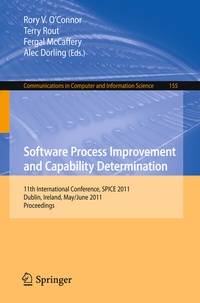
Software Process Improvement and Capability Determination
11th International Conference, SPICE 2011, Dublin, Ireland, May 30 - June 1, 2011. Proceedings
Published on 15. June 2011
XIII, 247 pages
978-3-642-21233-8 (ISBN)
Description

This book constitutes the refereed proceedings of the 11th International Conference on Software Process Improvement and Capability Determination, SPICE 2011, held in Dublin, Ireland, in May/June 2011.
The 15 revised full papers presented and 15 short papers were carefully reviewed and selected from numerous submissions. The papers are organized in topical sections on process modelling and assessment, safety and security, medi SPICE, high maturity, implementation and improvement.
More details
Series
Language
English
Place of publication
Berlin
Germany
Publishing group
Springer Berlin
Target group
Professional and scholarly
Illustrations
XIII, 247 p. 67 illus., 46 illus. in color.
File size
6,82 MB
ISBN-13
978-3-642-21233-8 (9783642212338)
DOI
10.1007/978-3-642-21233-8
Schweitzer Classification
Other editions
Additional editions
Rory O'Connor | Terry Rout | Fergal McCaffery
Software Process Improvement and Capability Determination
11th International Conference, SPICE 2011, Dublin, Ireland, May 30 - June 1, 2011. Proceedings
Book
05/2011
1st Edition
Springer
€53.49
Shipment within 7-9 days
Content
- Title
- Preface
- Organization
- Table of Contents
- Process Modelling and Assessment
- Using Composition Trees to Model and Compare Software Process
- Introduction
- Software Process Models
- Composition Trees
- Using the Composition Tree Approach to Model Process
- The Algorithm to Compare Two CTs
- Case Study
- Conclusions
- References
- A Modeling View of Process Improvement
- Introduction
- Model, Metamodel, Modeling and Chain of Models
- Process as a Model and Types of Process Models
- A Process Modeling View of Process Improvement
- CMMI, SPICE and Modeling View of Process Improvement
- Towards a Modeling Driven Process Improvement
- Conclusion
- References
- An Approach to Evaluating Software Process Adaptation
- Introduction
- Dynamic Capability
- Extent of SPI Activity
- Evaluating SPI Activity Using a Dedicated Survey Instrument
- Extent of Situational Change
- Evaluating Situational Change Using a Dedicated Survey Instrument
- Future Work - Dynamic SPI Capability
- Discussion and Conclusion
- References
- Evaluation of Software Process Assessment Methods - Case Study
- Introduction
- The MARES Assessment Method
- Evaluation Procedure
- Evaluation Results
- Strengths
- Weaknesses
- Conclusions and Future Works
- References
- Safety and Security
- Functional Safety Extensions to Automotive SPICE According to ISO 26262
- Introduction
- Related Work
- ISO 26262
- Automotive SPICE
- +SAFE
- ISO/IEC 15504-10 - Safety Extension
- Functional Safety Assessments in the Automotive Industry
- Swedish Standardization for Functional Safety Process Extensions
- Functional Safety Process Assessment Strategy
- Assessment Framework
- Selection of Assessment Framework
- Assessment Model
- Identification of Extensions
- Functional Safety Extensions to Automotive SPICE and ISO/IEC 15504
- Examples of Extensions and Safety Practices
- Implementation
- Conclusion and Further Work
- References
- An ISO/IEC 15504 Security Extension
- Introduction
- ISO/IEC 27002 Security Controls Covered by ISO/IEC 15504
- ISO/IEC 15504-5 Adaptation to Satisfy ISO/IEC 27002 Controls
- Using ISO/IEC 15504-5 Base Practices to Satisfy Security Controls
- Extending ISO/IEC 15504-5 Base Practices
- Adding a New Base Practice
- Adapting the Purpose of an ISO/IEC 15504 Process
- ISO/IEC 15504 Security Extension
- Conclusion and Further Work
- References
- Medi SPICE
- Verification & Validation in Medi SPICE
- Introduction
- V&V in Generic Software Development
- V&V for Safety-Critical Software Development
- Research Approach and Outcomes
- Regulatory Nature of the Medical Device Domain
- V&V in Medi SPICE
- Summary of V&V Related Processes in Medi SPICE
- Conclusions and Future Work
- References
- Medical Device Software Development - A Perspective from a Lean Manufacturing Plant
- Introduction
- Software for the Medical Device Industry
- Lean Software Development
- Research Approach
- The Company
- Research Findings
- Regulations
- Business Focus
- Discussion
- Leaning the Software Development Process
- Conclusion and Future Work
- References
- Standalone Software as an Active Medical Device
- Introduction
- Medical Device Directive (2007/47/EC)
- Classification Rules
- Software Process Improvement & IEC 62304:2006
- Software Process Improvement
- IEC 62304:2006 Medical Device Software - Software Lifecycle
- Problems with Existing Conformance Standards
- Resolving the Problems
- Conclusions
- References
- High Maturity
- Assessment of Software Process and Metrics to Support Quantitative Understanding: Experience from an Undefined Task Management Process
- Introduction
- The Assessment Method
- The Implementation
- Conclusions
- References
- Methodical Enhancement of Maturity Level: "SPICE" and "SixSigma" Intertwine
- At First a Short Mind Game
- Problem
- Problem Solver
- Approach
- Level 1
- Level 2
- Level 3
- Level 4
- Level 5
- Benefits
- Risks
- Conclusion
- References
- Implementation and Improvement
- Organizational Support for Process Improvement - Results of an International Survey
- Introduction
- Designing the Survey Questionnaire Based on ISO/IEC 33014
- Research Goals
- Data Collection and Description of the Sample
- Data Analyses
- Conclusions
- References
- Towards a Systemic Maturity Model for Public Software Ecosystems
- Introduction
- Motivation and Context
- Objectives, Methodology and Process
- The Path towards a Systemic Maturity Model
- Brazilian Public Software
- Reference Model for Brazilian Public Software
- First Attempts towards a Maturity Model: Leaning Cycles
- Systemic Map for Brazilian Public Software
- From Systemic Map to a Systemic Maturity Model
- Generalizing from BPS to Public Software Ecosystems
- The Proposed Systemic Maturity Model
- Initial Validation
- Conclusions
- References
- Linking Software Life Cycle Activities with Product Strategy and Economics: Extending ISO/IEC 12207 with Product Management Best Practices
- Introduction
- Products and Product Management
- Goals and Approach
- Analyzed Frameworks
- Identification of Key Product Management Activities
- Key Product Management Activities vs. ISO/IEC 12207
- Initial Observations
- Comparison Approach and Results
- Summary and Conclusions
- References
- Applying ISO/IEC 12207:2008 with SCRUM and Agile Methods
- Introduction
- Related Work
- ISO/IEC 12207 Processes Related with SCRUM
- Integrating ISO/IEC 12207 with SCRUM
- Degree of Relationship with Project Planning Process
- Degree of Relationship with Project Assessment and Control Process
- Degree of Relationship with the Other Selected Processes
- Final Considerations and Conclusions
- References
- Short Papers
- Agile and SPICE Capability Levels
- Introduction
- Agile and SPICE
- SCRUM: An Agile Methodology
- Capability Assessment
- Conclusions
- References
- Application of Lean Principles in Automotive Software Projects
- Introduction
- Background
- Case Study
- Value Stream Mapping
- Workload Leveling
- Visual Control
- Benefits
- Conclusions
- References
- Experiences Developing TMMi® as a Public Model
- Introduction
- Background
- TMMi Model Development
- Conclusions
- References
- Experiences from Informal Test Process Assessments in Ireland - Top 10 Findings
- Introduction
- Experiences
- Top 10 Recommendations (Not in Any Order of Priority)
- High Levels of Process Capability in CMMI and ISO/IEC 15504
- Introduction
- CMMI Model Structure
- Process Capability in ISO/IEC 15504
- Conclusions
- References
- Process Innovation Reaping Customer Satisfaction
- Introduction
- Background, Approach , Process Innovations
- Architecture of the SPY Tool
- Conclusions
- Process Improvement in an R&D&I Center Using Enterprise SPICE and SPICE for Research Models
- Introduction
- Process Capability Profile to Guide Process Improvement
- Conclusions
- References
- Med-Trace
- Introduction
- Software Traceability
- Med-Trace and Observations from Two Assessments
- Conclusions
- References
- Functional Safety - SPICE for Professionals?
- Introduction
- Background
- Project Management Starts with a Safety Culture
- I Know What to Do - But How?
- Never Change a Safe System!
- A Release Is Just a Release?
- Conclusions
- References
- Challenges for Requirements Development: An Industry Perspective
- Introduction
- Challenges for Requirements Development
- Industry Study Background
- Feedback
- Summary of Feedback
- Discussion
- References
- Software Engineering Strategies: Aligning Software Process Improvement with Strategic Goals
- Introduction and Overview
- Developing Software Engineering Strategies
- Experience and Conclusion
- References
- Deploying Lifecycle Profiles for Very Small Entities: An Early Stage Industry View
- Introduction
- ISO/IEC 29110 Background
- Deployment Assistance
- Pilot Implementation Projects
- Discussion
- References
- Past, Present and Future of Process Improvement in Ireland - An Industry View
- Introduction
- Past
- Present
- Future
- References
- Neural Network Based Effort Prediction Model for Maintenance Projects
- Introduction
- Background
- Methodology
- Results and Discussions
- Conclusions
- References
- A Framework of Organizational E-Readiness Impact on E-Procurement Implementation
- Introduction
- Framework and Hypothesis Development
- Conclusions and Future Work
- References
- Author Index
