

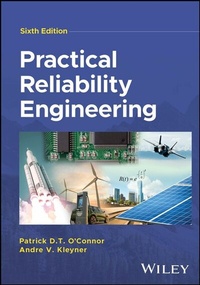
Practical Reliability Engineering
Description

A key reference for reliability professionals worldwide and widely adopted as a textbook by universities across many countries.
With a strong focus on practical engineering applications, the Sixth Edition of Practical Reliability Engineering continues to offer a balanced blend of reliability theory and real-world applications. This edition has been comprehensively updated to reflect the latest advancements in industry practices and state-of-the-art reliability engineering. Each chapter includes practical examples, and course instructors have access to a Solutions Manual and PowerPoint slides for training support available from the author at kleyner.consulting@sbcglobal.net.
The sixth edition introduces several significant updates. Every chapter has been refreshed with new material, and two new chapters - Repairable Systems and Human Reliability - have been added. This edition also covers emerging topics in reliability engineering, such as prognostics and health management (PHM), Agile hardware development, the reliability challenges posed by the ongoing miniaturization of integrated circuits, and many more, ensuring that the content remains relevant to modern technological developments.
Written by two highly qualified reliability professionals, each with decades of experience, this book covers nearly every aspect of reliability science and practice, making it a comprehensive reference guide. Practical Reliability Engineering has, over the years, helped to train multiple generations of reliability engineers and continues to be an essential resource for both emerging professionals and seasoned experts alike.
More details
Other editions
Additional editions
Persons
Patrick D.T. O'Connor received his engineering training at the Royal Air Force (RAF) Technical College and served for 16 years in the RAF Engineer Branch. Following a broad career that included posts as a visiting lecturer at the Universities of Lancaster, Leeds, and Cranfield (UK), he is now retired.
Andre V. Kleyner, PhD has over 30 years of engineering, research, consulting, and managerial experience specializing in the reliability of engineering systems designed to operate in severe environments. He spent his career in the automotive, defense, and medical devices industries and was a part-time lecturer at Purdue University. Andre Kleyner is also the editor of the Wiley Series in Quality and Reliability Engineering.
Content
Preface xxi
Acknowledgments xxiii
Abbreviations and Acronyms Used in this Book xxv
1 Introduction to Reliability Engineering 1
1.1 What is Reliability Engineering? 1
1.2 Why Teach Reliability Engineering? 2
1.3 Why Do Engineering Products Fail? 4
1.4 Probabilistic Reliability 6
1.5 Repairable and Non-repairable Items 7
1.6 The Pattern of Failures With Time (Bathtub Curve) 8
1.7 The Development of Reliability Engineering 9
1.8 Courses, Conferences, and Literature 11
1.9 Organizations Involved in Reliability Work 12
1.10 Reliability as an Effectiveness Parameter 12
1.11 Reliability Program Activities 12
1.12 Reliability Economics and Management 14
Questions 16
Selected Bibliography 17
Periodic Publications on Reliability 17
2 Reliability Mathematics 19
2.1 Introduction 19
2.2 Variation 19
2.3 Probability Concepts 21
2.4 Rules of Probability 22
2.5 Continuous Variation 27
2.6 Continuous Distribution Functions 32
2.7 Summary of Continuous Statistical Distributions 40
2.8 Variation in Engineering 40
2.9 Discrete Variation 46
2.10 Statistical Confidence 49
2.11 Statistical Hypothesis Testing 50
2.12 Non-parametric Inferential Methods 53
2.13 Goodness of Fit 55
2.14 Computer Software for Statistics 57
2.15 Practical Conclusions 57
Questions 58
Selected Bibliography 61
3 Life Data Analysis and Probability Plotting 63
3.1 Introduction 63
3.2 Life Data Classification 64
3.3 Ranking of Data 67
3.4 Weibull Distribution 70
3.5 Computerized Data Analysis and Probability Plotting 77
3.6 Confidence Bounds for Life Data Analysis 80
3.7 Choosing the Best Distribution and Assessing the Results 87
3.8 Conclusions 95
Questions 95
Selected Bibliography 100
4 Repairable Systems 101
4.1 Introduction 101
4.2 Renewal Process 102
4.3 Non-Parametric and Graphical Methods 112
4.4 Conclusions 115
Questions 115
Selected Bibliography 117
5 Monte Carlo Simulation 119
5.1 Introduction 119
5.2 Monte Carlo Simulation Basics 119
5.3 Additional Statistical Distributions 119
5.4 Sampling a Statistical Distribution 122
5.5 Running a Monte Carlo Simulation 125
5.6 Monte Carlo Method Summary 129
Questions 130
Selected Bibliography 132
6 Load-Strength Interference 133
6.1 Introduction 133
6.2 Load and Strength Models 133
6.3 Analysis of Load-Strength Interference 138
6.4 Multiple Load Applications 141
6.5 Dynamic Models 142
6.6 Practical Aspects 144
Questions 145
Selected Bibliography 147
7 Reliability Prediction and Modeling 149
7.1 Introduction 149
7.2 Fundamental Limitations of Reliability Prediction 150
7.3 Standards-Based Reliability Prediction 151
7.4 Other Methods for Reliability Predictions 157
7.5 Practical Aspects of Reliability Prediction 159
7.6 Systems Reliability Models 160
7.7 Availability of Repairable Systems 164
7.8 Modular Design 168
7.9 Block Diagram Analysis 169
7.10 Fault Tree Analysis (FTA) 173
7.12 Petri Nets 181
7.13 Reliability Apportionment 184
7.14 Conclusions 185
Questions 186
Selected Bibliography 192
8 Design for Reliability 195
8.1 Introduction 195
8.2 Design for Reliability Process 196
8.3 Identify 198
8.4 Design 203
8.5 Analyze 215
8.6 Verify 216
8.7 Validate 216
8.8 Control 217
8.9 Assessing the DfR Capability of an Organization 220
8.10 Summary 221
Questions 221
Selected Bibliography 223
9 Reliability of Mechanical Components and Systems 225
9.1 Introduction 225
9.2 Mechanical Stress, Strength, and Fracture 225
9.3 Fatigue 229
9.4 Creep 235
9.5 Wear 236
9.6 Corrosion 237
9.7 Vibration and Shock 238
9.8 Temperature Effects 242
9.9 Materials 244
9.10 Components 245
9.11 Processes 246
Questions 247
Selected Bibliography 249
10 Electronic Systems Reliability 251
10.1 Introduction 251
10.2 Reliability of Electronic Components 252
10.3 Component Types and Failure Mechanisms 255
10.4 Power Electronics 278
10.5 Device Failure Modes and Their Distributions 279
10.6 Circuit and System Aspects 281
10.7 Design for Reliability in Electronic Systems 282
10.8 Parameter Variation and Tolerances 288
10.9 Design for Production, Test, and Maintenance 291
Questions 292
Selected Bibliography 294
11 Analysis of Variance (ANOVA) and Design of Experiments (DOE) 297
11.1 Introduction 297
11.2 Statistical Design of Experiments and Analysis of Variance 297
11.3 Randomizing the Data 308
11.4 Engineering Interpretation of Results 309
11.5 The Taguchi Method 310
11.6 Conclusions 313
Questions 315
Selected Bibliography 317
12 Reliability Testing 319
12.1 Introduction 319
12.2 Planning Reliability Testing 320
12.3 Test Environments 322
12.4 Testing for Reliability and Durability. Accelerated Testing 331
12.5 Test Planning 340
12.6 Failure Reporting, Analysis, and Corrective Action Systems (FRACAS) 341
Questions 343
Selected Bibliography 345
13 Analyzing Reliability Data and Accelerated Testing 347
13.1 Introduction 347
13.2 Pareto Analysis 347
13.3 Accelerated Test Data Analysis 349
13.4 Acceleration Factor 349
13.5 Acceleration Models 350
13.6 Field-Test Relationship 355
13.7 Statistical Analysis of Accelerated Test Data 356
13.8 Reliability Analysis of Repairable Systems 359
13.9 Cusum Charts 360
13.10 Exploratory Data Analysis and Proportional Hazards Modeling 362
13.11 Field and Warranty Data Analysis 364
Questions 368
Selected Bibliography 372
14 Reliability Demonstration and Growth 375
14.1 Introduction 375
14.2 Reliability Metrics 375
14.3 Test to Success (Success-Run Method) 376
14.4 Test to Failure Method 378
14.5 Extended Life Test 378
14.6 Continuous Testing 381
14.7 Degradation Analysis 382
14.8 Demonstrated Reliability vs. Population Reliability 385
14.9 Combining Results Using Bayesian Statistics 386
14.10 Non-parametric Methods 388
14.11 Reliability Demonstration Software 388
14.12 Practical Aspects of Reliability Demonstration 389
14.13 Standard Methods for Repairable Systems 390
14.14 Reliability Growth and Monitoring 395
14.15 Making Product Reliability Grow 402
Questions 404
Selected Bibliography 407
15 Reliability in Manufacture 409
15.1 Introduction 409
15.2 Control of Production Variability 409
15.3 Control Charts 411
15.4 Control of Human Variation 418
15.5 Acceptance Sampling 419
15.6 Improving the Process. Problem Solving 424
15.7 Stress Screening 428
15.8 Failure Reporting Analysis and Corrective Action System (FRACAS) in Production 431
15.9 Conclusions 432
Questions 432
Selected Bibliography 434
16 Human Reliability Analysis 435
J. Robert Taylor and Igor Kozine
16.1 Introduction 435
16.2 Human Performance and Error Taxonomy 436
16.3 Quantitative Methods of HEP Estimation 439
16.4 Identification of Human Error Possibilities: Action Error Analysis 445
16.5 Quantification of Human Error Scenarios Combined With A Technical Failure 452
16.6 Causal Analysis 452
16.7 Data for Human Error Probability Quantification 457
16.8 Models of System Reliability Accounting for Human Error 459
16.9 Conclusions 463
Questions 463
Selected Bibliography 465
17 Maintainability, Maintenance, and Availability 469
17.1 Introduction 469
17.2 Availability Measures 470
17.3 Maintenance Time Distributions 473
17.4 Preventive Maintenance Strategy 474
17.5 FMEA and FTA in Maintenance Planning 478
17.6 Maintenance Schedules 478
17.7 Technology Aspects 479
17.8 Calibration 481
17.9 Maintainability 482
17.10 Integrated Logistic Support 484
Questions 485
Selected Bibliography 486
18 Reliability Management 489
18.1 Corporate Policy for Reliability 489
18.2 Integrated Reliability Programs 489
18.3 Specifying Reliability 492
18.4 Reliability and Costs 494
18.5 Safety and Product Liability 499
18.6 Standards for Reliability, Quality, and Safety Programs 499
18.7 Managing Lower-Tier Suppliers 502
18.8 Reliability Manuals 503
18.9 The Project Reliability Plan 505
18.10 Use of External Services (Outsourcing) 506
18.11 Customer Management of Reliability 507
18.12 Product Sustainment Activities 509
18.13 Reliability Training and Expertise 511
18.14 Reliability Capability and Maturity of an Organization 512
18.15 Managing Production Quality 514
18.16 Choosing the Methods: Strategy and Tactics 516
18.17 AI in Practical Reliability Engineering 517
18.18 Conclusions: The Importance of Reliability Management 518
Questions 520
Selected Bibliography 521
Appendix 1 Software Reliability 523
Appendix 2 Kolmogorov-Smirnov Tables 549
Appendix 3 Chi-square Distribution and MTTF/MTBF Calculations 551
Appendix 4 Matrix Algebra Revision 553
Appendix 5 Reliability, Maintainability, and Safety Plan Example 555
Index 561
1
Introduction to Reliability Engineering
1.1 What is Reliability Engineering?
No one disputes the need for engineered products to be reliable. The average consumer is acutely aware of the problem of less-than-perfect reliability in domestic products such as TV sets, computers, and automobiles. Most products and industries are affected by the costs of unreliability. Manufacturers often suffer high costs of failure under warranty. Arguments and misunderstandings begin when we try to quantify reliability values or try to assign financial or other cost or benefit values to levels of reliability.
The customer, having accepted the product, accepts that it might fail at some future time. This simple approach is often coupled with a warranty, or the customer may have some protection in law, so that he may claim redress for failures occurring within a stated or reasonable time. However, this approach provides no measure of quality or reliability over a period of time, particularly outside a warranty period. Even within a warranty period, the customer usually has no grounds for further action if the product fails once, twice, or several times, provided that the manufacturer repairs or replaces the product as promised each time. If it fails often, the manufacturer will suffer high warranty costs, and the customers will suffer inconvenience. Outside the warranty period, only the customer suffers. In any case, the manufacturer will also probably incur a loss of reputation, possibly affecting future business.
Whether failures occur or not, and their times to occurrence, can seldom be forecast accurately. Reliability is therefore an aspect of engineering uncertainty. Whether an item will work for a particular period is a question that can be answered as a probability.
The most commonly used definition of reliability is: Reliability is the probability that an item will perform its intended function without failure in specified operating conditions (or environments) for a specified period of time or usage. The terms in this definition, such as probability, intended function, failure, specified operating conditions, and specified period of time, are all very important and carry a special meaning, which will be addressed and discussed in this book.
This definition also contains several key elements of making a reliable product. It is important to understand that reliability science is a fusion of multiple engineering subjects, including key disciplines, such as reliability statistics and physics of failure (PoF), sometimes referred to as reliability mathematics and reliability physics.
Reliability physics (this term will be used interchangeably with the term "physics of failure") addresses the definitions of failure and of the stated conditions. It studies failure modes and failure mechanisms, which a product might experience under certain conditions, i.e., stress environments. For example, the failures caused by vibration are often attributed to fatigue, the failures experienced in high humidity environments are often caused by corrosion, mechanical shock often causes fracture, and so on. Understanding the physics of failure is critical to identifying, understanding, and correcting product failures to improve the reliability and the overall product design.
Since reliability is expressed as a probability, mathematical and statistical methods are also important for modeling reliability (for prediction, measurement, assessment, etc.) and for analyzing reliability data. Statistical methods are used to define reliability as a function of time, R = f(t) or a function of the appropriate usage equivalent of time, such as distance driven, number of ignition cycles, temperature cycles, mechanical shocks, ON/OFF cycles, and other product usage measures. Obtaining the reliability function, even with a degree of uncertainty, would allow an engineering professional to make an assessment of the expected reliability at the end of the product's mission life or at any time in between. This would allow us to make an assessment if the product is meeting (or not) its engineering requirements. Mathematical and statistical methods are covered in Chapters 2-6 of this book. A reliability professional needs to be knowledgeable in both key areas of reliability engineering-physics and mathematics.
Durability is a particular aspect of reliability, related to the ability of an item to withstand the effects of time or usage on failure mechanisms such as fatigue, wear, creep, and corrosion. Durability is usually expressed as a minimum time before the occurrence of wear-out failures. In repairable systems, it often characterizes the ability of the product to function while maintained.
The objectives of reliability engineering, in the order of priority, are:
- To apply engineering knowledge and specialist techniques to prevent or reduce the likelihood or frequency of failures.
- To identify and correct the causes of failures that do occur, despite the efforts to prevent them.
- To determine ways of coping with failures that do occur, if their causes have not been corrected.
- To apply methods for estimating the likely reliability of new designs and for analyzing reliability data.
The reason for the priority emphasis is that it is by far the most effective way of working, in terms of minimizing costs and generating reliable products. The primary skills that are required, therefore, are the ability to understand and anticipate the possible causes of failures, and knowledge of how to prevent them. It is also necessary to have knowledge of the methods that can be used for analyzing designs and data. The primary skills are nothing more than good engineering knowledge and experience, so reliability engineering is first and foremost the application of good engineering, in the widest sense, during design, development, manufacture, and service.
Overriding all of these aspects, though, is the management of the reliability engineering effort. Since reliability (and very often safety) is such a critical parameter of most modern engineering products, and since failures are directly or indirectly generated by the people involved (designers, test engineers, manufacturing, suppliers, maintainers, users), it can be maximized only by an integrated effort that encompasses training, teamwork, discipline, and application of the most appropriate methods. Reliability engineering specialists cannot make this happen alone. They can provide support, training, and tools, but only managers can organize, motivate, lead, and provide the resources. Reliability engineering is a team effort and, ultimately, effective management of engineering.
1.2 Why Teach Reliability Engineering?
Engineering education is traditionally concerned with teaching how engineering products work. However, the ways in which products fail, the effects of failure, and aspects of design, manufacture, maintenance, and use that affect the likelihood of failure are not usually paid as much attention in engineering schools. The engineer's tasks are to design, make, and maintain the product so that the failed state is deferred. In these tasks, an engineer faces the problems of variability of engineering materials, processes, and applications. Variability and chance play an important role in determining the reliability of most products. Basic parameters like mass, dimensions, friction coefficients, strengths, and stresses are never absolute but are in practice subject to variability due to process and material variations, human factors, and applications. Some parameters may also vary with time. Understanding the laws of chance and the causes and effects of variability is, therefore, necessary for the creation of reliable products and for the solution of problems of unreliability.
Competition, the pressure of schedules and deadlines, the cost of failures, the rapid evolution of new materials, methods and complex systems, the need to reduce product costs, and safety considerations all increase the risks of product development. Figure 1.1 shows the pressures that lead to the overall perception of risk. However, in today's world reliability is almost taken for granted, i.e., a consumer expects the product to be reliable, whether an automobile, mobile phone, appliance, or any other device, although it takes effort and a lot of work behind the scenes to achieve the expected level of product reliability.
Figure 1.1 Perception of risk.
Later chapters will show how reliability engineering methods can be applied to design, development, manufacturing, and maintenance to control the level of risk. The extent to which the methods are applicable must be decided for each project and each design area. They should be used to supplement good engineering practice. However, there are times when new risks are being taken, and the normal rules and guidelines are inadequate or do not apply. Sometimes we take risks unwittingly when we assume that we can extrapolate safely from our present knowledge. Designers and managers are often over-optimistic or are reluctant to point out risks about which they are unsure.
It is for these reasons that an understanding of reliability engineering principles and methods is now an essential ingredient of modern engineering. Despite its obvious importance, quality and reliability education, for some reason, is insufficient in today's engineering curricula. Few engineering schools offer degree programs or even an adequate number of courses in...
