

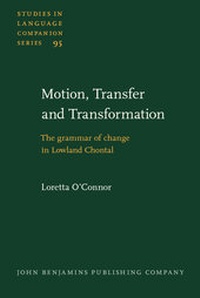
Motion, Transfer and Transformation
The grammar of change in Lowland Chontal
1st Edition
Published on 18. October 2007
XIV, 251 pages
978-90-272-9187-5 (ISBN)
Description

Typologies are critical tools for linguists, but typologies, like grammars, are known to leak. This book addresses the question of typological overlap from the perspective of a single language. In Lowland Chontal of Oaxaca, a language of southern Mexico, change events are expressed with three types of predicates, and each predicate type corresponds to a different language type in the well-known typology of lexicalization patterns established by Talmy and elaborated by others. O'Connor evaluates the predictive powers of the typology by examining the consequences of each predicate type in a variety of contexts, using data from narrative discourse, stimulus response, and elicitation. This is the first detailed look at the lexical and grammatical resources of the verbal system in Chontal and their relation to semantics of change. The analysis of how and why Chontal speakers choose among these verbal resources to achieve particular communicative and social goals serves both as a documentation of an endangered language and a theoretical contribution towards a typology of language use.
More details
Other editions
Additional editions
Book
10/2007
John Benjamins Publishing Co
€116.60
Shipment within 10-15 days
Person
Content
- Motion, Transfer and Transformation
- Editorial page
- Title page
- LCC data
- Table of contents
- Acknowledgements
- List of figures
- List of tables
- Abbreviations and conventions.
- 1. Introduction
- 1.2 Predicate types and framing strategies
- 1.3 The language and the speakers
- 1.4 Fieldwork and data
- 1.5 Theoretical context
- 2. GRAMMATICAL FEATURES OF LOWLAND CHONTAL
- 2.1 Phonology and morphophonemics
- 2.2 Nouns and nominal morphology
- 2.3 Verbs and verbal morphology
- 2.4 Other minor word classes
- 2.5 Clause types
- 3. SIMPLE PREDICATES OF CHANGE
- 3.1 Classes of 'change' verbs
- 3.2 Basic constructions of simple predicates of change
- 3.3 Endpoints and end-states of change
- 3.4 Path elaboration and trajectory of change
- 3.5 Means of change
- 3.6 Restrictions on the undergoer referent
- 3.7 Summary and conclusions
- 4. COMPLEX PREDICATES OF ASSOCIATED MOTION AND ASSOCIATED CHANGE
- 4.1 Introduction
- 4.2 Basic constructions of associated motion and change
- 4.3 Subevents of motion 'away from here' and 'to there'
- 4.4 Andative and dislocative in narrative discourse
- 4.5 Associated 'motion' in change of state predications
- 4.6 Subevents of motion 'to or toward here'
- 4.7 Conclusions
- 5. COMPLEX PREDICATES OF ASSOCIATED DIRECTION AND TOPOLOGICAL RELATION
- 5.1 Introduction
- 5.2 Components of the V1-DTR compound stem
- 5.3 Compound stems and constructional meaning
- 5.4 The means construction
- 5.5 The dispositional construction
- 5.6 The classificatory construction
- 5.7 The trajectory construction
- 5.8 Summary and conclusions
- 6. CONCLUSIONS
- 6.1 The grammar of change, in typological and discourse-functional perspective
- 6.2 Documentation of an understudied language
- REFERENCES
- INDEX
- The series Studies in Language Companion Series
- APPENDIX: Compound stem verbs, by construction type
