

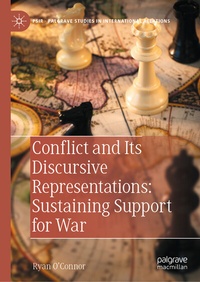
Conflict and Its Discursive Representations: Sustaining Support for War
Description

This project seeks to demonstrate how multiple sites of discursive production (political elite, media, and popular culture) interact to construct truths about a conflict that condition political possibility. Through breaking down the interaction between multiple sites of production within moments of discursive stability and by tracing major themes across multiple sites of discursive production this work will illuminate the processes by which the 'truth' for a conflict is produced, sustained, and challenged. Specifically, this project will be contesting two historical moments of 'naturalness' wherein a dominant discourse established a representational stability within American foreign policy in order to display how multiple sites of production work to produce, sustain, and challenge the political realities of military interventions. In doing so, the processes which impact the production of policy and public acceptance/condemnation for military interventions will be demonstrated.
More details
Other editions
Additional editions
Person
Content
Chapter One: Discursive Interactions: The Construction of Interventions.- Chapter Two: The Role of Discourse in Constructing our Political Realities.- Chapter Three: The Neoconservative Connection.- Chapter Four: The 1979 Soviet Invasion of Afghanistan.- Chapter Five: Stability Meta-Narrative: World Trope.- Chapter Six: Democracy Meta-Narrative: Freedom Trope.- Chapter Seven: The 2003 Iraq War.- Chapter Eight: Stability Metanarrative: Nuclear Trope.- Chapter Nine: Democracy Metanarrative: Democracy Trope.- Chapter Ten: Conclusion.
