

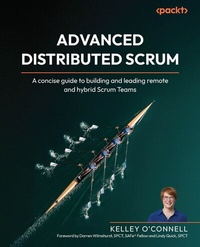
Advanced Distributed Scrum
Description

Key Features
Help your team succeed globally while staying grounded in Agile Values and the 2020 Scrum Guide
Bridge async and sync work to increase alignment and team accountability
Apply real-world strategies for leading high-performing distributed teams
Purchase of the print or Kindle book includes a free PDF eBook
Book DescriptionThe COVID-19 pandemic altered the way teams work, turning remote work into a common practice for Agile teams that were originally founded to be co-located, leaving teams to grapple with remote and hybrid setups. The Agile mindset, however, remains the standard for effective teamwork, and this book integrates distributed work into your Agile and Scrum Values. Advanced Distributed Scrum will guide you in harnessing the talents of global team members and overcoming the challenges of working across geographies. Renowned Agile coach and educator Kelley O'Connell distills 25+ years of experience into this concise guide. The book begins by establishing the foundational principles of distributed Scrum, highlighting the unique roles and responsibilities within hybrid and remote environments. You'll gain insights into the challenges faced by distributed Agile teams and explore how to cultivate a strong remote team culture, improve communication, and effectively manage conflicts in a virtual space. Finally, you'll put remote Scrum practices into action to maximize the outcomes you're aiming for. By the end of this book, you'll be equipped to lead and nurture high-performing distributed teams, facilitate remote ceremonies, implement remote-friendly CI/CD pipelines, and create team norms that drive engagement. What you will learn
Define and align remote roles for seamless collaboration
Set up tools, workspaces, and team agreements for success
Recruit, onboard, and integrate remote team members
Build a strong team culture and resolve conflicts remotely
Facilitate remote Scrum events across time zones
Implement CI/CD pipelines in distributed environments
Ensure security and compliance in remote Scrum setups
Who this book is forThis book is for Scrum Masters, Agile practitioners, coaches, product owners, and team leads who want to master remote and hybrid collaboration and build high-performing distributed Scrum teams. Whether you're experienced or new to leading distributed teams, this practical guide offers tools to enhance team effectiveness and continuous collaboration. A foundational understanding of Agile principles, the Agile mindset, and core frameworks is recommended to get the most value from this book.
All prices
More details
Other editions
Additional editions
Persons
Kelley's expertise is reflected in her extensive body of work, including more than a dozen courses and titles published on global platforms such as LinkedIn Learning and Coursera, where her engaging, real-world teaching style has attracted a dedicated global audience. Her work has been translated into multiple languages, making her one of the most widely followed voices in Agile coaching and leadership education.
Throughout her career, Kelley has held leadership roles at every level, guiding teams, programs, and enterprise-wide transformations across industries including healthcare, insurance, and financial services. A pioneer in leading distributed and remote teams, she has been practicing and coaching remote Agile collaboration for over two decades, well before it became mainstream.
As an Agile coach and consultant, Kelley partners with organizations to align strategy with execution, foster leadership agility, and build resilient teams capable of delivering lasting business outcomes. Her approach combines practical frameworks with a deep understanding of organizational dynamics, enabling clients to navigate complexity and achieve their strategic objectives.
Based in Chicago, Illinois, Kelley balances her professional life with a passion for travel and global exploration, continuously drawing inspiration from cultures and teams around the world. She welcomes connections and conversations with fellow Agile practitioners and leaders via LinkedIn, where she actively shares insights, tools, and stories from the field.
Content
Introduction to Agile and Scrum
Principles of Distributed Scrum
Roles and Responsibilities in a Distributed Scrum Team
Setting Up for Remote Scrum Success
Recruiting and Forming a Distributed Scrum Team
Cultivating a Strong Remote Culture
Effective Communication and Working Agreements
Managing Performance and Motivation
Collaboration Tools and Software
Remote Pair Programming and Code Reviews
Continuous Integration and Continuous Deployment (CI/CD)
Security and Compliance in Remote Work
Remote Sprint Planning
Conducting a Distributed Daily Scrum
Sprint Execution and Monitoring
Sprint Review and Retrospective
Preface
In a world where remote work has evolved from a rare exception to a daily reality, Agile teams are navigating uncharted territory. When the Agile Manifesto was first written, it envisioned teams co-located, collaborating face-to-face, and benefiting from spontaneous conversations and immediate feedback. Fast forward to today's globalized, digitally connected landscape, and the context has shifted dramatically.
Yet the core promise of Agile - empowering teams to make fast, value-driven decisions and adapt to change - remains more relevant than ever. The challenge is that these foundational frameworks were not designed with distance, time zones, or cultural divides in mind. Teams now need to revisit and reimagine how they apply Agile, particularly Scrum, to thrive in a remote setting.
This book is that guide.
Whether you are a Scrum Master facilitating Sprints across multiple continents, a Product Owner aligning stakeholders virtually, or a developer collaborating with teammates you may never meet in person, this book offers both a handbook and a playbook for success. It blends the timeless principles of Agile with the new realities of distributed teamwork, offering you practical tools, techniques, and strategies.
This book is organized into four focused parts to help you build, lead, and empower distributed Scrum Teams:
Throughout this book, you'll find actionable advice, real-world examples, and proven techniques to help your remote Scrum Team not just survive - but thrive.
Let's begin the journey to unlocking the full potential of distributed Scrum Teams.
Who this book is for
Advanced Distributed Scrum is written for Agile practitioners, leaders, and teams navigating the complexities of remote work in today's global environment.
This book is for the following:
- Scrum Masters and Agile coaches who are seeking practical tools and techniques to help distributed teams collaborate, deliver, and continuously improve
- Product Owners and business leaders who want to align stakeholders, manage priorities, and enable value-driven decision-making across geographies
- Developers, designers, and technical team members working in remote-first or hybrid environments who need to stay connected, productive, and engaged
- Agile transformation leaders and change agents driving organizational agility in remote or globalized enterprises
- Organizations of all sizes - from start-ups to enterprises - looking to optimize their Agile practices for distributed or virtual teams
Whether you are adapting existing Scrum practices for your remote team, launching a new distributed Agile team, or supporting a broader Agile transformation, this book offers actionable insights to help you build strong, high-performing Scrum Teams - wherever they are.
What this book covers
Chapter 1, Introduction to Agile and Scrum, explores the foundational principles and the streamlined Scrum framework to uncover the collaborative and adaptive approaches that empower teams to thrive.
Chapter 2, Principles of Distributed Scrum, delves into the intricacies of distributed collaboration by unveiling the essential principles of distributed Scrum.
Chapter 3, Roles and Responsibilities in a Distributed Scrum Team, explores the pivotal roles and responsibilities shaping the fabric of a distributed Scrum Team and provides insights into the nuanced dynamics of remote collaboration.
Chapter 4, Setting Up for Remote Scrum Success, lays the groundwork for triumph in remote Scrum environments by examining essential setup strategies and considerations to pave the way for efficient and collaborative distributed teams.
Chapter 5, Recruiting and Forming a Distributed Scrum Team, dives into the intricacies of team formation, recruitment, and onboarding, ensuring a cohesive and capable distributed Scrum Team that excels in remote collaboration.
Chapter 6, Cultivating a Strong Remote Culture, explores the nuances of fostering a vibrant remote team culture, promoting engagement, cohesion, and a shared sense of purpose among distributed Scrum Team members.
Chapter 7, Effective Communication and Working Agreements, explains how, through the art of remote communication and establishing robust working agreements, you can ensure seamless collaboration and alignment within your distributed Scrum Team.
Chapter 8, Managing Performance and Motivation, navigates the challenges of remote performance management and motivation, discovering strategies to keep distributed Scrum Teams inspired, productive, and aligned with organizational goals.
Chapter 9, Collaboration Tools and Software, unlocks the potential of collaboration tools and software to enhance productivity, communication, and project management within your distributed Scrum team.
Chapter 10, Remote Pair Programming and Code Reviews, teaches you how to leverage effective strategies for remote pair programming and code reviews, fostering collaborative development practices that ensure code quality and knowledge sharing.
Chapter 11, Continuous Integration and Continuous Deployment (CI/CD), explores the principles of CI/CD in the context of remote Scrum, ensuring a streamlined and automated development pipeline for rapid and reliable software delivery.
Chapter 12, Security and Compliance in Remote Work, addresses the critical aspects of security and compliance in a remote work environment, safeguarding your distributed Scrum Team and projects against potential risks and challenges.
Chapter 13, Remote Sprint Planning, explores how to master the intricacies of planning remote Sprints, ensuring a structured and effective approach to setting goals and priorities for your distributed Scrum Team.
Chapter 14, Conducting a Distributed Daily Scrum, covers how to deliver Daily Scrum meetings in a remote setting, fostering communication, transparency, and alignment among distributed team members.
Chapter 15, Sprint Execution and Monitoring, teaches proven strategies for successful Sprint execution and monitoring in a remote Scrum environment, ensuring progress tracking and timely adjustments for optimal project outcomes.
Chapter 16, Sprint Review and Retrospective, explains how to leverage insights from Sprint Reviews and Retrospectives to fuel continuous improvement within your distributed Scrum Team.
There is an Appendix at the end of this book. It covers notes and pointers on how to exploit the speed of AI to improve team efficiency and accuracy in planning.
Conventions used
Bold: Indicates a new term or an important word. Here is an example: Some common techniques you can use include icebreakers. There are myriad options you can find online; one of my favorites is "Would you rather?".
Tips or important notes
Appear like this.
Get in touch
Feedback from our readers is always welcome.
General feedback: If you have questions about any aspect of this book, email us at customercare@packtpub.com and mention the book title in the subject of your message.
Errata: Although we have taken every care to ensure the accuracy of our content, mistakes do happen. If you have found a mistake in this book, we would be grateful if you would report this to us. Please visit www.packtpub.com/support/errata and fill in the form.
Piracy: If you come across any illegal copies of our works in any form on the internet, we would be grateful if you would provide us with the location address or website name. Please contact us at copyright@packtpub.com with a link to the material.
If you are interested in becoming an author: If there is a topic that you have expertise in and you are interested in either writing or contributing to a book, please visit authors.packtpub.com.
Share Your Thoughts
Once you've read Advanced Distributed Scrum, we'd love to hear your thoughts! Please click here to go straight to the Amazon review page for this book and share your feedback.
Your review is important to us and the tech...
