

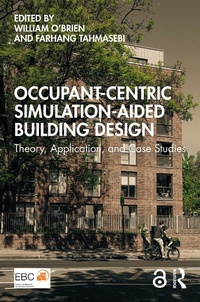
Occupant-Centric Simulation-Aided Building Design
Theory, Application, and Case Studies
1st Edition
Published on 31. May 2023
398 pages
978-1-000-86582-0 (ISBN)
Description

Occupant-Centric Simulation-Aided Building Design promotes occupants as a focal point for the design process. This resource for established and emerging building designers and researchers provides theoretical and practical means to restore occupants and their needs to the heart of the design process.
Helmed by leaders of the International Energy Agency Annex 79, this edited volume features contributions from a multi-disciplinary, globally recognized team of scholars and practitioners. Chapters on the indoor environment and human factors introduce the principles of occupant-centric design while chapters on selecting and applying models provide a thorough grounding in simulation-aided building design practice. A final chapter assembling detailed case studies puts the lessons of the preceding chapters into real-world context. In fulfillment of the International Energy Agency's mission of disseminating research on secure and sustainable energy to all, Occupant-Centric Simulation-Aided Building Design is available as an Open Access Gold title.
With a balance of fundamentals and design process guidelines, Occupant-Centric Simulation-Aided Building Design reorients the building design community toward buildings that recognize and serve diverse occupant needs, while aiming for superior environmental performance, based on the latest science and methods.
Helmed by leaders of the International Energy Agency Annex 79, this edited volume features contributions from a multi-disciplinary, globally recognized team of scholars and practitioners. Chapters on the indoor environment and human factors introduce the principles of occupant-centric design while chapters on selecting and applying models provide a thorough grounding in simulation-aided building design practice. A final chapter assembling detailed case studies puts the lessons of the preceding chapters into real-world context. In fulfillment of the International Energy Agency's mission of disseminating research on secure and sustainable energy to all, Occupant-Centric Simulation-Aided Building Design is available as an Open Access Gold title.
With a balance of fundamentals and design process guidelines, Occupant-Centric Simulation-Aided Building Design reorients the building design community toward buildings that recognize and serve diverse occupant needs, while aiming for superior environmental performance, based on the latest science and methods.
More details
Edition
1. Auflage
Language
English
Place of publication
London
United Kingdom
Publishing group
Taylor & Francis Ltd
Target group
College/higher education
Professional and scholarly
Product notice
Reflowable
Illustrations
1 Tables, color; 37 Tables, black and white; 90 Line drawings, color; 26 Line drawings, black and white; 56 Halftones, color; 1 Halftones, black and white; 146 Illustrations, color; 27 Illustrations, black and white
File size
19,17 MB
ISBN-13
978-1-000-86582-0 (9781000865820)
Copyright in bibliographic data and cover images is held by Nielsen Book Services Limited or by the publishers or by their respective licensors: all rights reserved.
Schweitzer Classification
Other editions
Additional editions
William O'Brien | Farhang Tahmasebi
Occupant-Centric Simulation-Aided Building Design
Theory, Application, and Case Studies
Book
approx. 06/2026
1st Edition
Routledge
€69.00
Not yet published
William O'Brien | Farhang Tahmasebi
Occupant-Centric Simulation-Aided Building Design
Theory, Application, and Case Studies
Book
05/2023
1st Edition
Routledge
€216.80
Shipment within 10-20 days
Persons
William O'Brien, PhD, PEng, is a Professor in Civil and Environmental Engineering and the principal investigator of the Human Building Interaction Lab at Carleton University, in Ottawa, Canada. From 2018 to 2023, he served as an operating agent for IEA EBC Annex 79, the team that led this book. He has won several prestigious awards including the IBPSA Outstanding Young Achiever Award, Ontario Building Envelope Council Rising Star Award, and the Ontario Early Researcher Award.
Farhang Tahmasebi, PhD, CEng, MCIBSE, is a Lecturer at UCL Institute for Environmental Design and Engineering, in London, United Kingdom. As a researcher and practitioner of building performance simulation and performance-based design, he co-led IEA EBC Annex 79 task group focused on applying occupant behavior models in simulation-aided building design process. Prior to his appointment at UCL, Dr Tahmasebi was a researcher and tutor at TU Wien Institute of Architectural Sciences, in Vienna, Austria.
Farhang Tahmasebi, PhD, CEng, MCIBSE, is a Lecturer at UCL Institute for Environmental Design and Engineering, in London, United Kingdom. As a researcher and practitioner of building performance simulation and performance-based design, he co-led IEA EBC Annex 79 task group focused on applying occupant behavior models in simulation-aided building design process. Prior to his appointment at UCL, Dr Tahmasebi was a researcher and tutor at TU Wien Institute of Architectural Sciences, in Vienna, Austria.
Content
1. Introduction. 2. Fundamentals of IEQ and Occupant Needs. 3. Occupants in the building design decision-making process. 4. Methods to obtain the occupant perspective. 5. Occupant-centric performance metrics and performance targets. 6. Introduction to occupant modeling. 7. Fit-for-purpose occupant modeling: Choosing the right approach. 8. Advanced simulation methods for occupant-centric building design. 9. Building interfaces: Design and considerations for simulation. 10. Design of sequences of operation for occupant-centric controls. 11. Detailed case studies. 12. Conclusion.
