

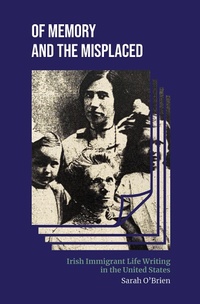
Of Memory and the Misplaced
Description

What can the life writing of post-famine Irish immigrants tell us about Irish diasporic memory?
Of Memory and the Misplaced considers the endurance and nature of Irish American memory across the twentieth century. Guided by 30 memoirs written between 1900 and 1970, Sarah O'Brien shows the prevalence of intimate and taboo themes in ordinary immigrants' writing, such as domestic violence, same-sex love, and famine-induced trauma. Importantly, Of Memory and the Misplaced critiques the role of the Irish landscape as a site of memory and shows how the interiority of the domestic world has provided Irish women with the language needed to reclaim their own lives.
Combining literary and historical theory, Of Memory and the Misplaced highlights voices that have traditionally been silenced and offers a rare and unexplored collection of primary source autobiographical texts to better understand the experiences of Irish immigrants in the United States.
More details
Other editions
Additional editions
Person
Sarah O'Brien is Lecturer at Mary Immaculate College, Limerick, Ireland, and codirector of the college's Oral History Centre. She is author of Linguistic Diasporas, Narrative and Performance: The Irish in Argentina.
Content
Acknowledgments
Introduction
Part I: Memory and the Irish in the United States
1. Social Frameworks of Memory
2. Irish American Memory Narratives
3. Life Writing and the Irish Immigrant
Part II: Life Writing
Note of Introduction
4. Edmond Ronayne (1900)
5. Mary Jane Hill Anderson (1922)
6. Nora O'Connor (1946)
7. Margaret McGuinness (1973)
Part III: Narratives of Proximity
Abridged Memoirs
Bibliography
