

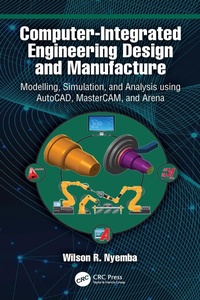
Computer-Integrated Engineering Design and Manufacture
Modelling, Simulation, and Analysis using AutoCAD, MasterCAM, and Arena
1st Edition
Published on 21. October 2025
398 pages
978-1-040-42945-7 (ISBN)
Description

This book presents advanced concepts of computer-aided design, and computer-aided manufacture, through modelling and computer numerical control, coupled with the simulation of production systems. It dwells on the subtle and key features such as the applications and effective use of dynamic blocks in modelling, subtractive and additive layer manufacturing, flexible manufacturing systems and automation and robotics.
The text:
Discusses the principles of computer-aided design in a comprehensive manner and applications of the AutoCAD interface programming language
Covers aspects of product development and design, together with accompanying principles of design for manufacture and assembly
Explains the integrated approach to design and manufacture, enhanced by modelling, simulation, and analysis software, with capabilities for electronic transfer and interchange between the software packages
Presents process planning and part programming with MasterCAM, generating toolpaths, and selecting machine tools for subtractive manufacturing and step-by-step worked examples to enhance the understanding of principles and concepts of engineering design and manufacture
Explores sequential control and logical sequencing, configuration of industrial robots, and challenges in programming robots
The integrated nature of this book and the examples therein, are intended for senior undergraduates, graduate students, academic researchers, and practising engineers in various fields of engineering, such as, but not limited to, aeronautical, civil, electrical, industrial, manufacturing, mechanical, mechatronics, and production engineering.
The text:
Discusses the principles of computer-aided design in a comprehensive manner and applications of the AutoCAD interface programming language
Covers aspects of product development and design, together with accompanying principles of design for manufacture and assembly
Explains the integrated approach to design and manufacture, enhanced by modelling, simulation, and analysis software, with capabilities for electronic transfer and interchange between the software packages
Presents process planning and part programming with MasterCAM, generating toolpaths, and selecting machine tools for subtractive manufacturing and step-by-step worked examples to enhance the understanding of principles and concepts of engineering design and manufacture
Explores sequential control and logical sequencing, configuration of industrial robots, and challenges in programming robots
The integrated nature of this book and the examples therein, are intended for senior undergraduates, graduate students, academic researchers, and practising engineers in various fields of engineering, such as, but not limited to, aeronautical, civil, electrical, industrial, manufacturing, mechanical, mechatronics, and production engineering.
More details
Edition
1. Auflage
Language
English
Place of publication
London
United Kingdom
Publishing group
Taylor & Francis Ltd
Target group
College/higher education
Professional and scholarly
Illustrations
28 Tables, black and white; 71 Line drawings, black and white; 64 Halftones, black and white; 135 Illustrations, black and white
File size
35,17 MB
ISBN-13
978-1-040-42945-7 (9781040429457)
Copyright in bibliographic data and cover images is held by Nielsen Book Services Limited or by the publishers or by their respective licensors: all rights reserved.
Schweitzer Classification
Other editions
Additional editions
Wilson R. Nyemba
Computer-Integrated Engineering Design and Manufacture
Modelling, Simulation, and Analysis using AutoCAD, MasterCAM, and Arena
Book
approx. 10/2025
1st Edition
CRC Press
€178.20
Not yet published
Person
Professor Wilson R. Nyemba has over 30 years of experience both in industry and academia. He designed and developed a wide range of engineering products in different capacities in industry from product development to engineering management. He also formulated and led a number of successful ventures at the University of Zimbabwe where he served as Dean of the Faculty of Engineering. He also served as Chairman of WaterNet and Project Manager for the Royal Academy of Engineering projects in Sub-Saharan Africa and subsequently, the Southern Africa Engineering Education Network (SAE2Net), where the focus has been on improving the quality of engineering education and practice.
Professor Nyemba holds a BSc Honours degree in Mechanical Engineering from the University of Zimbabwe, an MSc in Advanced Mechanical Engineering degree (Distinction) from the University of Warwick in England and Doctor of Engineering degree from the University of Johannesburg. He is an accomplished consultant and researcher with interests in Computer Aided Engineering Design and Manufacture, Engineering Education, Engineering Innovations, Capacity Building and Sustainability, Systems Thinking, Modelling and Simulation of Production Systems. He has successfully secured and managed several grants for various national and regional projects of strategic importance.
Professor Nyemba's main interest and focus is in bridging the gap between industry and academia through various initiatives including the integration of engineering design and manufacture. Apart from having published over 100 articles in journals and conference proceedings, Professor Nyemba has authored three books: Bridging the Academia Industry Divide: Innovation and Industrialisation Perspective using Systems Thinking Research in Sub-Saharan Africa, Computer Aided Design: Engineering Design and Modelling using AutoCAD (1st ed.) and Doctoral Training in Engineering: Developing Indigenous Capacities and Skills for Economic Growth in Industrialising Countries.
Professor Nyemba is a Fellow of the Zimbabwe Institution of Engineers (FZweIE), Associate Member of the Institution of Mechanical Engineers (AMIMechE), (UK), Member of the International Association of Engineers (MIAEng) and a registered Professional Engineer (PrEng). He has received several awards and recognitions for outstanding research.
Professor Nyemba holds a BSc Honours degree in Mechanical Engineering from the University of Zimbabwe, an MSc in Advanced Mechanical Engineering degree (Distinction) from the University of Warwick in England and Doctor of Engineering degree from the University of Johannesburg. He is an accomplished consultant and researcher with interests in Computer Aided Engineering Design and Manufacture, Engineering Education, Engineering Innovations, Capacity Building and Sustainability, Systems Thinking, Modelling and Simulation of Production Systems. He has successfully secured and managed several grants for various national and regional projects of strategic importance.
Professor Nyemba's main interest and focus is in bridging the gap between industry and academia through various initiatives including the integration of engineering design and manufacture. Apart from having published over 100 articles in journals and conference proceedings, Professor Nyemba has authored three books: Bridging the Academia Industry Divide: Innovation and Industrialisation Perspective using Systems Thinking Research in Sub-Saharan Africa, Computer Aided Design: Engineering Design and Modelling using AutoCAD (1st ed.) and Doctoral Training in Engineering: Developing Indigenous Capacities and Skills for Economic Growth in Industrialising Countries.
Professor Nyemba is a Fellow of the Zimbabwe Institution of Engineers (FZweIE), Associate Member of the Institution of Mechanical Engineers (AMIMechE), (UK), Member of the International Association of Engineers (MIAEng) and a registered Professional Engineer (PrEng). He has received several awards and recognitions for outstanding research.
Content
1. Introduction. 2. Computer Aided Design and Modelling using AutoCAD. 3. AutoLISP Programming. 4. New Product Development and Design. 5. Design for Manufacture and Assembly. 6. Computer Numerical Control for Manufacturing. 7. Computer-Aided Part Programming. 8. Subtractive Manufacturing using MasterCAM. 9. Additive Layer Manufacturing. 10. Automation and Robotics. 11. Flexible Manufacturing Systems. 12. Modelling and Simulation using Arena. 13. Computer-Integrated Manufacturing. 14. Practical Applications: Case Studies. 15. Consolidated Summary and Recommendations.
