

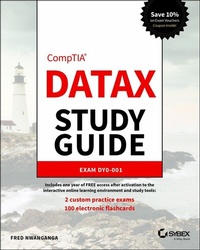
CompTIA DataX Study Guide
Description

Demonstrate your Data Science skills by earning the brand-new CompTIA DataX credential
In CompTIA DataX Study Guide: Exam DY0-001, data scientist and analytics professor, Fred Nwanganga, delivers a practical, hands-on guide to establishing your credentials as a data science practitioner and succeeding on the CompTIA DataX certification exam. In this book, you'll explore all the domains covered by the new credential, which include key concepts in mathematics and statistics; techniques for modeling, analysis and evaluating outcomes; foundations of machine learning; data science operations and processes; and specialized applications of data science.
This up-to-date Study Guide walks you through the new, advanced-level data science certification offered by CompTIA and includes hundreds of practice questions and electronic flashcards that help you to retain and remember the knowledge you need to succeed on the exam and at your next (or current) professional data science role. You'll find:
- Chapter review questions that validate and measure your readiness for the challenging certification exam
- Complimentary access to the intuitive Sybex online learning environment, complete with practice questions and a glossary of frequently used industry terminology
- Material you need to learn and shore up job-critical skills, like data processing and cleaning, machine learning model-selection, and foundational math and modeling concepts
Perfect for aspiring and current data science professionals, CompTIA DataX Study Guide is a must-have resource for anyone preparing for the DataX certification exam (DY0-001) and seeking a better, more reliable, and faster way to succeed on the test.
More details
Other editions
Additional editions
Person
ABOUT THE AUTHOR
FRED NWANGANGA is a technology professional and professor in the IT, Analytics, and Operations Department within the University of Notre Dame - Mendoza College of Business. He teaches undergraduate and graduate courses in Python for Data Analytics, Machine Learning, and Unstructured Data Analytics. He has over 20 years of experience in technology management and analytics. He is the author of several LinkedIn Learning machine learning courses and the founder of the Early Bridges to Data Science Program in the Notre Dame Lucy Family Institute for Data & Society.
Content
Introduction xxiii
Chapter 1 What Is Data Science? 1
Chapter 2 Mathematics and Statistical Methods 25
Chapter 3 Data Collection and Storage 63
Chapter 4 Data Exploration and Analysis 97
Chapter 5 Data Processing and Preparation 131
Chapter 6 Modeling and Evaluation 167
Chapter 7 Model Validation and Deployment 195
Chapter 8 Unsupervised Machine Learning 225
Chapter 9 Supervised Machine Learning 249
Chapter 10 Neural Networks and Deep Learning 271
Chapter 11 Natural Language Processing 293
Chapter 12 Specialized Applications of Data Science 315
Appendix Answers to Review Questions 337
Chapter 1: What Is Data Science? 338
Chapter 2: Mathematics and Statistical Methods 339
Chapter 3: Data Collection and Storage 341
Chapter 4: Data Exploration and Analysis 343
Chapter 5: Data Processing and Preparation 345
Chapter 6: Modeling and Evaluation 346
Chapter 7: Model Validation and Deployment 347
Chapter 8: Unsupervised Machine Learning 349
Chapter 9: Supervised Machine Learning 350
Chapter 10: Neural Networks and Deep Learning 352
Chapter 11: Natural Language Processing 353
Chapter 12: Specialized Applications of Data Science 355
Index 357
