

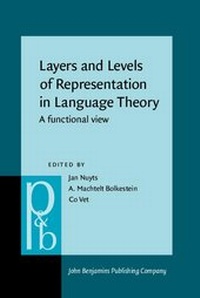
Layers and Levels of Representation in Language Theory
A functional view
1st Edition
Published on 1. January 1990
XII, 348 pages
978-90-272-8334-4 (ISBN)
Description

Rather than simply a record of proceedings (3rd International Conference on Functional Grammar, Amsterdam, June 1988), this volume contains revised and expanded papers from the conference and other papers inspired by the lively discussion there. The volume focuses on the nature of the structures assumed to underlie utterances in natural languages, in two respects. One area is the question of whether to expand the representations accepted in Functional Grammar (FG) in order to capture interpersonal functions, i.e., communication between speaker and hearer in a particular situation and context, to include, for example, aspect, tense, modality and illocutionary force. The second area concerns whether current underlying representation in FG is sufficiently abstract to be the format for the deepest level of human conceptual knowledge storage, as discussed by Simon Dik in a number of recent articles.
More details
Other editions
Additional editions
Jan Nuyts | A. Machtelt Bolkestein | Co Vet
Layers and Levels of Representation in Language Theory
A functional view
Book
01/1990
John Benjamins Publishing Co
€127.20
Shipment within 10-15 days
Content
- LAYERS AND LEVELSOF REPRESENTATION IN LANGUAGE THEORY A FUNCTIONAL VIEW
- Editorial page
- Title page
- Copyrigh page
- Table of contents
- List of Contributors
- Preface
- References
- The Hierarchical Structure of Utterances
- 0. Introduction
- 1. The representation of utterances
- 2. Layers, variables and frames
- 2.1. Layers and variables
- 2.2. Frames
- 3. Operators and satellites
- 3.1. Operators
- 3.2 Satellites
- 4. Subordination
- 4.1. Complements
- 4.2. Satellites
- 5. Conclusion
- Notes
- References
- The Hierarchical Structure of the Clause and the Typology of Adverbial Satellites
- 0. Introduction
- 1. The status of satellites
- 2. Satellite typology
- 2.1. General outline
- 2.2. Predicate satellites
- 2.3. Predication satellites
- 2.4. Proposition satellites
- 2.5. Illocutionary satellites
- 3. Some formal and behavioural correlates
- 3.1. Representational (s1, s2) vs. interpersonal satellites (s3, s4)
- 3.2. Predicate (s1) vs. predication (s2) satellites
- 3.3. Proposition (s3) vs. Illocutionaty (s4) satellites
- 3.4. Negation
- 4. Other parameters
- 4.1. The internal structure of satellites
- 4.2. Restrictive and non-restrictive satellites
- 5. Conclusion
- Notes
- References
- Sentential Complements in Functional Grammar: Embedded Predications, Propositions, Utterances in Latin
- 0. Introduction
- 1. Layers and complements
- 2. Data from Latin complements
- 2.1. Evidence from verbs of speech: ? vs. X plus ILL
- 2.2. Verbs of mental activity
- 2.3. Verbs of evaluation: X- and e-type complements
- 2.4. Latin verbs of 'happening'
- 3. Conclusion
- Notes
- References
- Semantic Relations in Non-Verbal Predication
- 0. Introduction
- 1. Non-verbal predicates
- 2. Arguments
- 3. Predicability
- 4. Copula constructions
- 5. Further perspectives
- Notes
- References
- Asymmetries in the Use of Tense and Modality
- 0. Introduction
- 1. Terms, propositions and utterances
- 2. Some cases of asymmetry
- 2.1. The verb 'hear' in English
- 2.2. Future tense in French
- 3. Conclusion
- Notes
- References
- Tense, Semantics and Layered Syntax
- 0. Introduction: Some basic assumptions
- 1. Sentences as signs: On content and expression in syntax
- 2. On the semantic content of operators
- 3. Tense operators as signs - and their syntax
- 4. Instructional semantics and auxiliaries
- 5. Cross-linguistic perspectives
- 6. Content elements in the four-layered model
- 7. Conclusion
- Notes
- References
- Toward a Unified Analysis of Terms and Predications
- 0. Introduction
- 1. Terms and predications
- 2. Quality operators
- 2.1. Verbal aspect
- 2.2. Nominal aspect
- 2.3. The representation of quality operators
- 3. Quantity operators
- 3.1. Number and cardinality
- 3.2 The representation of quantity operators
- 4. The locality (or: deictic) operator
- 4.1. Temporal debris: Tense
- 4.2. Spatial deixis: (Attributive) demonstrative pronouns
- 4.3. The scope of locality operators
- 5. Scope and the relative order of operators
- 6. Satellites in the term and in the predication
- 7. Conclusion
- Notes
- References
- Layered Syntax in Role and Reference Grammar
- 0. Introduction
- 1. The layered structure of the clause in RRG
- 2. Layered clause structure and operators in FG
- 3. The syntactic constrast between core and clause: The need for explicit syntactic representations
- 3.1. The V/2 constraint in Icelandic
- 3.2. Clause structure in head-marking and dependent-marking languages
- 4. Complex sentences
- 4.1. Juncture
- 4.2. Nexus
- 4.3. The role of operators in complex sentences
- 4.4. The representation of complex sentences in head-marking and dependent-marking languages
- 5. Conclusion
- Notes
- References
- On the Semantics of Conditionals
- 0. Introduction
- 1. General framework
- 2. Functional Logic
- 2.1 The syntax of FL
- 2.2. The semantics of FL
- 3. The interpretation of conditionals
- 4. Different types of conditionals
- 4.1. Propositional conditionals
- 4.2. Illocutionary conditionals
- 5. Conclusion
- Notes
- References
- Linguistic Representation and Conceptual Knowledge Representation
- 0. Introduction
- 1. Dik's cognitive theory
- 2. Basic representations in FG
- 3. Questions for lexical conceptualizations
- 3.1. Lexical form and meaning
- 3.2. Language and other aspects of behavior
- 4. Prospects for a model of conceptualization
- 4.1. The representation of states of affairs
- 4.2. Meta-level qualifications of SoAs
- 5. Conclusion
- Notes
- References
- The Functional Grammar Computational Natural Language User and Psychological Adequacy
- 0. Introduction
- 1. An outline of FG-CNLU
- 2. Some predictions from the model
- 2.1. Predictions based on the storage of UPs in memory
- 2.2. Predictions based on UPs as the arguments of thought processes
- 3. Is conceptual knowledge linguistic in a more abstract sense?
- 3.1. Declarative and procedural knowledge
- 3.2. Bilinguals
- 3.3. Conceptual and perceptual knowledge
- 3.4. Linguistic relativity
- 4. Improvements
- 5. Conclusion
- Notes
- References
- Context and Language
- 0. Introduction
- 1. The roots of the problem of representation
- 2. Language, thought, and memory
- 3. A paradox
- 4. The reconstruction problem
- 5. Features of a frame of reference for the study of language and representation
- 6. Conclusion
- Notes
- References
- Subject Index
- Index of Names
- Index of languages
