

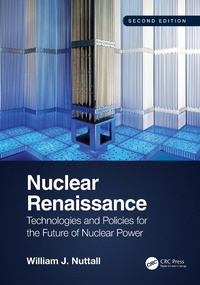
Nuclear Renaissance
Technologies and Policies for the Future of Nuclear Power
2nd Edition
Published on 15. June 2022
324 pages
978-1-000-59502-4 (ISBN)
Description

Nuclear power is low carbon and reliable, but in recent years it has struggled to play a strong role in global plans for electricity generation in the 21st century. Many of those involved with nuclear power and environmental agencies see controlled expansion of nuclear plants as the most environmentally friendly way of meeting growing energy demands. In the UK policy makers must recognise concerns around severe accidents and radioactive wastes and balance these against the risks arising from other energy technologies. In addition, energy policy-makers must ensure that energy supplies remain affordable for all in society. How might new nuclear power stations help meet emerging policy needs?
This second edition of Nuclear Renaissance: Technologies and Policies for the Future of Nuclear Power continues to examine the future of nuclear power in the contexts of economics, environmental sustainability, and security of electricity supplies. Fully updated with the latest technologies and concerns, this comprehensive guide illustrates the technical challenges and opportunities facing nuclear power.
This semi-technical overview of modern technologies meets the growing interest from scientists, environmentalists, and governments in the potential expansion of nuclear power. Various countries are starting to announce plans for new nuclear plants, either to replace those being decommissioned, to provide additional power or to contribute to the decarbonisation of especially challenging industrial activities. In the 2020s many commentators, once again, point to a renaissance just beginning.
Nuclear Renaissance: Technologies and Policies for the Future of Nuclear Power is essential reading for physicists, engineers, policy-makers, researchers, energy analysts and graduate students in energy sciences, engineering and public policy.
Key features
Fully updated throughout, with new content on topics including the latest developments in fission and fusion energy, the global financial crisis of 2008/2009, and the Fukushima-Daiichi nuclear accident.
Accessible to readers without a formal education in the area
Authored by an authority in the field
This second edition of Nuclear Renaissance: Technologies and Policies for the Future of Nuclear Power continues to examine the future of nuclear power in the contexts of economics, environmental sustainability, and security of electricity supplies. Fully updated with the latest technologies and concerns, this comprehensive guide illustrates the technical challenges and opportunities facing nuclear power.
This semi-technical overview of modern technologies meets the growing interest from scientists, environmentalists, and governments in the potential expansion of nuclear power. Various countries are starting to announce plans for new nuclear plants, either to replace those being decommissioned, to provide additional power or to contribute to the decarbonisation of especially challenging industrial activities. In the 2020s many commentators, once again, point to a renaissance just beginning.
Nuclear Renaissance: Technologies and Policies for the Future of Nuclear Power is essential reading for physicists, engineers, policy-makers, researchers, energy analysts and graduate students in energy sciences, engineering and public policy.
Key features
Fully updated throughout, with new content on topics including the latest developments in fission and fusion energy, the global financial crisis of 2008/2009, and the Fukushima-Daiichi nuclear accident.
Accessible to readers without a formal education in the area
Authored by an authority in the field
Reviews / Votes
"Open University Professor Bill Nuttall's updated version of his 2005 'Nuclear Renaissance' book makes a case for nuclear power as low carbon and reliable, although, as the promotional blurb says, it accepts that 'in recent years it has struggled to play a strong role in global plans for electricity generation in the 21st century'. The new book also accepts that the much-hyped renaissance didn't in the event happen - with Fukushima blowing it off course... The blurb says that now 'many of those involved with nuclear power and environmental agencies see controlled expansion of nuclear plants as the most environmentally friendly way of meeting growing energy demands'. This is a book for them...The new book is quite comprehensive (though there is not much on load following) and is mostly up to date, with revised coverage of most areas of development, including fusion and Generation IV reactors."?- Professor Dave Elliott in Renew Extra Weekly (https://renewextraweekly.blogspot.com/2022/08/nuclear-renaissance-revisited.html)
"This excellent book by Bill Nuttall, Professor of Energy at the Open University, is a revised update of his earlier book from 2004. Much has changed in the interim - technologies have evolved, and the politics of energy have developed, not least due to enhanced concern about climate change and the 2011 Fukushima accident - so an extensive re-write has been required. The book has a UK focus but includes international perspectives throughout. It is a pity that, in the period since the first edition was published, not much actual renaissance in the shape of new nuclear power stations has happened, but the author notes that projects such as Hinkley Point C and Rolls-Royce SMRs show that the renaissance is "far from still-born". After an introduction that reviews the current energy landscape, the book is divided
into three main sections: The Policy Landscape (covering energy policy and politics, new build and waste storage), Nuclear Fission Technologies (including EPR, AP1000, CANDU and ABWR, SMRs, HTRs, and
other advanced reactors), and Nuclear Fusion Technologies (a concise history of fusion so far). All sections provide a balanced and seemingly comprehensive overview of their chosen topics. The section on policy landscape includes a good discussion of the 'energy trilemma' of economics, security of supply, and environment - three issues which continue to dog policy makers - in addition to an extensive discussion on radwaste management. The sections on fission and fusion technologies are thorough and concise yet cover all the main issues. Highly recommended."
- Jim Thomson (FNucl) in The Nuclear Future (Journal of the Nuclear Institute, November/December, 2022)
More details
Edition
2nd edition
Language
English
Place of publication
London
United Kingdom
Publishing group
Taylor & Francis Ltd
Target group
College/higher education
Professional and scholarly
Adult education
Illustrations
13 Tables, black and white; 64 Line drawings, black and white; 36 Halftones, black and white; 100 Illustrations, black and white
ISBN-13
978-1-000-59502-4 (9781000595024)
Copyright in bibliographic data and cover images is held by Nielsen Book Services Limited or by the publishers or by their respective licensors: all rights reserved.
Schweitzer Classification
Other editions
Additional editions
Book
06/2022
2nd Edition
CRC Press
€205.10
Shipment within 15-20 days
Book
06/2022
2nd Edition
CRC Press
€76.70
Shipment within 15-20 days
Person
William Nuttall is Professor of Energy at the Open University. He is a specialist concerning the technology and policy issues of energy. He has a particular long-standing focus on matters of nuclear energy. Professor Nuttall's career started in experimental physics and this technical background informs his interests in energy and technology issues. He has been an author, or editor, of nine books and has published more than 80 journal articles. He is an experienced commentator for the media and he has offered advice to parliamentary, governmental and inter-governmental institutions. He is a Fellow of the Institute of Physics, a Fellow of Hughes Hall, a college of the University of Cambridge and a Non-Resident Fellow of the Payne Institute for Public Policy at Colorado School of Mines.
Content
Part I. Introduction. Chapter 1. Beginnings. Chapter 2. Nuclear Renaissance: Progress and Prospects. Part II. The Policy Landscape. Chapter 3. Issues in Energy Policy. Chapter 4. The Issues Facing New Nuclear Build. Chapter 5. Nucelar Waste Management. Part III. Nucelaer Fission Technologies. Chapter 6. Water-cooled Reactors. Chapter 7. High-temperature Reactors. Chapter 8. Advanced Fission Technologies and Systems. Part IV. Nuclear Fusion Technologies. Chapter 9. Fusion: An Introduction.
