

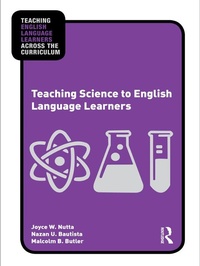
Teaching Science to English Language Learners
Published on 13. September 2010
208 pages
978-1-136-96330-8 (ISBN)
Description

Books in the Teaching English Language Learners (ELLs) across the Curriculum Series are written specifically for pre- and in- service teachers who may not have been trained in ELL techniques, but still find themselves facing the realities and challenges of today's diverse classrooms and learners. Each book provides simple and straightforward advice on how to teach ELLs through a given subject area, and how to teach content to ELLs who are at different levels of English language proficiency than the rest of their class. Authored by both language and content area specialists, each volume arms readers with practical, teacher-friendly strategies, and subject-specific techniques.
Teaching Science to English Language Learners offers science teachers and teacher educators a straightforward approach for engaging ELLs learning science, offering examples of easy ways to adapt existing lesson plans to be more inclusive. The practical, teacher-friendly strategies and techniques included here are proven effective with ELLs, and many are also effective with all students. The book provides context-specific strategies for the full range of the secondary sciences curriculum, including physical science, life science, earth and space science, science as inquiry, and history and nature of science and more. A fully annotated list of web and print resources completes the book, making this a one volume reference to help science teachers meet the challenges of including all learners in effective instruction.
Special features:
practical examples of science exercises make applying theory to practice simple when teaching science to ELLs
an overview of the National Science Education Standards offers useful guidelines for effective instructional and assessment practices for ELLs in secondary grades
graphs, tables, and illustrations provide additional access points to the text in clear, meaningful ways.
Teaching Science to English Language Learners offers science teachers and teacher educators a straightforward approach for engaging ELLs learning science, offering examples of easy ways to adapt existing lesson plans to be more inclusive. The practical, teacher-friendly strategies and techniques included here are proven effective with ELLs, and many are also effective with all students. The book provides context-specific strategies for the full range of the secondary sciences curriculum, including physical science, life science, earth and space science, science as inquiry, and history and nature of science and more. A fully annotated list of web and print resources completes the book, making this a one volume reference to help science teachers meet the challenges of including all learners in effective instruction.
Special features:
practical examples of science exercises make applying theory to practice simple when teaching science to ELLs
an overview of the National Science Education Standards offers useful guidelines for effective instructional and assessment practices for ELLs in secondary grades
graphs, tables, and illustrations provide additional access points to the text in clear, meaningful ways.
Reviews / Votes
"Teaching Science to English Language Learners is a good combination of theoretical background and practical ideas that will serve science teachers well...As the United States becomes increasingly diverse, it is important that science teachers have the knowledge and skills to meet the needs of all students. Teaching Science to English Language Learners provides an important piece of this knowledge by effectively bringing together and contextualizing key principles that must be considered when teaching science to ELLs."-Teachers College RecordMore details
Series
Language
English
Place of publication
London
United Kingdom
Publishing group
Taylor & Francis Ltd
Target group
College/higher education
Professional and scholarly
Product notice
Reflowable
Illustrations
15 s/w Tabellen, 10 s/w Zeichnungen
15 Tables, black and white; 10 Line drawings, black and white
File size
1,36 MB
ISBN-13
978-1-136-96330-8 (9781136963308)
Copyright in bibliographic data and cover images is held by Nielsen Book Services Limited or by the publishers or by their respective licensors: all rights reserved.
Schweitzer Classification
Other editions
Additional editions
Joyce Nutta | Nazan U. Bautista | Malcolm B. Butler
Teaching Science to English Language Learners
Book
08/2010
1st Edition
Routledge
€230.30
Shipment within 15-20 days
Joyce Nutta | Nazan U. Bautista | Malcolm B. Butler
Teaching Science to English Language Learners
Book
08/2010
1st Edition
Routledge
€61.40
Shipment within 15-20 days
Persons
Joyce W. Nutta is an Associate Professor of English for Speakers of Other Languages (ESOL) Education and the ESOL Co-ordinator of the College of Education at the University of Central Florida.
Nazan U. Bautista is an Assistant Professor of Science Education in the Department of Teacher Education at Miami University.
Malcolm B. Butler is an Associate Professor of Science Education at the University of South Florida in St. Petersburg, Florida.
Nazan U. Bautista is an Assistant Professor of Science Education in the Department of Teacher Education at Miami University.
Malcolm B. Butler is an Associate Professor of Science Education at the University of South Florida in St. Petersburg, Florida.
Content
Series Introduction
Part 1 Your English Language Learner, Tony Erben
1.1 Orientation
1.2 The Process of English Language Learning and What to Expect
1.3 Deciding on the Best ESOL Program
1.4 Teaching for English Language Development
1.5 Not All ELLs are the Same
1.6 Culturally Responsive Pedagogy
1.7 Not All Parents are the Same: Home-School Communication
1.8 English Language Learners with Special Needs
Part 2 What We Know From Research
2.1 Principles of Science Teaching and Learning
2.2 Science-Focused ESOL Research
2.3 Supporting Communication in Content Instruction for ELLs
2.4 Stages of Second Language Acquisition
2.5 Adapting Direct Instruction, Inquiry-Based Learning, and Assessment
2.6 Supporting ELLs' Academic Language Development in Science
Part 3 Teaching Science
Overview
3.1 Teaching Science to ELLs at Secondary Grade Levels
3.2 PreK-12 English Language Proficiency Standards for Science
3.3 Culturally and Linguistically Congruent Instruction and Assessment
3. 4 Science and Culturally Relevant Teaching
3.5 Classroom-based Science Assessment at the Secondary Level
3.6 Life Science
3.7 Physical Science
3.8 Earth and Space Science
3.9 Science as Inquiry
3.10 History and Nature of Science
3.11 Personal and Social Perspectives in Science
3.12 Science and Technology
3.13 Unifying Concepts and Processes
Resources
Internet Resources for Teachers
Literature for Teachers
Materials for Teachers
Resources for Students
References
Index
Part 1 Your English Language Learner, Tony Erben
1.1 Orientation
1.2 The Process of English Language Learning and What to Expect
1.3 Deciding on the Best ESOL Program
1.4 Teaching for English Language Development
1.5 Not All ELLs are the Same
1.6 Culturally Responsive Pedagogy
1.7 Not All Parents are the Same: Home-School Communication
1.8 English Language Learners with Special Needs
Part 2 What We Know From Research
2.1 Principles of Science Teaching and Learning
2.2 Science-Focused ESOL Research
2.3 Supporting Communication in Content Instruction for ELLs
2.4 Stages of Second Language Acquisition
2.5 Adapting Direct Instruction, Inquiry-Based Learning, and Assessment
2.6 Supporting ELLs' Academic Language Development in Science
Part 3 Teaching Science
Overview
3.1 Teaching Science to ELLs at Secondary Grade Levels
3.2 PreK-12 English Language Proficiency Standards for Science
3.3 Culturally and Linguistically Congruent Instruction and Assessment
3. 4 Science and Culturally Relevant Teaching
3.5 Classroom-based Science Assessment at the Secondary Level
3.6 Life Science
3.7 Physical Science
3.8 Earth and Space Science
3.9 Science as Inquiry
3.10 History and Nature of Science
3.11 Personal and Social Perspectives in Science
3.12 Science and Technology
3.13 Unifying Concepts and Processes
Resources
Internet Resources for Teachers
Literature for Teachers
Materials for Teachers
Resources for Students
References
Index
