

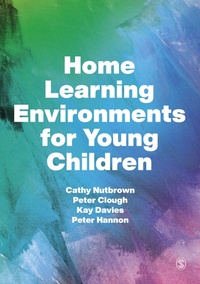
Home Learning Environments for Young Children
1st Edition
Published on 7. April 2022
224 pages
978-1-5297-8591-3 (ISBN)
Description

By bringing together research evidence on effectively supporting parents to engage with their children's early learning, and the role of education professionals in developing partnerships with families, this book focuses on partnerships between professionals and parents to enhance family learning for young children in literacy and other aspects of early learning.
The move towards setting, home-based, and online learning has accelerated, and it is important for both students and practitioners to value parents' roles in their young children's learning; to consider how parents can support young children's learning in these scenarios, and how to apply this in practice with children aged birth to five.
Through a wealth of case studies from real experience, the authors showcase an inspiring range of inclusive projects and approaches with families, including marginalised groups such as bilingual learners, fostering families, and families identified as 'vulnerable' including imprisoned fathers and children with specific learning needs.
The move towards setting, home-based, and online learning has accelerated, and it is important for both students and practitioners to value parents' roles in their young children's learning; to consider how parents can support young children's learning in these scenarios, and how to apply this in practice with children aged birth to five.
Through a wealth of case studies from real experience, the authors showcase an inspiring range of inclusive projects and approaches with families, including marginalised groups such as bilingual learners, fostering families, and families identified as 'vulnerable' including imprisoned fathers and children with specific learning needs.
More details
Edition
1. Auflage
Language
English
Place of publication
London
United Kingdom
Publishing group
Sage Publications Ltd (Digital)
Target group
College/higher education
Product notice
Reflowable
File size
3,05 MB
ISBN-13
978-1-5297-8591-3 (9781529785913)
Copyright in bibliographic data and cover images is held by Nielsen Book Services Limited or by the publishers or by their respective licensors: all rights reserved.
Schweitzer Classification
Other editions
Additional editions
Cathy Nutbrown | Peter Clough | Kay Davies
Home Learning Environments for Young Children
Book
04/2022
1st Edition
SAGE Publications Ltd
€65.80
Shipment within 15-20 days
Cathy Nutbrown | Peter Clough | Kay Davies
Home Learning Environments for Young Children
Book
04/2022
1st Edition
SAGE Publications Ltd
€134.30
Shipment within 15-20 days
Persons
Cathy Nutbrown is President of Early Education and Professor of Education in the School of Education at the University of Sheffield. Her research over the last 30 years, has focussed on young children's learning and work with parents to support young children's literacy development. She won an ESRC Award for Research with Outstanding Impact on Society and a Nursery World Lifetime Achievement Award. She is author of over 150 publications including Early Literacy Work with Families (with Hannon and Morgan, Sage, 2005), Early Childhood Educational Research (Sage, 2019), and Home Learning Environments for Young Children (with Clough, Davies and Hannon, Sage, 2022).
Peter Clough is Professor of Education at the University of Brighton. Often using innovative, arts-based qualitative methodologies, his research is concerned particularly with the inclusion of marginalised voices, and spans all age phases. Among his many publications are Inclusion in the Early Years (Sage), and Narratives and Fictions in Educational Research (OUP). Recent research includes the Family Literacy in Prisons project in collaboration with the Prison Advice and Care Trust.
Kay Davies was a headteacher in Brighton and West Yorkshire, and later an Early Years Consultant. Having a strong interest in early literacy and work with parents, Kay participated in ESRC-funded family literacy research on practitioners uses and developments of the ORIM Framework in 2012. She also developed the bilingual ORIM in WF13 project in Dewsbury. Kay has collaborated with colleagues through the ORIM network, since it was established, organising network events at The University of Sheffield.
Peter Hannon is Emeritus Professor at the University of Sheffield, School of Education. His pioneering research on family literacy, with many collaborators, led to the development of the ORIM Framework which was first used in the Sheffield Raising Early Achievement in Literacy Project, under his direction. He is author or co-author of over 100 publications, including, Literacy, Home and School (1995) and Early Literacy Work with Families (2005).
Peter Clough is Professor of Education at the University of Brighton. Often using innovative, arts-based qualitative methodologies, his research is concerned particularly with the inclusion of marginalised voices, and spans all age phases. Among his many publications are Inclusion in the Early Years (Sage), and Narratives and Fictions in Educational Research (OUP). Recent research includes the Family Literacy in Prisons project in collaboration with the Prison Advice and Care Trust.
Kay Davies was a headteacher in Brighton and West Yorkshire, and later an Early Years Consultant. Having a strong interest in early literacy and work with parents, Kay participated in ESRC-funded family literacy research on practitioners uses and developments of the ORIM Framework in 2012. She also developed the bilingual ORIM in WF13 project in Dewsbury. Kay has collaborated with colleagues through the ORIM network, since it was established, organising network events at The University of Sheffield.
Peter Hannon is Emeritus Professor at the University of Sheffield, School of Education. His pioneering research on family literacy, with many collaborators, led to the development of the ORIM Framework which was first used in the Sheffield Raising Early Achievement in Literacy Project, under his direction. He is author or co-author of over 100 publications, including, Literacy, Home and School (1995) and Early Literacy Work with Families (2005).
Content
Family Learning: Thinking about 'Disadvantage'
A Framework for Learning: Opportunities, Recognition, Interaction and Models
Home-Visiting to Support Early Literacy Development
Family Literacy in Group Settings
Family Literacy in Prisons
Supporting Family Learning In Everyday Life
Family Learning In Many Languages
Professional Development to Support Family Learning
Leadership of Family Learning
Evaluating Family Learning
A Manifesto for Family Learning - Birth To Five
A Framework for Learning: Opportunities, Recognition, Interaction and Models
Home-Visiting to Support Early Literacy Development
Family Literacy in Group Settings
Family Literacy in Prisons
Supporting Family Learning In Everyday Life
Family Learning In Many Languages
Professional Development to Support Family Learning
Leadership of Family Learning
Evaluating Family Learning
A Manifesto for Family Learning - Birth To Five
