

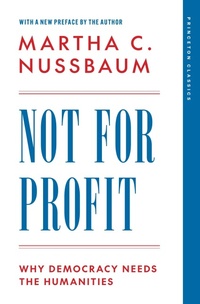
Not for Profit
Why Democracy Needs the Humanities
1st Edition
Published on 3. December 2024
192 pages
978-0-691-26441-7 (ISBN)
Description

A passionate defense of the humanities from one of today's foremost public intellectuals
In this short and powerful book, celebrated philosopher Martha C. Nussbaum makes a passionate case for the importance of the liberal arts at all levels of education.
Historically, the humanities have been central to education because they have been seen as essential for creating competent democratic citizens. But recently, Nussbaum argues, thinking about the aims of education has gone disturbingly awry in the United States and abroad. We increasingly treat education as though its primary goal were to teach students to be economically productive rather than to think critically and become knowledgeable, productive, and empathetic individuals. This shortsighted focus on profitable skills has eroded our ability to criticize authority, reduced our sympathy with the marginalized and different, and damaged our competence to deal with complex global problems. And the loss of these basic capacities jeopardizes the health of democracies and the hope of a decent world.
In response to this dire situation, Nussbaum argues that we must resist efforts to reduce education to a tool of the gross national product. Rather, we must work to reconnect education to the humanities in order to give students the capacity to be true democratic citizens of their countries and the world.
Translated into twenty-five languages, Not for Profit draws on the stories of troubling-and hopeful-global educational developments. Nussbaum offers a manifesto that should be a rallying cry for anyone who cares about the deepest purposes of education.
In this short and powerful book, celebrated philosopher Martha C. Nussbaum makes a passionate case for the importance of the liberal arts at all levels of education.
Historically, the humanities have been central to education because they have been seen as essential for creating competent democratic citizens. But recently, Nussbaum argues, thinking about the aims of education has gone disturbingly awry in the United States and abroad. We increasingly treat education as though its primary goal were to teach students to be economically productive rather than to think critically and become knowledgeable, productive, and empathetic individuals. This shortsighted focus on profitable skills has eroded our ability to criticize authority, reduced our sympathy with the marginalized and different, and damaged our competence to deal with complex global problems. And the loss of these basic capacities jeopardizes the health of democracies and the hope of a decent world.
In response to this dire situation, Nussbaum argues that we must resist efforts to reduce education to a tool of the gross national product. Rather, we must work to reconnect education to the humanities in order to give students the capacity to be true democratic citizens of their countries and the world.
Translated into twenty-five languages, Not for Profit draws on the stories of troubling-and hopeful-global educational developments. Nussbaum offers a manifesto that should be a rallying cry for anyone who cares about the deepest purposes of education.
More details
Other editions
Additional editions
Book
12/2024
Princeton University Press
€19.00
Available immediately
Person
Martha C. Nussbaum is the Ernst Freund Distinguished Service Professor of Law and Ethics at the Law School and in the Philosophy Department at the University of Chicago. Her many books include Justice for Animals and Hiding from Humanity (Princeton).
Content
- Cover
- Contents
- Foreword by Ruth O'Brien
- Preface to the Princeton Classics Edition
- Acknowledgments
- I. The Silent Crisis
- II. Education for Profit, Education for Democracy
- III. Educating Citizens: The Moral (and Anti-Moral) Emotions
- IV. Socratic Pedagogy: The Importance of Argument
- V. Citizens of the World
- VI. Cultivating Imagination: Literature and the Arts
- VII. Democratic Education on the Ropes
- Afterword: Reflections on the Future of the Humanities-at Home and Abroad
- Notes
- Index
