

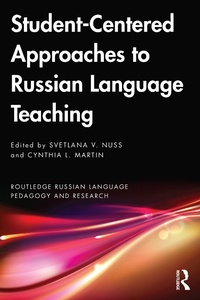
Student-Centered Approaches to Russian Language Teaching
Insights, Strategies, and Adaptations
1st Edition
Published on 30. December 2022
238 pages
978-1-000-82168-0 (ISBN)
Description

Student-Centered Approaches to Russian Language Teaching looks at how the field of Russian language pedagogy has evolved in recent years due to advances in technology along with shifts in attitudes to language pedagogy, and how the pandemic has compounded and accelerated these changes.
This edited collection brings together different perspectives from the field of Russian language pedagogy. With pedagogical conversations now centered around students and their needs, as well as the evolving role of the teacher in the 21st century, this volume highlights the diverse ways in which instructional practices have evolved, making curriculum and assessment more student-centered and Russian language learning more engaging.
The collection will be of interest to current and future instructors of Russian as a foreign or additional language who wish to diversify their instruction, as well as students of Russian language pedagogy and second language learning and teaching.
This edited collection brings together different perspectives from the field of Russian language pedagogy. With pedagogical conversations now centered around students and their needs, as well as the evolving role of the teacher in the 21st century, this volume highlights the diverse ways in which instructional practices have evolved, making curriculum and assessment more student-centered and Russian language learning more engaging.
The collection will be of interest to current and future instructors of Russian as a foreign or additional language who wish to diversify their instruction, as well as students of Russian language pedagogy and second language learning and teaching.
More details
Series
Edition
1. Auflage
Language
English
Place of publication
London
United Kingdom
Publishing group
Taylor & Francis Ltd
Product notice
Reflowable
Illustrations
34 Tables, black and white; 4 Line drawings, black and white; 15 Halftones, black and white; 19 Illustrations, black and white
ISBN-13
978-1-000-82168-0 (9781000821680)
Copyright in bibliographic data and cover images is held by Nielsen Book Services Limited or by the publishers or by their respective licensors: all rights reserved.
Schweitzer Classification
Other editions
Additional editions
Svetlana V. Nuss | Cynthia L. Martin
Student-Centered Approaches to Russian Language Teaching
Insights, Strategies, and Adaptations
Book
12/2022
1st Edition
Routledge
€69.30
Shipment within 10-20 days
Svetlana V. Nuss | Cynthia L. Martin
Student-Centered Approaches to Russian Language Teaching
Insights, Strategies, and Adaptations
Book
12/2022
1st Edition
Routledge
€208.30
Shipment within 10-20 days
Persons
Svetlana V. Nuss is a Second Language Acquisition (SLA) consultant and coach affiliated with the University of Alaska, USA.
Cynthia L. Martin is the Undergraduate Program Director for Russian, University of Maryland, USA.
Cynthia L. Martin is the Undergraduate Program Director for Russian, University of Maryland, USA.
Content
Contextualizing Student-centered Teaching of RFL
1. Student-centered Teaching of Russian: From Principles to Practice
Cynthia L. Martin and Svetlana V. Nuss
2. History of Student-centeredness, Its Modern Vision in Education, and What This Means for Teaching L2 Russian Today
Svetlana V. Nuss
Know your students
3. Self-Efficacy-Based Instructional Method in Teaching Beginner Russian:
Towards Better Strategic Self-Regulated Learning
Tatiana Maslova
4. Correct Me if I'm Wrong: Student Attitudes towards Learning Russian Grammar
Alexander Lorenz
5. Rough and Beautiful: Russian in Contemporary Czechia from the Perspectives of Corpus Research and Pupils? Attitudes
Michal Mistecky and Denisa Mistecka
Moving toward student-centered curriculum design and assessment
6. Making More Time for Proficiency: A "Flipped" Model for Adding Authenticity
Cori Anderson
7. My Russian Journey: Rethinking Teaching Russian to Beginners
Svetlana Sokolova, Daria Kosheleva, Elena Bjorgve, Laura A. Janda, Tore Nesset and Elmira Zhamaletdinova
8. Bringing Task-Based Instruction Online: Challenges of Remote Language Assessment
Brian James Baer and Tanya McIntyre
Embracing change and innovation
9. Lessons of the Pandemic: A Critical Look at Digital Tools for Online and Face-to-Face Instruction of Russian as a Foreign Language
Maria Khotimsky and Anna Leontyeva
10. Preparation for Study Abroad: The Action-oriented Approach for RFL Students
Snezhana Zheltoukhova
11. Transposing Venice to Russia: Task-based "Recipes" for developing figurative thinking
Ludmilla A'Beckett
12. Reflections on practice, additional considerations, and the importance of institutional support for teachers
Cynthia L. Martin and Svetlana V. Nuss
1. Student-centered Teaching of Russian: From Principles to Practice
Cynthia L. Martin and Svetlana V. Nuss
2. History of Student-centeredness, Its Modern Vision in Education, and What This Means for Teaching L2 Russian Today
Svetlana V. Nuss
Know your students
3. Self-Efficacy-Based Instructional Method in Teaching Beginner Russian:
Towards Better Strategic Self-Regulated Learning
Tatiana Maslova
4. Correct Me if I'm Wrong: Student Attitudes towards Learning Russian Grammar
Alexander Lorenz
5. Rough and Beautiful: Russian in Contemporary Czechia from the Perspectives of Corpus Research and Pupils? Attitudes
Michal Mistecky and Denisa Mistecka
Moving toward student-centered curriculum design and assessment
6. Making More Time for Proficiency: A "Flipped" Model for Adding Authenticity
Cori Anderson
7. My Russian Journey: Rethinking Teaching Russian to Beginners
Svetlana Sokolova, Daria Kosheleva, Elena Bjorgve, Laura A. Janda, Tore Nesset and Elmira Zhamaletdinova
8. Bringing Task-Based Instruction Online: Challenges of Remote Language Assessment
Brian James Baer and Tanya McIntyre
Embracing change and innovation
9. Lessons of the Pandemic: A Critical Look at Digital Tools for Online and Face-to-Face Instruction of Russian as a Foreign Language
Maria Khotimsky and Anna Leontyeva
10. Preparation for Study Abroad: The Action-oriented Approach for RFL Students
Snezhana Zheltoukhova
11. Transposing Venice to Russia: Task-based "Recipes" for developing figurative thinking
Ludmilla A'Beckett
12. Reflections on practice, additional considerations, and the importance of institutional support for teachers
Cynthia L. Martin and Svetlana V. Nuss
