

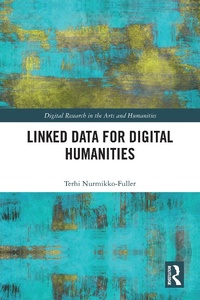
Linked Data for Digital Humanities
1st Edition
Published on 18. August 2023
156 pages
978-1-000-92970-6 (ISBN)
Description

Linked Data for Digital Humanities provides insights into how digital technologies can enrich and diversify humanities scholarship and make it pioneering in the digital age.
Written in non-specialist language, the book illustrates how information is captured, published, represented, accessed, and interpreted using computational systems and, in doing so, shows how technologies actively shape the way we understand what we encounter. Focusing as it does on underlying Web architecture and projects accessible online, the book has an inherently international focus. The interdisciplinary case study examples include bibliographic data from works published in England between 1470 and 1700; literature from ancient Iraq; jazz performances, predominantly from the USA in the 1930s; and even reach as far as an alien, fictional future. Whilst these case study examples span vast spatio-temporal distances, they all share a common thread in the use of the Linked Data information publication paradigm. Using existing computer science methods, as well as processes such as ontology development and database design, the book also includes reflections on practical considerations and offers advice about how to take institutional policies, socio-cultural sensitivities, and economic models into consideration when implementing Linked Data projects.
Linked Data for Digital Humanities discusses technological issues in the context of Humanities scholarship, bridging disciplines and enabling informed conversations across disciplinary boundaries. It will be of interest to humanities scholars, computer and data scientists, and library and information scientists.
Written in non-specialist language, the book illustrates how information is captured, published, represented, accessed, and interpreted using computational systems and, in doing so, shows how technologies actively shape the way we understand what we encounter. Focusing as it does on underlying Web architecture and projects accessible online, the book has an inherently international focus. The interdisciplinary case study examples include bibliographic data from works published in England between 1470 and 1700; literature from ancient Iraq; jazz performances, predominantly from the USA in the 1930s; and even reach as far as an alien, fictional future. Whilst these case study examples span vast spatio-temporal distances, they all share a common thread in the use of the Linked Data information publication paradigm. Using existing computer science methods, as well as processes such as ontology development and database design, the book also includes reflections on practical considerations and offers advice about how to take institutional policies, socio-cultural sensitivities, and economic models into consideration when implementing Linked Data projects.
Linked Data for Digital Humanities discusses technological issues in the context of Humanities scholarship, bridging disciplines and enabling informed conversations across disciplinary boundaries. It will be of interest to humanities scholars, computer and data scientists, and library and information scientists.
More details
Series
Edition
1. Auflage
Language
English
Place of publication
London
United Kingdom
Publishing group
Taylor & Francis Ltd
Target group
College/higher education
Illustrations
4 Tables, black and white
ISBN-13
978-1-000-92970-6 (9781000929706)
Copyright in bibliographic data and cover images is held by Nielsen Book Services Limited or by the publishers or by their respective licensors: all rights reserved.
Schweitzer Classification
Other editions
Additional editions
Terhi Nurmikko-Fuller
Linked Data for Digital Humanities
Book
12/2024
1st Edition
Routledge
€62.50
Shipment within 10-20 days
Terhi Nurmikko-Fuller
Linked Data for Digital Humanities
Book
08/2023
1st Edition
Routledge
€205.00
Shipment within 10-20 days
Person
Dr Terhi Nurmikko-Fuller is a Senior Research Fellow at the Centre for Social Research & Methods at the Australian National University. Her research focuses on interdisciplinary experimentation into ways digital technologies and computational methods can be used to support and diversify research in the humanities, arts, and social sciences in general, and in relation to public culture, including Web Science, and the cultural heritage sector in particular. Terhi's publications centre on topics related to Linked Data, but cover a range of others from the role of gamification and informal online environments in education to 3D digital models of items in museums in the UK and Australia.
Content
1. A False Dichotomy 2. Privacy, Ethics, and Trust 3. Closed But Not for Business 4. "Truth" and Bias 5. Data Demands 6. Future Directions
